Ask, Seek, Knock
Matt 7:7–11; Luke 11:9–13 · Early ministry in Galilee
Scripture
Matthew 7:7–11
sk, and it shall be given you; seek, and ye shall find; knock, and it shall be opened unto you: 8For every one that asketh receiveth; and he that seeketh findeth; and to him that knocketh it shall be opened. 9Or what man is there of you, whom if his son ask bread, will he give him a stone? 10Or if he ask a fish, will he give him a serpent? 11If ye then, being evil, know how to give good gifts unto your children, how much more shall your Father which is in heaven give good things to them that ask him?
King James Version · public domain
Mateu 7:7–11
ypni, edhe dot’u epetë juve; kërkoni edhe dotë gjeni; trokitni, edhe dot’u hapetë juve; 8Sepse kushdo që lypën merr, edhe ay që kërkon gjen, edhe ati që trokollin dot’i hapetë. 9A cili ësht’ ay njeri nga ju, i-cili, ndë lyptë i biri bukë, dot’i apë ati gur? 10Edhe ndë lyptë peshk, mos dot’i apë ati gjarpër? 11Ndë qoftë pra se ju që jeni të-liq dini t’u epni të-dhëna të mira bijvet t’uaj, sa më tepërë Ati juaj që është ndë qiejt dot’u apë të-mira atyre që lypëjnë nga ay?
Kristoforidhi, Dhiata e Re Toskërisht 1879 · zotërim publik
In their own words
Most ready therefore is our heavenly Father to bestow gifts upon us: so that whosoever is denied what he asks, is himself the cause of it: for he asks, as I said, what God will not give.
St. Cyril of Alexandria, Commentary on Luke, Sermon 79 (on Luke 11:11–13)
Patristic sources
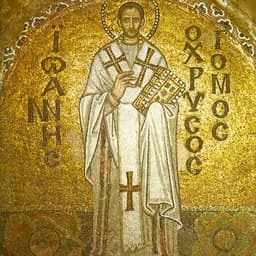
- St. John Chrysostom
- Homilies on the Gospel of Matthew, Hom. 23
- St. Cyril of Alexandria
- Commentary on the Gospel of Luke, Sermons 78–79
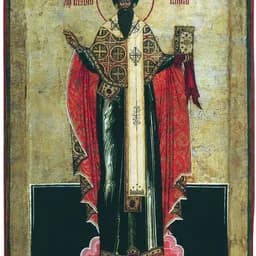
- St. Basil the Great
- As preserved in the Catena Aurea on Luke
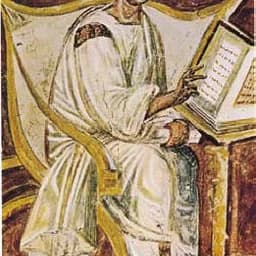
- Blessed Augustine of Hippo
- Our Lord's Sermon on the Mount, Book II
Venerated in the East as Blessed; his exegesis is drawn on in later Byzantine catenae.
- St. Jerome
- Commentary on Matthew (Catena Aurea)
- St. Ambrose of Milan
- Exposition of the Gospel of Luke (Catena Aurea)
Read the sources: Chrysostom, Homilies on Matthew, Homily 23 (CCEL) · Cyril of Alexandria on Luke, Sermons 66–80 (tertullian.org) · Augustine, Sermon on the Mount, Book II (CCEL) · Catena Aurea on Luke (isidore.co) · Catena Aurea on Matthew, ch. 7 (CCEL)
Ask, Seek, Knock (Matthew 7:7–11; Luke 11:9–13)
The texts below are quoted verbatim from public-domain English translations; nothing is paraphrased.
St. John Chrysostom (c. 347–407)
Homilies on the Gospel of Matthew, Homily 23 (on Matthew 7:7–11). Trans. in the Nicene and Post-Nicene Fathers, First Series, Vol. 10. Public domain. Full text: https://www.ccel.org/ccel/schaff/npnf110/npnf110.iii.XXIII.html
On the earnestness that "seek" and "knock" require above bare asking:
On not despairing if the door is not opened at once:
On asking spiritual things, so that the petition itself does not hinder the answer:
St. Cyril of Alexandria (c. 376–444)
Commentary on the Gospel of Luke, Sermons 78–79 (on Luke 11:9–13). Trans. R. Payne Smith, Library of Fathers, 1859. Public domain. Full text: https://www.tertullian.org/fathers/cyril_on_luke_07_sermons_66_80.htm
On being urgent in prayer and not fainting when the gift is delayed:
On the fatherly wisdom that withholds what would harm us, as earthly fathers do:
On Luke's "good spirit" as the gift of spiritual grace:
On the Father's readiness to give, so that the unanswered petitioner is himself the cause:
St. Basil the Great (c. 330–379)
As preserved in the Catena Aurea on Luke (on Luke 11:9–13), trans. J. H. Newman, 1841. Public domain. Full text: https://isidore.co/aquinas/english/CALuke.htm
On offering our own effort while crying to God for help, and praying without a wavering mind:
Blessed Augustine of Hippo (354–430)
Our Lord's Sermon on the Mount, Book II, Chapter 21 (on Matthew 7:7–11). Trans. in the Nicene and Post-Nicene Fathers, First Series, Vol. 6. Public domain. Full text: https://www.ccel.org/ccel/schaff/npnf106/npnf106.v.iii.xxi.html
On the distinct offices of asking, seeking, and knocking:
On the perseverance the promise requires:
St. Jerome (c. 347–420)
Commentary on Matthew, as preserved in the Catena Aurea on Matthew (on Matthew 7:7–11). Public domain. Full text: https://www.ccel.org/ccel/aquinas/catena1.ii.vii.html
On what the Lord teaches us to ask, once He has forbidden prayer for fleshly things:
On why He calls us "evil," condemning the human race in the person of the Apostles:
St. Ambrose of Milan (c. 339–397)
From his Exposition of the Gospel of Luke, as preserved in the Catena Aurea on Luke (on Luke 11:9–13). Public domain. Full text: https://isidore.co/aquinas/english/CALuke.htm
On the hope of obtaining as the ground that persuades us to constant prayer: