Calming the storm
Matt 8:23–27; Mark 4:35–41; Luke 8:22–25 · Later ministry in Galilee
Scripture
Matthew 8:23–27
nd when he was entered into a ship, his disciples followed him. 24And, behold, there arose a great tempest in the sea, insomuch that the ship was covered with the waves: but he was asleep. 25And his disciples came to him, and awoke him, saying, Lord, save us: we perish. 26And he saith unto them, Why are ye fearful, O ye of little faith? Then he arose, and rebuked the winds and the sea; and there was a great calm. 27But the men marvelled, saying, What manner of man is this, that even the winds and the sea obey him!
King James Version · public domain
Mateu 8:23–27
dhe kur hyri ndë lundrët, i vanë pas nxënësit’ e ati. 24Edhe ja tek ubë një tërmet i-math ndë dett, kaqë sa po mbulonej lundra nga valëtë; po ay flinte. 25Edhe nxënësit’ e ati i erthnë përanë edhe e ngritnë atë, dyke thënë, Zot, shpëto-na, se po humbasëmë. 26Edhe ay u thot’ atyre, Përse jeni frikacarë, o besë-pakë? Atëhere ungrit e qërtoj erërat’ edhe detinë, edhe ubë bunacë e-madhe. 27Edhe njerëzitë çudite-shinë, e thoshinë, Ç’farë njeriu është ky që edhe erërat’ edhe deti e dëgjonjënë?
Kristoforidhi, Dhiata e Re Toskërisht 1879 · zotërim publik
In their own words
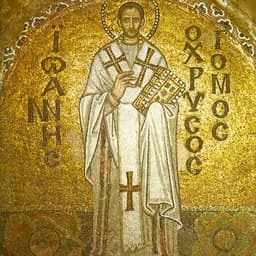
While the sleep and the outward appearance showed man, the sea and the calm declared Him God. For because Moses had once done some such thing, in this regard also does He signify His own superiority, and that the one works miracles as a slave, the other as Lord.
St. John Chrysostom, Homilies on the Gospel of Matthew, Homily 28 (on Matthew 8:23–27) (NPNF1 Vol. 10)
Patristic sources
- St. John Chrysostom
- Homilies on Matthew, Hom. 28
- St. Cyril of Alexandria
- Commentary on Luke, on Luke 8
- St. Jerome
- Catena Aurea on Matthew, on Matt 8
- St. Hilary of Poitiers
- Catena Aurea on Matthew, on Matt 8
- St. Bede the Venerable
- Catena Aurea on Matthew, on Matt 8
The Calming of the Storm (Matthew 8:23–27; Mark 4:35–41; Luke 8:22–25)
The texts below are quoted verbatim from public-domain English translations; nothing is paraphrased.
St. John Chrysostom (c. 347–407)
Homilies on the Gospel of Matthew, Homily 28 (on Matthew 8:23–27) Source: trans. in the Nicene and Post-Nicene Fathers, First Series, Vol. 10. Public domain. Full text: https://www.newadvent.org/fathers/200128.htm
On why Christ took only the disciples into this trial, which carried a discipline within it:
On His rebuking the disciples before He rebuked the sea, calming the soul before the water:
On the sleep that showed Him man and the calm that declared Him God, and His superiority to Moses:
St. Cyril of Alexandria (c. 376–444)
Commentary on the Gospel of Luke (on Luke 8:22–25) Source: trans. R. Payne Smith, 1859. Public domain. Full text: https://www.tertullian.org/fathers/cyril_on_luke_04_sermons_39_46.htm
On why Christ purposely fell asleep, that His power might be the more manifest:
On the smallness of faith mixed with faith in the disciples' cry:
On faith tried by trials as gold is tried by fire:
On Christ calming both the sea and the shaken faith of the disciples:
St. Jerome (c. 347–420)
As preserved in the Catena Aurea on Matthew. Public domain.
On the sleeping Christ prefigured in Jonah:
On all creation knowing its Creator and obeying the mind that commands it:
On why those who marvelled are called "the men":
St. Hilary of Poitiers (c. 310–367)
As preserved in the Catena Aurea on Matthew. Public domain.
On Christ asleep within us through our own sloth, and hope that escapes danger by His watching might:
St. Bede the Venerable (c. 673–735)
As preserved in the Catena Aurea on Matthew. Public domain.
On the boat as the Church crossing the sea of this world: