Christ Fulfills the Law and the Prophets
Matt 5:17–20 · Early ministry in Galilee
Scripture
Matthew 5:17–20
hink not that I am come to destroy the law, or the prophets: I am not come to destroy, but to fulfil. 18For verily I say unto you, Till heaven and earth pass, one jot or one tittle shall in no wise pass from the law, till all be fulfilled. 19Whosoever therefore shall break one of these least commandments, and shall teach men so, he shall be called the least in the kingdom of heaven: but whosoever shall do and teach them, the same shall be called great in the kingdom of heaven. 20For I say unto you, That except your righteousness shall exceed the righteousness of the scribes and Pharisees, ye shall in no case enter into the kingdom of heaven.
King James Version · public domain
Mateu 5:17–20
os kujtoni se erdha të prish nomnë a profitëritë; nuk’ erdha të prish, po të mbush. 18Sepse me të-vërtetë po u them juve, gjersa të shkonjë qielli edhe dheu, një jotë a një pikë nukë dotë shkonjë nga nomi, gjersa të bënenë të-gjitha. 19Ay pra që të zgjithnjë një nga këto porosit’ e vogëla, edhe të mësonjë kështu njerëzitë, i-vogëlë dotë quhetë ndë mbretërit të qiejvet; po ay që të bënjë e të mësonjë, ky dotë quhetë i-math ndë mbretërit të qiejvet. 20Sepse po u them juve, se ndë mos tepëroftë drejtëria juaj më tepërë se ajo e shkronjësvet edhe e Farisenjvet, nukë dotë hyni ndë mbretërit të qiejvet.
Kristoforidhi, Dhiata e Re Toskërisht 1879 · zotërim publik
In their own words
The prophets He fulfilled, inasmuch as He confirmed by His actions all that had been said concerning Him ... But the law He fulfilled, not in one way only, but in a second and third also. In one way, by transgressing none of the precepts of the law.
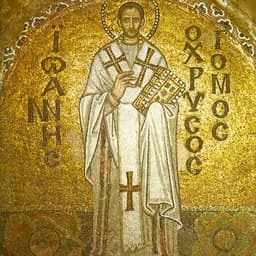
St. John Chrysostom, Homilies on Matthew, Hom. 16 (on Matthew 5:17–20)
Patristic sources
- St. John Chrysostom
- Homilies on Matthew, Hom. 16
- Blessed Augustine of Hippo
- Our Lord's Sermon on the Mount, Book I
Venerated in the East as Blessed; his Sermon on the Mount is the earliest sustained Latin exposition of Matthew 5–7.
- St. Jerome
- Commentary on Matthew
His Gospel exegesis survives in public-domain English only through the Catena Aurea.
- St. Hilary of Poitiers
- Commentary on Matthew
Catena-only in public-domain English.
- St. Gregory the Great
- Forty Gospel Homilies, Hom. 12
The Forty Gospel Homilies are public-domain English only through the Catena Aurea.
Read the sources: Chrysostom on Matthew, Homily 16 (CCEL) · Augustine, Sermon on the Mount, Book I (CCEL) · Catena Aurea on Matthew 5 (CCEL)
Christ Fulfills the Law and the Prophets (Matthew 5:17–20)
The texts below are quoted verbatim from public-domain English translations; nothing is paraphrased.
St. John Chrysostom (c. 347–407)
Homilies on the Gospel of Matthew, Homily 16 (on Matthew 5:17–20) Source: trans. in the Nicene and Post-Nicene Fathers, First Series, Vol. 10. Public domain. Full text: https://www.ccel.org/ccel/schaff/npnf110.iii.XVI.html
On why He says not merely that He does not destroy the Law, but that He establishes it:
On the manner in which He fulfilled the Prophets and the Law:
On the jot and tittle that cannot pass away:
On the righteousness that must exceed that of the Scribes and Pharisees:
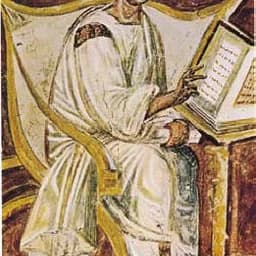
Blessed Augustine of Hippo (354–430)
Our Lord's Sermon on the Mount, Book I (on Matthew 5:17–20) Source: trans. in the Nicene and Post-Nicene Fathers, First Series, Vol. 6. Public domain. Full text: https://www.ccel.org/ccel/schaff/npnf106.v.ii.viii.html
On the twofold sense of fulfilling — adding what is wanting, which confirms rather than destroys:
On the iota and the tittle as a figure of the Law's completeness:
On the greater righteousness that goes beyond the outward act to the heart:
St. Jerome (c. 347–420)
Commentary on Matthew (on Matthew 5:19) As preserved in the Catena Aurea on Matthew. Public domain. Full text: https://www.ccel.org/ccel/aquinas/catena1.ii.v.html
On the teacher whose life must not undo his teaching:
St. Hilary of Poitiers (c. 310–367)
Commentary on Matthew (on Matthew 5:18–19) As preserved in the Catena Aurea on Matthew. Public domain. Full text: https://www.ccel.org/ccel/aquinas/catena1.ii.v.html
On what it means that heaven and earth shall pass:
On the least commandment understood as the confession of the cross:
St. Gregory the Great (c. 540–604)
Forty Gospel Homilies, Homily 12 (on Matthew 5:19) As preserved in the Catena Aurea on Matthew. Public domain. Full text: https://www.ccel.org/ccel/aquinas/catena1.ii.v.html
On the kingdom of heaven understood as the Church, and the teacher who is called least: