Cursing of the fig tree
Matt 21:18–22; Mark 11:12–14, 20–26 · Passion week in Jerusalem
Scripture
Matthew 21:18–22
ow in the morning as he returned into the city, he hungered. 19And when he saw a fig tree in the way, he came to it, and found nothing thereon, but leaves only, and said unto it, Let no fruit grow on thee henceforward for ever. And presently the fig tree withered away. 20And when the disciples saw it, they marvelled, saying, How soon is the fig tree withered away! 21Jesus answered and said unto them, Verily I say unto you, If ye have faith, and doubt not, ye shall not only do this which is done to the fig tree, but also if ye shall say unto this mountain, Be thou removed, and be thou cast into the sea; it shall be done. 22And all things, whatsoever ye shall ask in prayer, believing, ye shall receive.
King James Version · public domain
Mateu 21:18–22
dhe ndë mëngjest kur ukthye ndë qytett, i erdhi uri; 19Edhe kur pa një dru fiku mb’udhë, erdhi mb’atë, po nukë gjeti gjë mb’atë, veç fletë vetëmë; edhe i thotë, Mos ubëftë më pemë prej teje për gjithë jetënë. Edhe drur’ i fikut për-një-here utha. 20Edhe nxënësitë kur panë, uçuditnë, e thanë, Qysh utha drur’ i fikut për-një-here! 21Edhe Jisuj upërgjeq e u tha atyre, Me të-vërtetë po u them juve, ndë paçi besë, edhe të mos jeni me dy mëndje, jo vetëmë këtë të drurit të fikut kini për të bërë, po edhe këti mali ndë i thënçi, Ngreu edhe bjerë ndë dett, dotë bënetë. 22Edhe gjithë sa të lypni ndë lutjet, dyke pasurë besë, dot’i merrni.
Kristoforidhi, Dhiata e Re Toskërisht 1879 · zotërim publik
Summary
The fig tree full of leaves but bearing no fruit is, the Fathers say, an acted parable of judgment on a religion of show without substance: on Israel, who had the leaves of the Law and the prophets yet did not bring forth the fruit of righteousness, and on every hypocrite whose appearance promises what the life does not yield. The leaves stand for words and profession, the fruit for works; and the tree is found wanting at the very hour the Lord, hungry, looks for fruit, when God comes seeking the obedience His own people owe Him.
Chrysostom takes the miracle on a complementary note. He observes that of all the Lord's signs this is the one "destructive" wonder, and that Christ works it upon a tree precisely to spare men: He shows that He has power to punish, yet pours it out upon a plant and not upon any person, so that the disciples might gain confidence in His authority while learning His forbearance. He treats the difficulty that "the time of figs was not yet" as belonging to the disciples' own supposition, and he is cautious about pressing the tree into an allegory of the Law.
The saying Christ adds turns the whole event toward faith and prayer: if the disciples believe and do not doubt, they will not only do what was seed to the fig tree but will move mountains. The tradition reads this together with His word that prayer must be joined to forgiveness, so that the fruit He seeks in His own is faith working through love. The barren tree stands as a warning, and the promise that follows as the remedy: let the soul that would not wither bring forth, in season and out, the fruit of repentance and good works.
In their own words
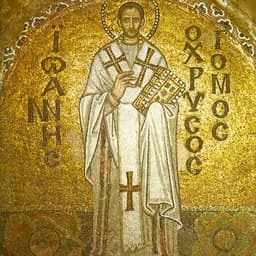
Wherefore then was it cursed? For the disciples' sakes, that they might have confidence.
St. John Chrysostom, Homilies on the Gospel of St. Matthew, Homily LXVII, section 1 (on Matt. xxi. 12-13), NPNF1 Vol. 10
Patristic sources
- St. John Chrysostom
- Homilies on Matthew, Hom. 67
- Theophylact of Ohrid
- Commentary on Matthew, on Matt 21
- Commentary on Mark, on Mark 11
- Origen of Alexandria
- Commentary on Matthew, Book XVI
Read the sources: Chrysostom on Matthew (CCEL)
The Cursing of the Fig Tree (Matthew 21:18–22; Mark 11:12–14, 20–25)
Public-Domain Patristic Commentary
In the morning, returning to the city, the Lord is hungry. He sees a fig tree by the road, comes to it, and finds "nothing thereon, but leaves only." He says, "Let no fruit grow on thee henceforward for ever," and the tree withers at once. When the disciples marvel, He turns the wonder into a lesson on faith: "If ye have faith, and doubt not... if ye shall say unto this mountain, Be thou removed, and be thou cast into the sea, it shall be done." Matthew tells it as a single event just after the cleansing of the temple; Mark spreads it over two days and adds the detail that puzzles every reader, that "it was not the season for figs."
This is the one miracle of judgment, the only time the Lord's power falls destructively rather than in healing, and the Fathers read it as a sign rather than a punishment of a tree. Gathered below are several of the greatest, from the East and the West, each quoted verbatim from a public-domain translation. Chrysostom explains why a judgment fell on a senseless plant; Theophylact of Ohrid draws out the divine mercy that grants us the power of miracles; Origen reads the withered tree mystically, as the barren synagogue and the soul without the fruit of the Spirit; Augustine, in the classic Western sermon on the passage, draws out both the warning ("lest we have leaves only") and the prophetic meaning; and Bede comments on the Markan account.
The Markan quotations and the patristic ordering follow the Catena Aurea (St. Thomas Aquinas, trans. J. H. Newman, 1841).
St. John Chrysostom (c. 347–407)
From his Homilies on the Gospel of Matthew (Homily 67, on Matthew 21:18–22), NPNF translation. Public domain.
On why the tree was cursed, and for whose sake:
On the one demonstration of His power to punish, shown upon a plant and not upon men:
On not quarrelling over the justice done to a senseless tree:
Theophylact of Ohrid (c. 1050–1108)
As preserved in the Catena Aurea on Mark. Public domain.
On the desolate temple, and the proof that He could have exterminated His crucifiers:
On the greatness of the miracle:
On the divine mercy that confers on the faithful the power of miracles:
On the heart that prays in faith, and on forgiving one's brother:
Origen (c. 185–254)
From his Commentary on Matthew, as compiled in the Catena Aurea on Matthew (Newman trans.). Public domain.
On the barren synagogue, and the curse that lasts until the Gentiles come in:
On the soul in which Christ abides, and the fruit of the Spirit He hungers for:
Blessed Augustine of Hippo (354–430)
From his Sermon 39 on the New Testament (on Matthew 21:19), NPNF translation. Public domain.
On the alarming warning of leaves without fruit:
On the tree as the reprobate synagogue, whose Scriptures are leaves without Christ:
On why there is no fruit where there is no charity:
On the value of faith that the withering was meant to teach:
On the Lord acting prophetically, since the tree itself bore no blame:
On how clemency would have made a withered tree green, and what the reverse was meant to teach:
St. Bede the Venerable (c. 673–735)
As preserved in the Catena Aurea on Mark. Public domain.
On the Lord's deeds as parables, and the barren Jewish people:
On the hunger for man's salvation, and the warning to bear fruit:
On the tree dried up from the roots:
On the objection of the Gentiles concerning the moving of mountains:
Note on sources and other Fathers
The Fathers face the same difficulty and answer it together: why curse a tree for bearing no fruit "when it was not the season for figs"? Chrysostom replies that the objection itself belongs to "the suspicion of His disciples, who were yet in a somewhat imperfect state," and that the true purpose was a single "demonstrative proof of His power to take vengeance," shown "upon the plant" and not upon men, so that the disciples and the Jews might see that He who could "blast them that crucify Him" instead "of His own will submits." Theophylact reads it likewise, that the Lord wished "to shew His disciples that if He chose He could in a moment exterminate those who were about to crucify Him," and finds in it the "Divine mercy, how it confers on us, if we approach Him in faith, the power of miracles." Augustine answers that the tree "could not be to blame," and that the Lord therefore "acted prophetically," withering a green tree to teach what He would not say in words: that He has "no delight in the withering away of this tree," but warns every soul that has "leaves only, and no fruit." Augustine, Origen, and Bede all read the barren tree as the synagogue barren of Christ: Augustine finds in it "all the writings of the Prophets" but no Christ; Origen calls "the Jewish synagogue barren... until the end of the world, when the multitude of the Gentiles shall come in"; and Bede sees the tree "condemned to perpetual barrenness," to shew that "the Jewish people could not be saved through the leaves... without fruit, that is, good works."
This passage drew the same reading from many Fathers: Jerome and Hilary likewise saw the fig tree as Israel, and the prophets had long used it so (Jeremiah, Hosea, and Micah all speak of Israel as a fig tree that fails). In the Catena on Mark the same exposition is gathered, with further comments left unquoted here from Gloss, Remigius, and Rabanus.