All entriesmiracle

Feeding of the 4,000

Matt 15:32–39; Mark 8:1–10 · Later ministry in Galilee

Matthew 15:32–39

hen Jesus called his disciples unto him, and said, I have compassion on the multitude, because they continue with me now three days, and have nothing to eat: and I will not send them away fasting, lest they faint in the way. 33And his disciples say unto him, Whence should we have so much bread in the wilderness, as to fill so great a multitude? 34And Jesus saith unto them, How many loaves have ye? And they said, Seven, and a few little fishes. 35And he commanded the multitude to sit down on the ground. 36And he took the seven loaves and the fishes, and gave thanks, and brake them, and gave to his disciples, and the disciples to the multitude. 37And they did all eat, and were filled: and they took up of the broken meat that was left seven baskets full. 38And they that did eat were four thousand men, beside women and children. 39And he sent away the multitude, and took ship, and came into the coasts of Magdala.

King James Version · public domain

Mateu 15:32–39

tëhere Jisuj thirri përanë nxënësit’ e ti, e tha, Më dhëmbetë për gjindjenë, sepse kanë ndashti tri dit që mbesënë përanë meje, e s’kanë ç’të hanë; edhe nukë dua t’i lëshonj ata pa ngrënë, se mos gajasënë udhësë. 33Edhe nxënësit’ e ati i thon’ ati, Ku dotë na gjendenë këtu ndë shkretëtirët kaqë bukë, sa të nginjenë kaqë gjindje? 34Edhe Jisuj u tha atyre, Sa bukë keni? Edhe ata thanë, Shtatë, edhe pak pishqe të-vegjëlë. 35Edhe ay urdhëroj gjindjenë të unjenë përdhe. 36Edhe si mori të shtatë bukëtë edhe pishqetë, ufal ndersë, e i theu, e u’a dha nxënësvet të ti, edhe nxënësitë gjindjesë. 37Edhe hëngrrë të-gjithë, e unginjnë; edhe ngritnë tepëricën’ e copavet, shtatë shporta plot. 38Edhe ata që hëngrrë ishinë katrë mijë burra, veç gravet e çunavet të-vegjëlë. 39Edhe si lëshoj gjindjenë, hyri ndë lundrët, edhe erdhi ndë sinorët të Magdhallasë.

Kristoforidhi, Dhiata e Re Toskërisht 1879 · zotërim publik

Summary

A second multiplication, which the Fathers commonly distinguish from the first rather than confuse with it. The Lord Himself recalls both miracles to the disciples later (Matt 16:9-10), so the two are not one event told twice but two distinct works. The setting differs: where the five thousand were fed within Israel, this crowd has come from Gentile regions and remains with Christ three days, and so the Fathers often read the four thousand of the nations gathered to Him. The numbers too are read with care: the seven loaves and the seven baskets that remain answer to a fullness, the seven nations of Canaan now called in and seven as the figure of completeness, where the first feeding's twelve baskets answered to the twelve tribes.

Chrysostom dwells on the disciples' slowness: having seen the five thousand fed, they still ask where bread is to be found, and from this he draws both the weakness of our memory and the patience of the Teacher, who does not rebuke but again provides. Here too the Lord Himself first speaks His compassion, unwilling to send the people away fasting lest they faint on the road. Origen presses the numbers toward their spiritual sense, reading the loaves as the teaching multiplied by the Word and the leftover fragments as the deeper truths the simple cannot yet carry but the apostles gather up. Theophylact, gathering the earlier Fathers, keeps both the literal distinction and this fuller meaning together.

The repetition therefore deepens the Eucharistic and providential sense rather than merely doubling it. The same hands that blessed and broke for the multitude feed the Church, and the bread that does not fail teaches that what Christ gives is never spent. That a Gentile multitude is filled with the same blessing prefigures the one table at which Jew and nations are fed together.

The Feeding of the Four Thousand (Matthew 15:32–39; Mark 8:1–10)

Public-Domain Patristic Commentary

This is the second wilderness feeding, distinct from the feeding of the five thousand. Christ has compassion on a multitude that has been with Him three days with nothing to eat, and will not send them away fasting lest they faint on the road. The disciples ask where bread could be found in the wilderness; He asks how many loaves they have (seven, and a few little fishes), commands the crowd to sit, takes the loaves and fishes, gives thanks, breaks them, and gives them to the disciples to distribute. All eat and are filled, and they take up seven baskets of fragments; those who ate were four thousand men, beside women and children. Luke does not record this feeding. The texts below are quoted verbatim from public-domain translations. The Chrysostom passages are from his own homily; the Jerome and Hilary passages are preserved in the Catena Aurea on Matthew, and the Theophylact, Gregory the Great, Ambrose, and Bede passages in the Catena Aurea on Mark (St. Thomas Aquinas, trans. J. H. Newman, 1841).


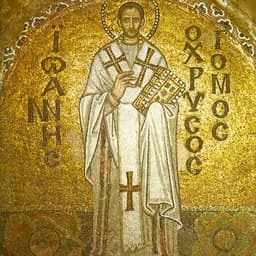
St. John Chrysostom (c. 347–407)

Homilies on the Gospel of Matthew, Homily 53 (on Matthew 15:32–39) Source: trans. in the Nicene and Post-Nicene Fathers, First Series, Vol. 10. Public domain. Full text: https://www.newadvent.org/fathers/200153.htm

On why He let three days pass before feeding them:

For lest they should say that they came having provisions for the way, He says, "They continue with me now three days;" so that even if they came having any, it is all spent. For therefore He Himself did not this on the first and second day, but when all had been consumed by them, in order that having first been in want, they might more eagerly accept His work.

On His giving unasked, and on the authority in "I will not send them away":

But now He says not this, "Give ye them to eat," but what? "I have compassion on them, and will not send them away fasting;" bringing the disciples nearer, and provoking them more, and granting them clearer sight, to ask these things of Him. For in truth they were the words of one signifying that He has power not to send them away fasting; of one manifesting His authority. For the expression, "I will not," implies such a purpose in Him.

On the disciples' restraint, and on their honesty in recording their own fault:

And herewith consider also their strictness in another matter, how they were conquerors of their appetite... For being in the wilderness and abiding there three days, they had seven loaves... admire their love of truth, how, writing themselves, they conceal not their own defects, great as they were. For it was no small blame to have presently forgotten this miracle, which had so recently taken place; wherefore they are also rebuked.

On why both feedings happened in the wilderness:

Both before this, and now, they make mention of the wilderness... lest any should affirm... that they obtained it from some neighboring village, the place is acknowledged, that the miracle may be believed. With this view, both the former miracle and this He works in a wilderness, at a great distance from the villages.

On why fewer fragments remained than at the first feeding:

But why at the former time, when there were five thousand, did twelve baskets full remain over and above, whereas here, when there were four thousand, it was seven baskets full?... lest the equality of the miracle should again cast them into forgetfulness, He rouses their recollection by the difference, that by the variation they might be reminded of both one and the other. Accordingly, in that case, He makes the baskets full of fragments equal in number to His disciples, in this, the other baskets equal to the loaves; indicating even hereby His unspeakable power.


Theophylact of Ohrid (c. 1050–1108)

As preserved in the Catena Aurea on Mark. Public domain.

On the occasion of the second sign, repeated from compassion:

After the Lord had performed the former miracle concerning the multiplication of the loaves, now again, a fitting occasion presents itself, and He takes the opportunity of working a similar miracle.

On why He did not feed the crowds at every turn:

For He did not always work miracles concerning the feeding of the multitude, lest they should follow Him for the sake of food; now therefore He would not have performed this miracle, if He had not seen that the multitude was in danger.

On His patience with the disciples' ignorance:

But the Lord Himself does not blame them, teaching us that we should not be grievously angry with ignorant men and those who do not understand, but bear with their ignorance.

On the four thousand as the perfect:

Or there are four thousand, that is, men perfect in the four virtues; and for this reason, as being more advanced, they ate more, and left fewer fragments.


St. Jerome (c. 347–420)

As preserved in the Catena Aurea on Matthew 15, trans. J. H. Newman, 1841. Public domain. Full text: https://www.ccel.org/ccel/aquinas/catena1.ii.xv.html

On the order of healing and then feeding, and on taking counsel with disciples:

Christ first took away the infirmities of the sick, and afterwards supplied food to them that had been healed. Also He calls His disciples to tell them what He is about to do... This He does that He may give an example to masters of sharing their counsels with the young, and their disciples; or, that by this dialogue they might come to understand the greatness of the miracle.

On the number four thousand:

For these are not five, but four thousand; the number four being one always used in a good sense, and a four-sided stone is firm and rocks not, for which reason the Gospels also have been sacredly bestowed in this number.

On the meaning of the three days:

But here the Lord Himself says, that He has compassion upon them, "because they continue now three days" with Him, that is, they believed on the Father, Son, and Holy Spirit.


St. Hilary of Poitiers (c. 310–367)

As preserved in the Catena Aurea on Matthew 15, trans. J. H. Newman, 1841. Public domain.

On the two multitudes as the two peoples:

As that first multitude which He fed answers to the people among the Jews that believed; so this is compared to the people of the gentiles, the number of four thousand denoting an innumerable number of people out of the four quarters of the earth.

On the three days as the time of the Passion:

Or, they spend the whole time of the Lord's passion with the Lord; either because when they should come to baptism, they would confess that they believed in His passion and resurrection; or, because through the whole time of the Lord's passion they are joined to the Lord by fasting in a kind of union of suffering with Him.


St. Gregory the Great (c. 540–604)

From his Morals on the Book of Job, as preserved in the Catena Aurea on Mark. Public domain.

On why He will not dismiss them fasting:

He does not however wish to dismiss them fasting, lest they should faint by the way; for it is necessary that men should find in what is preached the word of consolation, lest hungering through want of the food of truth, they sink under the toil of this life.


St. Ambrose of Milan (c. 339–397)

As preserved in the Catena Aurea on Mark. Public domain.

On the Lord who gives strength while requiring diligence:

The good Lord indeed whilst He requires diligence, gives strength; nor will He dismiss them fasting, "lest they faint by the way," that is, either in the course of this life, or before they have reached the fountainhead of life, that is, the Father, and have learnt that Christ is of the Father.

On the Dispenser of all things, and the hand stretched out to receive:

Therefore the Lord Jesus divides the food, and His will indeed is to give to all, to deny none; He is the Dispenser of all things, but if thou refusest to stretch forth thy hand to receive the food, thou wilt faint by the way; nor canst thou find fault with Him, who pities and divides.


St. Bede the Venerable (c. 673–735)

From his Commentary on Mark, as preserved in the Catena Aurea on Mark. Public domain.

On the two natures shown at once in the one Redeemer:

In this passage then we should notice, in one and the same, our Redeemer, a distinct operation of Divinity and of Manhood ... For who does not here see that the pity of our Lord for the multitude is the feeling and sympathy of humanity; and that at the same time His satisfying four thousand men with seven loaves and a few fishes, is a work of Divine virtue?

On the difference between the two feedings:

The typical difference between this feeding and the other of the five loaves and two fishes, is, that there the letter of the Old Testament, full of spiritual grace, is signified, but here the truth and grace of the New Testament, which is to be ministered to all the faithful, is pointed out.

On those who come from afar:

But they who return to repentance after the crimes of the flesh, after thefts, violence, and murders, come to the Lord from afar ... The believers amongst the Gentiles came from afar to Christ, but the Jews from near, for they had been taught concerning Him by the letter of the law and the prophets.

On the breaking of the bread and the ministry of the Apostles:

For our Lord's breaking the bread means the opening of mysteries; His giving of thanks shews how great a joy He feels in the salvation of the human race; His giving the loaves to His disciples that they might set them before the people, signifies that He assigns the spiritual gifts of knowledge to the Apostles, and that it was His will that by their ministry the food of life should be distributed to the Church.


Note on sources and other Fathers

The Fathers read this second feeding largely by its likeness to and difference from the first. Chrysostom keeps to the literal scene and to the disciples' formation: Christ waits three days so that "having first been in want, they might more eagerly accept His work," gives the bread unasked while "manifesting His authority," and works the sign in the wilderness so that "the miracle may be believed." He twice praises the apostles' candor in recording, against themselves, how quickly they had forgotten the earlier wonder. Theophylact, reading the Marcan account, marks why the Lord did not feed the crowds at every turn ("lest they should follow Him for the sake of food") and how patiently He bears with the disciples' ignorance, and he sees in the four thousand "men perfect in the four virtues."

Jerome and Hilary turn to the figures: for Hilary the five thousand are the believing Jews and the four thousand the Gentiles "out of the four quarters of the earth"; for Jerome the very number four signifies stability, "a four-sided stone is firm and rocks not," and the three days a faith in the Holy Trinity, which Hilary reads instead as the three days of the Lord's Passion. Gregory the Great hears in the feeding the word of consolation that the preacher must supply, "lest hungering through want of the food of truth, they sink under the toil of this life," and Ambrose names Christ "the Dispenser of all things" who denies none, if only we stretch forth the hand to receive. Bede gathers the whole: against the error of Eutyches he sees in one Redeemer "a distinct operation of Divinity and of Manhood"; the second feeding signifies "the truth and grace of the New Testament," the breaking of the bread "the opening of mysteries," and the loaves given through the disciples the food of life "distributed to the Church."

On the same passage the Catena on Matthew also gathers Blessed Augustine, who notes that the two feedings are plainly distinct events ("those who have related the one, have also related the other"), and Remigius, who finds both natures shown at once. The Catena on Mark further preserves Remigius and several passages under the name of Pseudo-Jerome, which are not quoted here as inauthentic. Cyril of Alexandria's homilies on Luke do not treat this feeding, since Luke alone omits it.

Patristic sources