Feeding of the 5,000
Matt 14:13–21; Mark 6:30–44; Luke 9:10–17; John 6:1–15 · Later ministry in Galilee
Scripture
Matthew 14:13–21
hen Jesus heard of it, he departed thence by ship into a desert place apart: and when the people had heard thereof, they followed him on foot out of the cities. 14And Jesus went forth, and saw a great multitude, and was moved with compassion toward them, and he healed their sick. 15And when it was evening, his disciples came to him, saying, This is a desert place, and the time is now past; send the multitude away, that they may go into the villages, and buy themselves victuals. 16But Jesus said unto them, They need not depart; give ye them to eat. 17And they say unto him, We have here but five loaves, and two fishes. 18He said, Bring them hither to me. 19And he commanded the multitude to sit down on the grass, and took the five loaves, and the two fishes, and looking up to heaven, he blessed, and brake, and gave the loaves to his disciples, and the disciples to the multitude. 20And they did all eat, and were filled: and they took up of the fragments that remained twelve baskets full. 21And they that had eaten were about five thousand men, beside women and children.
King James Version · public domain
Mateu 14:13–21
dhe Jisuj, kur dëgjoj, iku andej me lundrë mbë një vënt të-shkretë veçanë; edhe gjindja kur dëgjuanë i vanë prapa mbë këmbë nga qytetetë. 14Edhe kur dolli (Jisuj), pa shumë gjindje, edhe i udhemp për ata, edhe shëroj të-sëmurët’ e tyre. 15Edhe si ungrys, i erthnë përanë nxënësit e ati, e i thanë, se Vëndi ësht’ i-shkretë, edhe koha ndashti ka shkuarë; lësho gjindjenë, që të venë ndëpër krye-fshatrat të blenë të-ngrëna për vetëhen’ e tyre. 16Po Jisuj u tha atyre, Nukë kanë nevojë të venë; ep-u-ni ju atyre të hanë. 17Edhe ata i thon’ ati, Nukë kemi këtu veç pesë bukë edhe dy pishqe. 18Edhe ay tha, Bi-m’i-ni mua ato këtu. 19Edhe urdhëroj gjindjenë të rrijnë përmi barërat, edhe mori të pesë bukët’ e të dy pishqetë, edhe ngriti sytë përpjetë ndë qiejt e bekoj; edhe passi i theu, u’a dha bukëtë nxënësvet, edhe nxënësitë gjindjesë. 20Edhe hëngrrë të-gjithë e unginjnë; edhe ngritnë tepëricën’ e copavet, dy-mbë-dhjetë kofinë plot. 21Edhe ata që hëngrrë ishinë sindonja pesë mijë burra, veç gravet e çunavet.
Kristoforidhi, Dhiata e Re Toskërisht 1879 · zotërim publik
In their own words
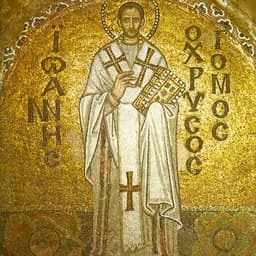
And I marvel not only at the quantity of loaves created, but besides the quantity, at the exactness of the surplus, that He caused the superabundance to be neither more nor less than just so much as He willed, foreseeing how much they would consume; a thing which marked unspeakable power.
St. John Chrysostom, Homilies on the Gospel of St. John, Homily XLII (on John vi. 1ff), section 3; NPNF1 Vol. 14
Patristic sources
- St. John Chrysostom
- Homilies on Matthew, Hom. 49
- Homilies on John, Hom. 42–43
- St. Cyril of Alexandria
- Commentary on John, Book III (on John 6)
- Commentary on Luke, on Luke 9
- Theophylact of Ohrid
- Commentary on Matthew, on Matt 14
- Commentary on John, on John 6
- Origen of Alexandria
- Commentary on Matthew, Book XI
Read the sources: Chrysostom on John (CCEL)
The Feeding of the Five Thousand (Matthew 14:13–21; Mark 6:30–44; Luke 9:10–17; John 6:1–14)
The texts below are quoted verbatim from public-domain English translations; nothing is paraphrased.
St. John Chrysostom (c. 347–407)
Homilies on the Gospel of Matthew, Homily 49 (on Matthew 14:13–21) Source: trans. in the Nicene and Post-Nicene Fathers, First Series, Vol. 10. Public domain. Full text: https://www.newadvent.org/fathers/200149.htm
On the Teacher's skill in saying "Give ye them to eat" rather than "I feed them":
On why He looked up to heaven for this lesser work, though He raised the dead and stilled the sea with authority:
On why He made the food out of existing loaves rather than from nothing, against Marcion and Manichaeus:
On the self-restraint of the disciples, and the lesson to give from our little:
On why twelve baskets remained over:
St. Cyril of Alexandria (c. 376–444)
As preserved in the Catena Aurea on Luke. Public domain.
On the various needs that drew the crowds, and on those who loved His teaching:
On the overflowing kindness of Christ, who gives beyond what is asked:
On giving thanks before we break bread:
On the twelve baskets as the reward of love to our neighbor:
St. Gregory of Nyssa (c. 335–395)
As preserved in the Catena Aurea on Luke. Public domain.
On the blessing poured forth from the unspeakable garner of divine power:
Theophylact of Ohrid (c. 1050–1107)
As preserved in the Catena Aurea on Luke. Public domain.
On why He chose a desert place for the miracle:
On wisdom divided into word and work:
On why He asked though He knew the answer:
On hospitality, that we should give our guest every comfort:
St. Isidore of Pelusium (c. 360–c. 450)
As preserved in the Catena Aurea on Luke. Public domain.
On why our Lord departed after the murder of the Baptist:
St. Jerome (c. 347–420)
Commentary on Matthew (on Matthew 14:13–21) As preserved in the Catena Aurea, trans. J. H. Newman, 1841. Public domain. Full text: https://www.ccel.org/ccel/aquinas/catena1.ii.xiv.html
On the breaking of the loaves as a sowing of food:
On the fragments in the apostles' baskets as a witness to the miracle:
On the mysteries of the hour, and the broken Law made food for the Gentiles:
Blessed Augustine of Hippo (354–430)
As preserved in the Catena Aurea on Luke. Public domain.
On the harmony of the Evangelists, and seeking the meaning of the speaker rather than the words:
St. Ambrose of Milan (c. 339–397)
As preserved in the Catena Aurea on Luke. Public domain.
On the manner of the multiplying, seen in the hands of those who distributed:
On to whom the nourishment of grace is given, namely those who seek Christ in the desert:
On the bread that Jesus broke as the word of God, increased by being divided:
St. Bede the Venerable (c. 673–735)
As preserved in the Catena Aurea on Luke. Public domain.
On why our Lord withdrew, not from fear of death, but to spare His enemies:
On why He blessed existing loaves rather than creating new food:
On the twelve baskets as a figure of the Apostles and their successors: