All entriesmiracle

Healing of a leper

Matt 8:1–4; Mark 1:40–45; Luke 5:12–16 · Early ministry in Galilee

Matthew 8:1–4

hen he was come down from the mountain, great multitudes followed him. 2And, behold, there came a leper and worshipped him, saying, Lord, if thou wilt, thou canst make me clean. 3And Jesus put forth his hand, and touched him, saying, I will; be thou clean. And immediately his leprosy was cleansed. 4And Jesus saith unto him, See thou tell no man; but go thy way, shew thyself to the priest, and offer the gift that Moses commanded, for a testimony unto them.

King James Version · public domain

Mateu 8:1–4

dhe kur zbriti nga mali, i vanë prapa shumë gjindje. 2Edhe ja tek erdhi një i krromosur’ e i ufal ati, dyke thënë, Zot, ndë daç, munt të më qëronjç. 3Edhe Jisuj ngjati dorënë, edhe e preku dyke thënë, Dua, qërohu. Edhe për-një-herë i uqërua krroma. 4Edhe Jisuj i thot’ ati, Shiko mos i thuash ndonjëj; po shko e dëfte vetëhenë t’ënde te prifti; edhe shpierë dhurëtinë që ka urdhëruarë Moisiu për dëshmim mb’ata.

Kristoforidhi, Dhiata e Re Toskërisht 1879 · zotërim publik

Summary

The Law forbade touching a leper, for the disease made a man unclean and cut him off from the camp and the assembly; yet Christ stretches out His hand and touches him. The Fathers see here that the Source of purity cannot be defiled by contact; rather, He cleanses what He touches. He is not bound by the Law as a servant but is Lord of it, and so does freely what the Law could only forbid. His touch is also a sign of His incarnate descent, by which He lays hold of our fallen condition without being stained by it.

The leper's approach is read as a model of faith joined to humility, for he does not doubt the power but submits to the will, saying in effect, "If Thou wilt, Thou canst make me clean." Christ's answer, "I will; be clean," meets his words exactly and joins the willing and the doing in a single divine act, for with God to will is already to accomplish. The tradition takes this as proof of His authority: He heals not by prayer to another, as the prophets did, but by His own word.

The Fathers commonly take leprosy as a figure of sin, which spreads, disfigures, and isolates, and which only Christ can cleanse. The command to show himself to the priest and offer the gift Moses appointed preserves the order of the Law even as it is surpassed: it stands as a testimony that the man is cleansed and that Christ came not to abolish the Law but to fulfill it. In Mark and Luke the charge to tell no one is read as a lesson against vainglory; and the report that Jesus withdrew to pray in lonely places shows the same humility, even as the crowds gathered the more.

In their own words

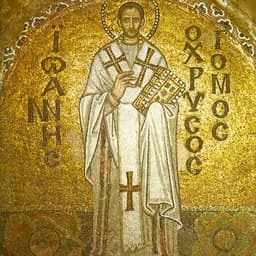
Whereas the Lord, to signify that He heals not as a servant, but as absolute master, doth also touch. For His hand became not unclean from the leprosy, but the leprous body was rendered clean by His holy hand.

St. John Chrysostom, Homilies on the Gospel of Matthew, Homily XXV, section 2 (NPNF1 Vol. 10)

The Cleansing of the Leper (Matthew 8:1–4; Mark 1:40–45; Luke 5:12–16)

Public-Domain Patristic Commentary

A leper, "full of leprosy," begs, "Lord, if thou wilt, thou canst make me clean," and Christ touches him with the word, "I will; be thou clean." The texts below are quoted verbatim from public-domain English translations. Cyril is taken from his own commentary; Chrysostom and Jerome are taken from the public-domain Catena Aurea (Oxford, 1842), and the further Fathers below are taken from the Catena Aurea on Luke (St. Thomas Aquinas, trans. J. H. Newman, 1841). Note on attribution: the Catena's chain on Matthew also carries a body of material under the name Pseudo-Chrysostom (the anonymous Opus Imperfectum); none of that is used here, only the portions the Catena marks as genuinely Chrysostom and Jerome. Nothing is paraphrased.


St. Cyril of Alexandria (c. 376–444)

Commentary on the Gospel of Luke, Sermon XII (on Luke 5:12–16) Source: trans. R. Payne Smith, Library of Fathers, 1859. Public domain. Full text: https://www.tertullian.org/fathers/cyril_on_luke_02_sermons_12_25.htm

On the leper's faith, and the one act at once divine and human (Luke 5:12–13):

The faith, however, of him who drew near is worthy of all praise: for he testifies that the Emmanuel can successfully accomplish all things, and seeks deliverance by His godlike commands, although his malady was incurable: for leprosy will not yield to the skill of physicians. I see, however, he says, the unclean demons expelled by a godlike authority: I see others set free from many diseases: I recognise that such things are wrought by some divine and resistless force: I see, further, that He is good, and most ready to pity those who draw near unto Him: what therefore forbids His taking pity on me also? And what is Christ's answer? He confirms His faith, and produces full assurance upon this very point. For He accepts His petition, and confesses that He is able, and says, "I will: be thou cleansed." He grants him also the touch of His holy and all-powerful hand, and immediately the leprosy departed from him, and his affliction was at an end. And in this join with me in wondering at Christ thus exercising at the same time both a divine and a bodily power. For it was a divine act so to will, as for all that He willed to be present unto Him: but to stretch out the hand was a human act: Christ therefore is perceived to be One of both, if, as is the case, the Word was made flesh.

On the command to tell no man (Luke 5:14):

Even though the leper had been silent, the very nature of the fact was enough to proclaim to all who knew him how great was His power Who had wrought the cure. But He bids him tell no man: and why? That they who receive from God the gift of working cures may hereby learn not to look for the applause of those whom they have healed, nor indeed any one's praises whatsoever, lest they fall a prey unto pride, of all vices the most disgraceful.

On the offering to the priest, and Christ's authority above that of Moses:

He purposely, however, bids the leper offer unto the priests the gift according to the law of Moses. For it was indeed confessedly His wish to put away the shadow, and transform the types unto a spiritual service. As the Jews, however, because as yet they did not believe on Him, attached themselves to the commands of Moses, supposing their ancient customs to be still in force, He gives leave to the leper to make the offering for a testimony unto them.

For Mariam, the sister of Moses, was herself struck with leprosy for speaking against him: and at this Moses was greatly distressed; and when he was unable to remove the disease from the woman, he fell down before God, saying, "O God, I beseech Thee, heal her." Observe this, then, carefully: on the one hand, there was a request; he sought by prayer to obtain mercy from above: but the Saviour of all spake with godlike authority, "I will: be thou cleansed."

Cyril goes on, at length, to read the two clean birds offered at the leper's cleansing in Leviticus 14 as a figure of the one Christ, dying in His flesh yet remaining beyond suffering in His Godhead, against those who would divide Him into two sons.


St. John Chrysostom (c. 347–407)

Homilies on the Gospel of Matthew (on Matthew 8:1–4) Source: as preserved in the Catena Aurea, trans. Oxford: Parker, 1842. Public domain. (Chrysostom's Homilies on Matthew are also in the Nicene and Post-Nicene Fathers, First Series, Vol. 10.) Catena Aurea (public domain): https://archive.org/details/p1catenaaureacom01thomuoft

On the leper's faith in Christ's own power:

He said not, "If Thou wilt ask of God," or, "If Thou wilt make adoration to God;" but, "If thou wilt."

Nowhere else do we see Him using this word though He be working ever so signal a miracle; but He here adds, "I will," to confirm the opinion of the people and the leprous man concerning His power.

On the touch that sanctifies rather than defiles:

He was able to cleanse by a word, or even by mere will, but He put out His hand, and touched him, to show that He was not subject to the Law, and that to the pure nothing is impure. Elisha truly kept the Law in all strictness, and did not go out and touch Naaman, but sends him to wash in Jordan. But the Lord shows that He does not heal as a servant, but as Lord heals and touches; His hand was not made unclean by the leprosy, but the leprous body was made pure by the holy hand.


St. Athanasius the Great (c. 296–373)

As preserved in the Catena Aurea on Luke. Public domain.

On the leper adoring the Creator in the temple of His flesh:

Now the leper worshipped the Lord God in His bodily form, and thought not the Word of God to be a creature because of His flesh, nor because He was the Word did he think lightly of the flesh which He put on; nay rather in a created temple he adored the Creator of all things, falling down on his face.


Titus of Bostra (d. c. 378)

As preserved in the Catena Aurea on Luke. Public domain.

On committing all things to the will of God:

Let us learn from the words of the leper not to go about seeking the cure of our bodily infirmities, but to commit the whole to the will of God, Who knows what is best for us, and disposes all things as He will.


St. Gregory of Nyssa (c. 335–395)

As preserved in the Catena Aurea on Luke. Public domain.

On the Deity manifest in both soul and body of the Lord:

And because the Deity is united with each portion of man, i.e. both soul and body, in each are evident the signs of a heavenly nature. ... For as the sense of touch is the property of the body, so the motion of the will of the soul. The soul wills, the body touches.


Theophylact of Ohrid (c. 1050–1107)

As preserved in the Catena Aurea on Luke. Public domain.

On the life-giving power of the flesh of the Word:

For His sacred flesh has a healing, and life-giving power, as being indeed the flesh of the Word of God.

On the cleansed man made worthy to offer the holy Gifts:

But mark, that after a man has been cleansed he is then worthy to offer this gift, namely, the body and blood of the Lord, which is united to the Divine nature.


St. Gregory Nazianzen (c. 329–390)

As preserved in the Catena Aurea on Luke. Public domain.

On the Lord's withdrawal to pray as our example:

And His works He indeed performed among the people, but He prayed for the most part in the wilderness, sanctioning the liberty of resting a while from labor to hold converse with God with a pure heart.


St. Jerome (c. 347–420)

Commentary on Matthew (on Matthew 8:1–4) Source: as preserved in the Catena Aurea, trans. Oxford: Parker, 1842. Public domain.

On the miracle confirming the preceding teaching:

After the preaching and teaching, is offered an occasion of working miracles, that by mighty works following, the preceding doctrine might be confirmed.

On reading the words of the cure precisely:

It is not to be read, as most of the Latins think, "I will to cleanse thee;" but separately, He first answers, "I will," and then follows the command, "be thou clean." The leper has said, "If thou wilt;" the Lord answers, "I will;" he first said, "Thou canst make me clean;" the Lord spake, "Be thou clean."


St. Ambrose of Milan (c. 339–397)

From his Exposition of the Gospel of Luke, as preserved in the Catena Aurea on Luke. Public domain.

On the unnamed place, signifying that all nations are healed:

Rightly no definite place is mentioned where the leprous man was healed, to signify that not one people of any particular city, but all nations were healed.

On the Lord of the law touching the leper:

The law forbids to touch the leprous man, but He who is the Lord of the law submits not to the law, but makes the law; He did not touch because without touching He was unable to make him clean, but to show that he was neither subject to the law, nor feared the contagion as man; for He could not be contaminated Who delivered others from the pollution.

On the will, command, and touch confounding the heretics:

He says then, I will, for Photinus, He commands, for Arius, He touches, for Manichaeus. But there is nothing intervening between God's work and His command, that we may see in the inclination of the healer the power of the work.

On the word as the medicine, and contempt of it as the true leprosy:

But if the word is the healing of leprosy, the contempt of the word is the leprosy of the mind.


Blessed Augustine (i Hiponit) (354–430)

As preserved in the Catena Aurea on Luke. Public domain.

On the commanded sacrifice yielding to the sacrifice of Christ's body:

He seems here to approve of the sacrifice which had been commanded through Moses though the Church does not require it. It may therefore be understood to have been commanded, because not as yet had commenced that most holy sacrifice which is His body. For it was not fitting that typical sacrifices should be taken away before that which was typified should be confirmed by the witness of the Apostles' preaching, and the faith of believers.


St. Gregory the Great (c. 540–604)

As preserved in the Catena Aurea on Luke. Public domain.

On the Lord's miracles by day and prayer by night, teaching preachers to balance action and contemplation:

Our Redeemer performs His miracles by day, and passes the night in prayer ... hinting, as it were, to perfect preachers, that as neither they should entirely desert the active life from love of contemplation, so neither should they despise the joys of contemplation from an excess of activity, but in silent thought imbibe that which they might afterwards give back in words to their neighbors.


St. Bede the Venerable (c. 673–735)

As preserved in the Catena Aurea on Luke. Public domain.

On the one man's healing drawing the multitudes:

Now the perfect healing of one brings many multitudes to the Lord ... For the leprous man that he might show both his outward and inward cure, even though forbid ceases not, as Mark says, to tell of the benefit he had received.

On the leper as a figure of the whole race of man:

How typically the leprous man represents the whole race of man, languishing with sins full of leprosy, for all have sinned and fall short of the glory of God; that so by the hand put forth, i.e. the word of God partaking of human nature, they might be cleansed from the vanity of their old errors, and offer for cleansing their bodies as a living sacrifice.


Note on other Fathers

The greater part of this commentary is now drawn from the Catena Aurea on Luke (St. Thomas Aquinas, trans. J. H. Newman, 1841), whose chain on this passage preserves Greek and Eastern voices alongside the Latin Fathers received in the East. Beyond those quoted above, the Catena's chain also carries brief remarks under the names of Cyril and Chrysostom drawn from their works on Luke, as well as material from the Western glossators and compilers (the Gloss, Remigius, Rabanus) which has been set aside as not properly patristic. As noted above, the Catena's Pseudo-Chrysostom material on the parallel passage in Matthew has likewise been set aside, since it is not securely Chrysostom's.

Patristic sources