All entriesmiracle

Healing of blind Bartimaeus

Matt 20:29–34; Mark 10:46–52; Luke 18:35–43 · Journey to Jerusalem

Matthew 20:29–34

nd as they departed from Jericho, a great multitude followed him. 30And, behold, two blind men sitting by the way side, when they heard that Jesus passed by, cried out, saying, Have mercy on us, O Lord, thou son of David. 31And the multitude rebuked them, because they should hold their peace: but they cried the more, saying, Have mercy on us, O Lord, thou son of David. 32And Jesus stood still, and called them, and said, What will ye that I shall do unto you? 33They say unto him, Lord, that our eyes may be opened. 34So Jesus had compassion on them, and touched their eyes: and immediately their eyes received sight, and they followed him.

King James Version · public domain

Mateu 20:29–34

dhe ata tek po dilninë nga Jerihoja, i vanë pas ati shumë gjindje. 30Edhe ja dy të-verbërë, që rrininë mb’udhët, kur dëgjuanë, se po shkonte Jisuj, bërtitnë, dyke thënë, Përdëlle-na, o Zot, bir’ i Dhavidhit. 31Edhe gjindja i qërtoj ata, që të pushoninë; po ata bërtitninë më fort, dyke thënë, Përdëlle-na, o Zot, bir’ i Dhavidhit. 32Edhe Jisuj qëndroj e i thirri ata, edhe tha, ç’doni t’u bënj juve? 33I thonë, Zot, të na hapenë sytë. 34Edhe Jisuj si i udhëmp për ta, preku syt’ e atyre; edhe për-një-here uhapnë syt’ e atyre, e vanë pas ati.

Kristoforidhi, Dhiata e Re Toskërisht 1879 · zotërim publik

Summary

As Jesus draws near Jericho, a blind beggar by the road cries out, "Son of David, have mercy on me," and when the crowd tries to silence him he cries all the louder. The Fathers note first what the man confesses: though his eyes are dark, he sees by faith what the sighted do not, naming Jesus the Son of David, that is, the promised Messiah of David's line. His outward blindness throws his inward sight into relief, and his cry becomes for the tradition the pattern of prayer that will not be hushed by discouragement but presses harder against every obstacle until it is heard.

Chrysostom dwells on this persistence: the crowd that rebukes him only sharpens his desire, and his refusal to be quieted is itself the faith Christ praises. "Your faith has saved you" locates the cure in trust rather than in any merit, and the Fathers read the healing as a sign of the whole Gospel, that Christ opens the eyes of those who acknowledge their darkness and beg for light. Cyril and the tradition see here the Physician who answers what the man truly asks, restoring sight to one who already saw enough to call upon him rightly.

On the moral and allegorical level the Fathers, Origen among them, read the blind man as the soul, or as the nations, sitting in darkness by the wayside of this life, until the Word passing by is implored and grants the light of knowledge. In Mark the man casts off his garment, which the tradition takes as the laying aside of the old life in order to run unhindered to Christ. Given sight, he does not return to begging but follows Jesus on the road, his blindness of soul healed together with his eyes, becoming a disciple.

Blind Bartimaeus (Mark 10:46–52)

Public-Domain Patristic Commentary

As the Lord leaves Jericho on the road to Jerusalem, a blind beggar named Bartimaeus, the son of Timaeus, sits by the wayside. Hearing that it is Jesus of Nazareth, he cries out, "Jesus, thou Son of David, have mercy on me." The crowd charges him to be silent, but "he cried the more a great deal." The Lord stands still and calls him; the man casts away his garment, springs up, and comes. Asked what he wants, he answers, "Lord, that I might receive my sight," and the Lord replies, "Go thy way; thy faith hath made thee whole." He receives his sight at once and follows Jesus in the way.

The Fathers read this healing alongside its parallels: Matthew tells of two blind men, Luke of one as the Lord drew near to Jericho, and only Mark gives the beggar's name. Gathered below are eight Fathers, several from the East and several from the West, each quoted verbatim from a public-domain translation, drawn from the NPNF homilies and from the Catena Aurea (St. Thomas Aquinas, trans. J. H. Newman, 1841) on Mark and on Luke. Chrysostom dwells on the persistence of faith that would not be silenced; Theophylact on the gratitude that followed; Cyril on the right confession of the Son of David as God; Bede on the harmony of the Gospels and the mystery of the Light; Jerome on the name of Jericho; Gregory the Great, Augustine, and Ambrose on the blindness of the human race and the light restored at the nearness of the Passion.


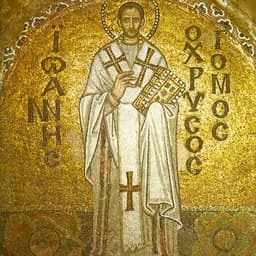
St. John Chrysostom (c. 347–407)

From his Homilies on the Gospel of Matthew (Homily 66, on the parallel in Matthew 20:29–34), NPNF translation. Public domain.

On the blind who were better than many who see, borne up by the very things that hindered them:

Let us listen to these blind men, who were better than many that see. For neither having a guide, nor being able to see Him when come near to them, nevertheless they strove to come unto Him, and began to cry with a loud voice, and when rebuked for speaking, they cried the more. For such is the nature of an enduring soul, by the very things that hinder, it is borne up.

On why the Lord allowed them to be rebuked:

But Christ suffered them to be rebuked, that their earnestness might the more appear, and that you might learn that worthily they enjoy the benefits of their cure. Therefore He does not so much as ask, "Do ye believe?" ... for their cry, and their coming unto Him, sufficed to make their faith manifest.

On the lesson for the outcast who prays with earnestness:

Hence learn, O beloved, that though we be very vile and outcast, but yet approach God with earnestness, even by ourselves we shall be able to effect whatsoever we ask. See, for instance, these men, how, having none of the apostles to plead with them, but rather many to stop their mouths, they were able to pass over the hindrances, and to come unto Jesus Himself.

On persevering even when the gift is deferred:

Though God defer the gift, though there be many withdrawing us, let us not desist from asking. For in this way most of all shall we win God to us. See at least even here, how not poverty, not blindness, not their being unheard, not their being rebuked by the multitude, not anything else, impeded their exceeding earnestness.

On why He asks what they want, and how they proved worthy:

Wherefore does He ask them? Lest any one should think that when they wish to receive one thing, He gives them another thing ... that He might show that they were enjoying the gift worthily ... But that they were worthy is manifest, both from what they cried out, and from the fact that, when they had received, they did not hasten away, as many do, being ungrateful after the benefits. Nay, they were not like this, but were both persevering before the gift, and after the gift grateful, for "they followed Him."


Theophylact of Ohrid (c. 1055–1107)

From his Explanation of the Gospel of Mark, as compiled in the Catena Aurea on Mark. Public domain.

On the gratitude of the healed man, who did not leave but followed:

The mind of the blind man is grateful, for when he was made whole, he did not leave Jesus, but followed Him.

On following in the way, that is, in this life:

He followed the Lord in the way, that is, in this life, because, after it, all are excluded who follow Him not here, by working His commandments.


St. Cyril of Alexandria (c. 376–444)

As preserved in the Catena Aurea on Luke. Public domain.

On the blind man, brought up a Jew, who confessed the Son of David as God:

Having been brought up a Jew, he was not ignorant that of the seed of David should God be born according to the flesh, and therefore he addresses Him as God, saying, Have mercy upon me. Would that those might imitate him who divide Christ into two. For he speaks of Christ as God, yet calls Him Son of David.

On the holy boldness of faith, which resists all and triumphs over all:

But by checks of this kind his ardor was not damped. For faith is able to resist all, and to triumph over all. It is a good thing to lay aside shame in behalf of divine worship. ... The voice of one invoking in faith stops Christ, for He looks back upon them who call upon Him in faith.

On the double blindness from which he was released:

From which it is clear, that he was released from a double blindness, both bodily and intellectual. For he would not have glorified Him as God, had he not truly seen Him as He is. But he also gave occasion to others to glorify God.


St. Bede the Venerable (c. 673–735)

From his Commentary on Mark, as compiled in the Catena Aurea on Mark. Public domain.

On the harmony of the three Gospel accounts:

Matthew says, that there were two blind men sitting by the wayside, who cried to the Lord, and received their sight; but Luke relates that one blind man was enlightened by Him ... where no one, at least no wise man, will suppose that the Evangelists wrote things contrary to one another, but that one wrote more fully, what another has left out. We must therefore understand that one of them was the more important, which appears from this circumstance, that Mark has related his name and the name of his father.

On why the Lord asks a question He already knows the answer to:

Could He who was able to restore sight be ignorant of what the blind man wanted? His reason then for asking is that prayer may be made to Him; He puts the question, to stir up the blind man's heart to pray.

On the one gift the blind man prizes above all others:

For the blind man looks down upon every gift except light, because, whatever a blind man may possess, without light he cannot see what he possesses.

On Jericho, the waning moon, and the nearness of the Passion:

In a mystical sense, however, Jericho, which means the moon, points out the waning of our fleeting race. The Lord restored sight to the blind man, when drawing near to Jericho, because coming in the flesh and drawing near to His Passion, He brought many to the faith.

On casting away the garment and seeking the true Light:

He throws away his garment and leaps, who, throwing aside the bonds of the world, with unencumbered pace hastens to the Giver of eternal light ... let us not seek for riches, earthly goods, or honours from the Lord, but for that Light, which we alone with the Angels can see, the way to which is faith.


St. Jerome (c. 347–420)

From his commentary, as compiled in the Catena Aurea on Mark. Public domain.

On the name of Jericho and the approaching Passion:

The name of the city agrees with the approaching Passion of our Lord; for it is said, "And they came to Jericho." Jericho means moon or anathema; but the failing of the flesh of Christ is the preparation of the heavenly Jerusalem.


St. Gregory the Great (c. 540–604)

As preserved in the Catena Aurea on Luke. Public domain.

On why the carnal disciples are brought to a miracle:

Because the disciples being yet carnal were unable to receive the words of mystery, they are brought to a miracle. Before their eyes a blind man receives his sight, that by a divine work their faith might be strengthened.

On blindness as the symbol of the human race, and the meaning of sitting by the wayside and begging:

Blindness is a symbol of the human race, which in our first parent knowing not the brightness of heavenly light, now suffers the darkness of his condemnation. ... He then who is ignorant of this brightness of the everlasting light, is blind. But if he does no more than believe in the Redeemer who said, I am the way, the truth, and the life; he sits by the way side. If he both believes and prays that he may receive the everlasting light, he sits by the way side and begs.

On the crowd of vices that scatter our thoughts in prayer, and the need to cry the more:

Those that went before Jesus, as He was coming, represent the multitude of carnal desires, and the busy crowd of vices which before that Jesus comes to our heart, scatter our thoughts, and disturb us even in our prayers. But the blind man cried out the more; for the more violently we are assailed by our restless thoughts, the more fervently ought we to give ourselves to prayer.

On the passing by of His humanity and the standing still of His divinity, and on seeking not gold but light:

The Lord then passing by heard the blind man crying, standing still restored him to sight, for by His humanity in compassion to our blindness He has pity upon our cries, by the power of His divinity He pours upon us the light of His grace. ... The blind man seeks from the Lord not gold, but light. Let us then seek not for false riches, but for that light which together with the Angels alone we may see, the way whereunto is faith.


Blessed Augustine (354–430)

As preserved in the Catena Aurea on Luke. Public domain.

On the two miracles, the one as the Lord drew near to Jericho and the other as He departed:

But seeing that what follows in St. Luke's Gospel most plainly proves the truth of his account, that while they were yet coming to Jericho, the miracle took place, we cannot but suppose that there were two such miracles, the first upon one blind man when our Lord was coming to that city, the second on two, when He was departing out of it; Luke relating the one, Matthew the other.

On Jericho as the moon and death, and the one blind man and the two as figures of the Jews and the Gentiles:

If we interpret Jericho to mean the moon, and therefore death, our Lord when approaching His death commanded the light of the Gospel to be preached to the Jews only, who are signified by that one blind man whom Luke speaks of, but rising again from the dead and ascending to heaven, to both Jews and Gentiles; and these two nations seem to be denoted by the two blind men whom Matthew mentions.


St. Ambrose of Milan (c. 339–397)

As preserved in the Catena Aurea on Luke. Public domain.

On the blind man as a figure of the Gentile people, who received again the lost light:

In the blind man we have a type of the Gentile people, who have received by the Sacrament of our Lord the brightness of the light which they had lost. And it matters not whether the cure is conveyed in the case of one or two blind men, inasmuch as deriving their origin from Ham and Japhet, the sons of Noah, in the two blind men they put forward two authors of their race.

On why the Lord questioned the blind man, that we might learn that none is saved without confession:

He asked the blind man to the end that we might believe, that without confession no man can be saved.


Note on sources and other Fathers

The Fathers read Bartimaeus on two levels at once. On the plain level, Chrysostom presses the lesson of persevering prayer: the blind men were "better than many that see," they "cried the more" when rebuked, and the Lord "suffered them to be rebuked, that their earnestness might the more appear," so that even the outcast who approaches "with earnestness" obtains his request. Theophylact adds that the healed man's gratitude is shown in his following, and Cyril, reading the Luke account, shows the blind man's right confession of the Son of David as God, and the holy boldness of a faith that "is able to resist all, and to triumph over all." On the mystical level, Bede and Jerome read Jericho (whose name means "moon") as the waning of our mortal race, and the healing as the Lord, "drawing near to His Passion," bringing many to faith; Bede draws from the two-and-one of the accounts a figure of the Jews before the Passion and the Gentiles after, and turns the cast-off garment into the bonds of the world flung aside by one who seeks "that Light, which we alone with the Angels can see." Gregory the Great reads blindness as the symbol of the whole human race darkened in Adam, and the crowd going before as the press of carnal desires that scatter our thoughts in prayer, teaching that "the more violently we are assailed by our restless thoughts, the more fervently ought we to give ourselves to prayer." Augustine reconciles Matthew and Luke as two distinct miracles and reads the one and the two blind men as the Jews and the Gentiles, while Ambrose sees in the blind man "a type of the Gentile people" who received again the light they had lost, and teaches that "without confession no man can be saved."

The Catena on Luke also carries comments attributed to Pseudo-Chrysostom; because that attribution is spurious (the words are not the saint's own), they are not quoted here. The Catena on Mark likewise carries comments attributed to Pseudo-Chrysostom (Victor of Antioch) and to Pseudo-Jerome, which are also omitted for the same reason.

Patristic sources