Healing of Peter's mother-in-law
Matt 8:14–15; Mark 1:29–31; Luke 4:38–39 · Early ministry in Galilee
Scripture
Matthew 8:14–15
nd when Jesus was come into Peter’s house, he saw his wife’s mother laid, and sick of a fever. 15And he touched her hand, and the fever left her: and she arose, and ministered unto them.
King James Version · public domain
Mateu 8:14–15
dhe Jisuj kur erdhi ndë shtëpit të Pjetrit, pa të vjehërrën’ e ati që po dergjej ndër ethe. 15Edhe e zuri atë prej dore, edhe e lanë ethetë; edhe ajo ungrit e u shërbente atyre.
Kristoforidhi, Dhiata e Re Toskërisht 1879 · zotërim publik
In their own words
Sometimes He heals by a word, sometimes He reaches forth His hand; as here, He touched her hand, and the fever left her. For He would not always work miracles with display of surpassing power, but would sometimes be hid.
St. John Chrysostom, Homilies on the Gospel of Matthew, Homily XXVII (on Matthew 8:14–15) (Catena Aurea)
Patristic sources
- St. Cyril of Alexandria
- Commentary on the Gospel of Luke, Sermon XII (on Luke 4:38–39)
Quoted from his own continuous Commentary on Luke (Payne Smith, 1859); the quotes are exact substrings of the tertullian.org page (sermons 12–25). PD.
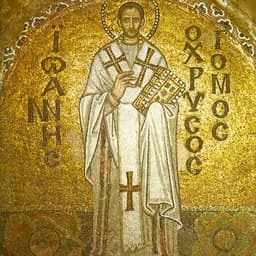
- St. John Chrysostom
- Homilies on the Gospel of Matthew, Homily XXVII (on Matthew 8:14–15)
Quoted as preserved in the Catena Aurea on Matthew (Newman, Oxford, 1874); his Homilies on Matthew are also in NPNF, First Series, Vol. 10. PD.
- St. Jerome
- Commentary on Matthew (as preserved in the Catena Aurea on Matthew)
On the completeness of the cure; a briefer reading from the Catena Aurea on Matthew. PD.
- St. Bede the Venerable
- Catena Aurea on Matthew (the figurative reading of the synagogue)
Figurative reading of Peter's mother-in-law as the synagogue; a briefer reading from the Catena Aurea on Matthew. PD.
- St. Remigius of Auxerre
- Catena Aurea on Matthew
Continues the figurative reading of the Law restored; a briefer reading from the Catena Aurea on Matthew. PD.
- St. Hilary of Poitiers
- Commentary on Matthew (as preserved in the Catena Aurea on Matthew)
Allegorical reading: unbelief cured when the Lord enters the body. PD.
- Blessed Augustine of Hippo
- De Consensu Evangelistarum (On the Harmony of the Evangelists), II, 21 (Catena Aurea on Matthew)
On why Matthew gives no fixed time, and the order of the Evangelists' narratives. PD.
Read the sources: Cyril on Luke, Sermons 12–25 (Tertullian.org) · Catena Aurea on Matthew, Vol. 1 (Archive.org scan)
The Healing of Peter's Mother-in-Law (Matthew 8:14–15; Mark 1:29–31; Luke 4:38–39)
The texts below are quoted verbatim from public-domain English translations; nothing is paraphrased.
St. Cyril of Alexandria (c. 376–444)
Commentary on the Gospel of Luke, Sermon XIV (on Luke 4:38–39) Source: trans. R. Payne Smith, Library of Fathers, 1859. Public domain. Full text: https://www.tertullian.org/fathers/cyril_on_luke_02_sermons_12_25.htm
On Christ lodging with a poor disciple:
On the fever rebuked, as though it were a living thing (Luke's distinctive phrasing):
On the touch of His flesh, and the soul that receives Him (Luke 4:39):
On the power of His holy flesh:
St. John Chrysostom (c. 347–407)
Homilies on the Gospel of Matthew, Homily XXVII (on Matthew 8:14–15) Source: as preserved in the Catena Aurea, trans. J. H. Newman et al., Oxford: Parker, 1874. Public domain. (Chrysostom's Homilies on Matthew are also in the Nicene and Post-Nicene Fathers, First Series, Vol. 10.) Catena Aurea (public domain): https://archive.org/details/p1catenaaureacom01thomuoft
On why He entered the house, and Peter's reverence:
On the touch and the completeness of the cure:
On her service:
Briefer readings (from the Catena Aurea, public domain)
St. Jerome (c. 347–420), Commentary on Matthew, on the completeness of the cure:
St. Bede the Venerable (c. 673–735) and St. Remigius of Auxerre (c. 841–908), from the Catena Aurea, reading the healing as a figure of the synagogue restored:
St. Hilary of Poitiers (c. 310–367)
From his Commentary on Matthew, as preserved in the Catena Aurea on Matthew. Public domain.
On the cure of unbelief when the Lord enters the body:
Blessed Augustine of Hippo (354–430)
From his De Consensu Evangelistarum (On the Harmony of the Evangelists), II, 21, as preserved in the Catena Aurea on Matthew. Public domain.
On why Matthew gives no fixed time for the miracle:
On the order of the Evangelists' narratives: