Healing of the centurion's servant
Matt 8:5–13; Luke 7:1–10 · Early ministry in Galilee
Scripture
Matthew 8:5–13
nd when Jesus was entered into Capernaum, there came unto him a centurion, beseeching him, 6And saying, Lord, my servant lieth at home sick of the palsy, grievously tormented. 7And Jesus saith unto him, I will come and heal him. 8The centurion answered and said, Lord, I am not worthy that thou shouldest come under my roof: but speak the word only, and my servant shall be healed. 9For I am a man under authority, having soldiers under me: and I say to this man, Go, and he goeth; and to another, Come, and he cometh; and to my servant, Do this, and he doeth it. 10When Jesus heard it, he marvelled, and said to them that followed, Verily I say unto you, I have not found so great faith, no, not in Israel. 11And I say unto you, That many shall come from the east and west, and shall sit down with Abraham, and Isaac, and Jacob, in the kingdom of heaven. 12But the children of the kingdom shall be cast out into outer darkness: there shall be weeping and gnashing of teeth. 13And Jesus said unto the centurion, Go thy way; and as thou hast believed, so be it done unto thee. And his servant was healed in the selfsame hour.
King James Version · public domain
Mateu 8:5–13
dhe Jisuj kur hyri ndë Kapernaum, i erdhi përanë një urdhër-qindës, dyke lutur’ ati, e dyke thënë, 6Zot, shërbëtori im dergjetë ndë shtëpit ulok, e mundonetë keq. 7Edhe Jisuj i thot’ ati, Unë dotë vinj e dot’a shëronj. 8Edhe urdhër-qindësi upërgjeq e tha, Zot, nukë jam i-zoti të më hynjç ndënë strehët; po thuaj vetëmë një fjalë, edhe shërbëtori im dotë shëronetë. 9Sepse edhe unë jam një njeri ndënë urdhërë; edhe i them këti, Shko, edhe shkon; edhe tjatërit, Eja, edhe vjen; edhe shërbëtorit t’im, Bëj këtë, edhe e bën. 10Edhe Jisuj kur dëgjoj uçudit, e u tha atyre që i vininë prapa, Me të vërtetë u them juve, se as ndë Israilt nukë kam gjeturë kaqë besë. 11Edhe po u them juve, se shumë dotë vijnë nga të-lindurit’ e nga të-perënduarit’ e djellit, edhe dotë rrinë bashkë me Avraaminë e me Isaakunë e me Jakovinë ndë mbretërit të qiejvet; 12Po të bijt’ e mbretërisë dotë hidhenë nd’errësirët të-përjashtësme; atje dotë jetë të-qarët’ e të-kërcëlliturit’ e dhëmbëvet. 13Edhe Jisuj i tha urdhërqindësit, Shko, edhe t’ubëftë sindëkur besove. Edhe shërbëtor’ i ati ushërua që mb’atë herë.
Kristoforidhi, Dhiata e Re Toskërisht 1879 · zotërim publik
In their own words
He asked for the saving word, the loving assent, the all mighty utterance; and justly therefore did he win a sentence of surpassing worth
St. Cyril of Alexandria, Commentary on St. Luke, Sermon XXXV (on Luke 7:1-10), trans. R. Payne Smith, 1859
Patristic sources
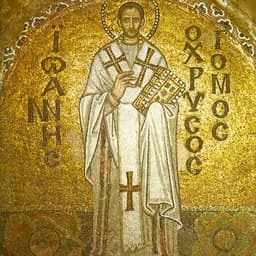
- St. John Chrysostom
- Homilies on Matthew, Hom. 26
- St. Cyril of Alexandria
- Commentary on Luke, Sermon 35
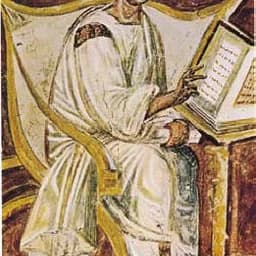
- Blessed Augustine of Hippo
- Sermons on Selected Lessons of the New Testament, Sermon 12
Venerated in the East as Blessed; his Sermon 12 on the New Testament expounds Matt 8:8.
- St. Hilary of Poitiers
- Commentary on Matthew
His Matthew commentary survives in public-domain English only through the Catena Aurea.
- St. Jerome
- Commentary on Matthew
His Matthew commentary survives in public-domain English only through the Catena Aurea.
- St. Peter Chrysologus
- Sermon 102
His Sermon 102 survives in public-domain English only through the Catena Aurea on Matthew.
Read the sources: Chrysostom, Homilies on Matthew, Hom. 26 (CCEL, NPNF1-10) · Cyril on Luke, Sermons 26–38 (Tertullian.org) · Augustine, Sermon 12 on the New Testament (NPNF1-6) · Catena Aurea on Matthew, ch. 8 (CCEL)
The Healing of the Centurion's Servant (Matthew 8:5–13; Luke 7:1–10)
The texts below are quoted verbatim from public-domain English translations; nothing is paraphrased.
St. John Chrysostom (c. 347–407)
Homilies on the Gospel of Matthew, Homily 26 (on Matthew 8:5–13) Source: trans. in the Nicene and Post-Nicene Fathers, First Series, Vol. 10. Public domain. Full text: https://www.newadvent.org/fathers/200126.htm
On the centurion's faith, greater even than that of the men who broke open the roof:
On "speak the word only," and the right opinion it revealed:
On the centurion's reasoning from his own authority to Christ's:
On how humility joined to faith won him a kingdom:
On the calling of the Gentiles foretold in him:
St. Cyril of Alexandria (c. 376–444)
Commentary on the Gospel of St. Luke, Sermon XXXV (on Luke 7:1–10) Source: trans. R. Payne Smith, 1859. Public domain. Full text: https://www.tertullian.org/fathers/cyril_on_luke_03_sermons_26_38.htm
On Christ as very God even though He became flesh, who works all things by His word:
On a faith reached, not through Moses or the Scriptures, but from rumour alone:
On the difference between the elders' request and the centurion's faith:
On Israel slow to believe and the nations ready, so that the Gentile's faith is crowned:
Blessed Augustine of Hippo (354–430)
Sermons on Selected Lessons of the New Testament, Sermon 12 (on Matthew 8:8) Source: trans. in the Nicene and Post-Nicene Fathers, First Series, Vol. 6. Public domain. Full text: https://www.newadvent.org/fathers/160312.htm
On how, by confessing himself unworthy, the centurion became worthy:
On the contrast with the proud Pharisee, and with Zacchaeus:
On "I have not found so great faith, no, not in Israel":
St. Hilary of Poitiers (c. 310–367)
From his Commentary on Matthew, as preserved in the Catena Aurea on Matthew. Public domain.
On the centurion's servant as a figure of the Gentiles, sick with the diseases of sin:
On why a word alone was asked, since the Gentiles' salvation is of faith:
St. Jerome (c. 347–420)
From his Commentary on Matthew, as preserved in the Catena Aurea on Matthew. Public domain.
On the faith and humility joined together in the centurion:
On the discernment by which he saw the Godhead hidden beneath the body:
On the faith of the Gentiles preferred to that of Israel:
On the weeping and gnashing of teeth as a proof of the resurrection of the body:
St. Peter Chrysologus (c. 380–450)
From his Sermon 102, as preserved in the Catena Aurea on Matthew. Public domain.
On the body as the house that God does not disdain to enter: