The healing of the nobleman's son
John 4:46–54 · Early ministry in Galilee
Scripture
John 4:46–54
o Jesus came again into Cana of Galilee, where he made the water wine. And there was a certain nobleman, whose son was sick at Capernaum. 47When he heard that Jesus was come out of Judaea into Galilee, he went unto him, and besought him that he would come down, and heal his son: for he was at the point of death. 48Then said Jesus unto him, Except ye see signs and wonders, ye will not believe. 49The nobleman saith unto him, Sir, come down ere my child die. 50Jesus saith unto him, Go thy way; thy son liveth. And the man believed the word that Jesus had spoken unto him, and he went his way. 51And as he was now going down, his servants met him, and told him, saying, Thy son liveth. 52Then enquired he of them the hour when he began to amend. And they said unto him, Yesterday at the seventh hour the fever left him. 53So the father knew that it was at the same hour, in the which Jesus said unto him, Thy son liveth: and himself believed, and his whole house. 54This is again the second miracle that Jesus did, when he was come out of Judaea into Galilee.
King James Version · public domain
Joani 4:46–54
isuj pra erdhi përsëri ndë Kana të Galilesë, ku kishte bërë ujëtë verë. Edhe ishte një njeri mbretërie, djal’ i të-cilit ishte i-sëmurë ndë Kapernaum. 47Ky kur dëgjoj, se Jisuj erdhi nga Judhea ndë Galilet, vate tek ay, edhe i lutej të sbresë e të shëronjë të birr’ e ati; Sepse ishte për të vdekurë. 48Jisuj pra i tha, Ndë mos pafshi shënja e çudira, s’kini për të besuarë. 49Njeriu i mbretërisë i thotë, Zot, sbrit para se të vdesë çuni im. 50Jisuj i thotë, Ecë, se yt bir rron. Edhe njeriu i besoj fjalësë që i tha Jisuj, edhe iku. 51Edhe tek po sbriste, shërbëtorët’ e ati upoqnë me atë, edhe i dhanë zë, Se yt bir rron. 52I pyeti pra mbë ç’orë ubë më mirë. Edhe i thanë, Se dje mbë të-shtattënë orë e lanë ethetë. 53I ati pra e kupëtoj se këjo ubë mb’atë orë që i tha Jisuj, Se yt bir rron; edhe besoj ay edhe gjithë shtëpi’ e ati. 54Jisuj bëri përsëri këtë çudi të-dytë, si erdhi nga Judhea ndë Jerusalim.
Kristoforidhi, Dhiata e Re Toskërisht 1879 · zotërim publik
In their own words
The one command of the Saviour healeth two souls. For in the nobleman it worketh unwonted faith, the child it rescueth from bodily death.
St. Cyril of Alexandria, Commentary on the Gospel of St. John, Book 2 (on John 4:46–54)
Patristic sources
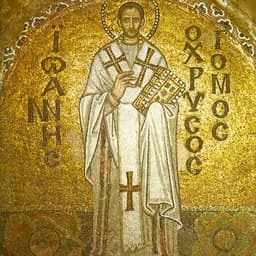
- St. John Chrysostom
- Homilies on the Gospel of St. John, Homily 35
Quoted from his continuous Homilies on John (NPNF, First Series, Vol. 14, trans. G. T. Stupart).
- St. Cyril of Alexandria
- Commentary on the Gospel of St. John, Book 2
Quoted from Pusey's translation (Library of Fathers, Vol. 43, 1874).
- Theophylact of Ohrid
- Explanation of the Gospel of John
No "St."; Catena-preserved (the Stade translation is under copyright).
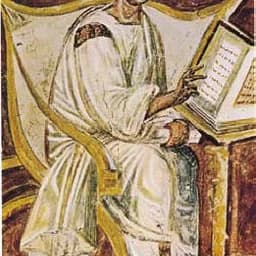
- Blessed Augustine of Hippo
- Tractates on the Gospel of John, Tractate 16
Venerated in the East as Blessed; never "St. Augustine."
- St. Gregory the Great
- Forty Gospel Homilies, Homily 28
Catena-preserved; Hurst's translation (Cistercian, 1990) is under copyright.
- St. Bede the Venerable
- Exposition of the Gospel of John
Catena-preserved (later compiler in curation order).
Read the sources: Chrysostom, Homilies on the Gospel of St. John, Homily 35 (CCEL, NPNF1-14) · Cyril of Alexandria, Commentary on John, Book 2 (tertullian.org, Pusey 1874) · Augustine, Tractates on John, Tractate 16 (CCEL, NPNF1-7)
The healing of the nobleman's son (John 4:46–54)
The texts below are quoted verbatim from public-domain English translations; nothing is paraphrased.
St. John Chrysostom (c. 347–407)
Homilies on the Gospel of St. John, Homily 35 (on John 4:46–54) Source: trans. G. T. Stupart, Nicene and Post-Nicene Fathers, First Series, Vol. 14, 1889. Public domain. Full text: https://www.ccel.org/ccel/schaff/npnf114.iv.xxxvii.html
On why this nobleman is a different man from the centurion of Matthew, and shows a weaker faith:
On Christ healing the father, sick in mind, no less than the son:
St. Cyril of Alexandria (c. 376–444)
Commentary on the Gospel of St. John, Book 2 (on John 4:46–54) Source: trans. P. E. Pusey, Library of Fathers of the Holy Catholic Church, Vol. 43, 1874. Public domain. Full text: https://www.tertullian.org/fathers/cyril_on_john_02_book2.htm
On the nobleman who calls Him Lord yet does not yet own Him God, able to heal even from afar:
On the one word that heals two souls at once:
Theophylact of Ohrid (c. 1055–1107)
Explanation of the Gospel of John (on John 4:46–54) As preserved in the Catena Aurea on John. Public domain.
On why the Evangelist recalls the miracle at Cana, and the nobleman's still-imperfect faith:
Blessed Augustine of Hippo (354–430)
Tractates on the Gospel of John, Tractate 16 (on John 4:43–54) Source: trans. John Gibb and James Innes, Nicene and Post-Nicene Fathers, First Series, Vol. 7, 1888. Public domain. Full text: https://www.ccel.org/ccel/schaff/npnf107.iii.xvii.html
On the ruler as a man lukewarm in faith, who came only to test what Christ could do:
On the difference between this ruler and the centurion, presence demanded, and unworthiness confessed:
St. Gregory the Great (c. 540–604)
Forty Gospel Homilies, Homily 28 (on John 4:46–53) As preserved in the Catena Aurea on John. Public domain.
On the nobleman's deficient faith, which thought Christ could not save unless present:
On Christ, present by His power even where He is absent in place, who saves by His command alone:
St. Bede the Venerable (c. 673–735)
Exposition of the Gospel of John (on John 4:46–54) As preserved in the Catena Aurea on John. Public domain.
On faith formed by degrees, beginning, growth, and maturity: