Healing of the paralytic lowered through the roof
Matt 9:1–8; Mark 2:1–12; Luke 5:17–26 · Early ministry in Galilee
Scripture
Matthew 9:1–8
nd he entered into a ship, and passed over, and came into his own city. 2And, behold, they brought to him a man sick of the palsy, lying on a bed: and Jesus seeing their faith said unto the sick of the palsy; Son, be of good cheer; thy sins be forgiven thee. 3And, behold, certain of the scribes said within themselves, This man blasphemeth. 4And Jesus knowing their thoughts said, Wherefore think ye evil in your hearts? 5For whether is easier, to say, Thy sins be forgiven thee; or to say, Arise, and walk? 6But that ye may know that the Son of man hath power on earth to forgive sins, (then saith he to the sick of the palsy,) Arise, take up thy bed, and go unto thine house. 7And he arose, and departed to his house. 8But when the multitudes saw it, they marvelled, and glorified God, which had given such power unto men.
King James Version · public domain
Mateu 9:1–8
dhe ay si hyri ndë lundrët uhoth përtej, e erdhi ndë qytett të ti. 2Edhe ja tek i prunë një ulok të-dergjurë mbi shtrat; edhe Jisuj si pa besën’ e atyre, i tha ulogut, Merr zëmërë, o bir; të janë falurë fajet’ e tu. 3Edhe ja ca nga shkronjësitë tek thanë me vetëhen’ e tyre, se Ky po vllasfimis. 4Edhe Jisuj si pa mendimet’ e atyre, tha, Përse mendoni ju punëra të-liga ndë zëmërat t’uaj? 5Sepse ç’është më lehtë, të them, T’u-falnë fajet’ e tu, apo të them, Ngreu e ecë? 6Po që t’a dini se i bir’ i nje-riut ka pushtet mbi dhet të falnjë faje, (atëhere i thot’ ulogut), Ngreu, e merr mbë krahë shtratinë t’ënt, edhe ecë ndë shtëpit t’ënde. 7Edhe ay ungrit edhe vate ndë shtëpit të ti. 8Edhe gjindja, kur panë, uçuditnë, edhe lavdëruanë Perëndinë, që u dha njerëzet një të-këtillë pushtet.
Kristoforidhi, Dhiata e Re Toskërisht 1879 · zotërim publik
In their own words
He healed first that which is invisible, the soul, by forgiving his sins
St. John Chrysostom, Homilies on the Gospel of St. Matthew, Homily XXIX (on Matt. ix. 1-8) (NPNF1 Vol. 10)
Patristic sources
- St. Cyril of Alexandria
- Commentary on the Gospel of Luke, Sermon XII (on Luke 5:17–26)
Quoted from his own continuous Commentary on Luke (Payne Smith, 1859), exact substrings of the tertullian.org page. PD.
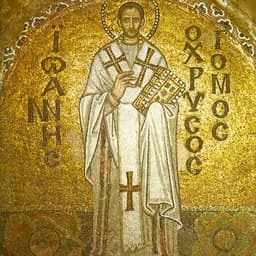
- St. John Chrysostom
- Homily on the Paralytic Let Down Through the Roof (NPNF, First Series, Vol. 9)
His standalone homily on the paralytic. PD.
- Blessed Augustine of Hippo
- On the Harmony of the Evangelists (as preserved in the Catena Aurea on Matthew)
On how Matthew's 'his own city' agrees with Mark's Capharnaum. PD.
- St. Jerome
- Commentary on Matthew (as preserved in the Catena Aurea on Matthew)
On Christ calling the paralytic 'son', the blasphemy charge, and the spiritual sense. PD.
- St. Hilary of Poitiers
- As preserved in the Catena Aurea on Matthew
On the boat that is the Church and the paralytic as the whole Gentile world. PD.
- St. Peter Chrysologus
- Sermon 50 (as preserved in the Catena Aurea on Matthew)
On the Creator who became a citizen, and the power of another's faith to heal. PD.
- St. Gregory the Great
- Morals on the Book of Job (as preserved in the Catena Aurea on Matthew)
On the bed as the pleasure of the body, now borne by the man made whole. PD.
Read the sources: Cyril on Luke, Sermons 12–25 (Tertullian.org) · Chrysostom, Homily on the Paralytic (New Advent) · Catena Aurea on Matthew, Vol. 1 (Archive.org scan)
The Healing of the Paralytic Let Down Through the Roof (Matthew 9:1–8; Mark 2:1–12; Luke 5:17–26)
The texts below are quoted verbatim from public-domain English translations; nothing is paraphrased.
St. Cyril of Alexandria (c. 376–444)
Commentary on the Gospel of Luke, Sermon XVI (on Luke 5:17–26) Source: trans. R. Payne Smith, Library of Fathers, 1859. Public domain. Full text: https://www.tertullian.org/fathers/cyril_on_luke_02_sermons_12_25.htm
On the bearers, the opened roof, and the faith that heals (Luke 5:18–20):
On healing the soul before the body, and sin as the root of the disease:
On the charge of blasphemy, and how Christ proves He is God (Luke 5:21):
On the visible proof, and the honour given to mankind (Luke 5:24):
St. John Chrysostom (c. 347–407)
Homily on the Paralytic Let Down Through the Roof Source: trans. in the Nicene and Post-Nicene Fathers, First Series, Vol. 9. Public domain. Full text: https://www.newadvent.org/fathers/1911.htm
On the faith of the bearers, measured against others:
On the paralytic's own faith, shown by his willingness to be let down through the roof:
On the man's patience when offered forgiveness instead of healing:
On why Christ forgave the sins first:
Blessed Augustine of Hippo (354–430)
From On the Harmony of the Evangelists, as preserved in the Catena Aurea on Matthew. Public domain.
On how Matthew's "his own city" agrees with Mark's Capharnaum:
St. Jerome (c. 347–420)
As preserved in the Catena Aurea on Matthew. Public domain.
On Christ calling the paralytic "son," and disease as a punishment of sin:
On the scribes' charge of blasphemy, and how Christ shews Himself God:
On the spiritual sense: the sick soul brought by others to be healed:
St. Hilary of Poitiers (c. 315–367)
As preserved in the Catena Aurea on Matthew. Public domain.
On the city of God and the boat that is the Church:
On the paralytic as the whole Gentile world, healed by faith:
On the fear of dying unforgiven, and the gifts given to men:
St. Peter Chrysologus (c. 380–450)
From Sermon 50, as preserved in the Catena Aurea on Matthew. Public domain.
On the Creator who became a citizen for our sakes:
On the power of another's faith to heal:
On Christ and the vessel of the Church:
St. Gregory the Great (c. 540–604)
From the Morals on the Book of Job, as preserved in the Catena Aurea on Matthew. Public domain.
On the bed as the pleasure of the body, now borne by the man made whole: