Jesus before Herod Antipas
Luke 23:6–12 · Passion week in Jerusalem
Scripture
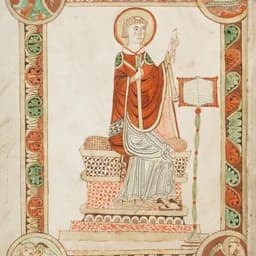
Luke 23:6–12
hen Pilate heard of Galilee, he asked whether the man were a Galilaean. 7And as soon as he knew that he belonged unto Herod’s jurisdiction, he sent him to Herod, who himself also was at Jerusalem at that time. 8And when Herod saw Jesus, he was exceeding glad: for he was desirous to see him of a long season, because he had heard many things of him; and he hoped to have seen some miracle done by him. 9Then he questioned with him in many words; but he answered him nothing. 10And the chief priests and scribes stood and vehemently accused him. 11And Herod with his men of war set him at nought, and mocked him, and arrayed him in a gorgeous robe, and sent him again to Pilate. 12And the same day Pilate and Herod were made friends together: for before they were at enmity between themselves.
King James Version · public domain
Lluka 23:6–12
dhe Pillati kur dëgjoj fjalënë Galilea, pyeti, ndë është njeriu Galileas. 7Edhe kur e mori vesh, se ishte prej vëndit të pushtetit të Irodhit, e dërgoj te Irodhi, i-cili edhe ay ato dit ishte ndë Jerusalim. 8Edhe Irodhi kur pa Jisunë, ugëzua shumë; se kish mjaft kohë që doj t’a shihte, sepse kishte dëgjuarë shumë gjërra për atë; edhe shprente të shihte ndonjë shënjë të bënej prej ati. 9Edhe e pyeste me shumë fjalë; po ay nuk’ i përgjigjej asgjë. 10Edhe kryepriftërit’ e shkronjësitë rrininë dyke përfolur’ atë me nxehtësirë të-madhe. 11Edhe Irodhi bashkë me ushtëtarët’ e ti e bëri për asgjë, edhe e përqeshi, edhe i veshi një rrobë të-ndriçime, edhe e dërgoj përsëri te Pillati. 12Edhe nd’atë ditë Pillati edhe Irodhi u bënë miq njeri me tjatrinë; sepse më përpara ishinë nd’armiqësi njeri me tjatrinë.
Kristoforidhi, Dhiata e Re Toskërisht 1879 · zotërim publik
In their own words
For a word uttered to one whom it profits nothing becomes the cause of his condemnation.
Theophylact of Ohrid, as preserved in the Catena Aurea on Luke
Patristic sources
- St. Cyril of Alexandria
- Commentary on Luke, Sermon 151
- Theophylact of Ohrid
- Explanation of the Gospel of Luke (Catena Aurea)
- St. Ambrose of Milan
- Exposition of the Gospel of Luke (Catena Aurea)
- St. Gregory the Great
- Homilies on the Gospels (Catena Aurea)
- St. Bede the Venerable
- Commentary on Luke (Catena Aurea)
Read the sources: Cyril of Alexandria, Commentary on Luke (tertullian.org) · Catena Aurea on Luke (isidore.co)
Jesus before Herod Antipas (Luke 23:6–12)
The texts below are quoted verbatim from public-domain English translations; nothing is paraphrased.
St. Cyril of Alexandria (c. 376–444)
Commentary on the Gospel of Luke, Sermon CLI (on Luke 23:13–16), trans. R. Payne Smith, Library of Fathers, 1859. Public domain. Full text: https://www.tertullian.org/fathers/cyril_on_luke_14_sermons_146_156.htm
On the accusers who hid the real nature of Christ's teaching, and the judge who could find no fault:
On the malice that begged for the death of One whom the judge had already acquitted:
Theophylact of Ohrid (c. 1055–1107)
As preserved in the Catena Aurea on Luke (on Luke 23:8–12), trans. J. H. Newman, 1841. Public domain. Full text: https://isidore.co/aquinas/english/CALuke.htm
On Herod's curiosity, which sought a spectacle and not salvation, and the silence it earned:
On the new-made friendship of Pilate and Herod, and the devil who unites the divided against Christ:
St. Ambrose of Milan (c. 339–397)
As preserved in the Catena Aurea on Luke (on Luke 23:9–12), trans. J. H. Newman, 1841. Public domain. Full text: https://isidore.co/aquinas/english/CALuke.htm
On the silence of the Lord before unbelief:
On the mocking robe, turned into a sign of the spotless Passion:
On the two enemies reconciled, as a figure of Israel and the Gentiles:
St. Gregory the Great (c. 540–604)
As preserved in the Catena Aurea on Luke (on Luke 23:8–11), trans. J. H. Newman, 1841. Public domain. Full text: https://isidore.co/aquinas/english/CALuke.htm
On the lesson of holy silence before those who praise but will not amend:
On the Redeemer who held His peace and would not work a miracle for idle wonder:
St. Bede the Venerable (c. 673–735)
As preserved in the Catena Aurea on Luke (on Luke 23:6–12), trans. J. H. Newman, 1841. Public domain. Full text: https://isidore.co/aquinas/english/CALuke.htm
On Pilate, glad of a pretext to escape judging the innocent:
On the alliance of Herod and Pilate as a dark unity against the faithful: