The Angel Appears to Joseph in a Dream
Matt 1:18–25 · Infancy and childhood
Scripture
Matthew 1:18–25
ow the birth of Jesus Christ was on this wise: When as his mother Mary was espoused to Joseph, before they came together, she was found with child of the Holy Ghost. 19Then Joseph her husband, being a just man, and not willing to make her a publick example, was minded to put her away privily. 20But while he thought on these things, behold, the angel of the LORD appeared unto him in a dream, saying, Joseph, thou son of David, fear not to take unto thee Mary thy wife: for that which is conceived in her is of the Holy Ghost. 21And she shall bring forth a son, and thou shalt call his name JESUS: for he shall save his people from their sins. 22Now all this was done, that it might be fulfilled which was spoken of the Lord by the prophet, saying, 23Behold, a virgin shall be with child, and shall bring forth a son, and they shall call his name Emmanuel, which being interpreted is, God with us. 24Then Joseph being raised from sleep did as the angel of the Lord had bidden him, and took unto him his wife: 25And knew her not till she had brought forth her firstborn son: and he called his name JESUS.
King James Version · public domain
Mateu 1:18–25
dhe të-lindurit e Jisu Krishtit kështu ka qenë; passi uvlua e ëm’ e ati Maria me Josifnë, përpara se të bashkoneshinë, ugjënt me barrë nga Frym’e-Shënjtëruarë. 19Edhe Josifi, burr’ i asaj, dyke qenë i drejtë, e dyke mos dashurë t’i nxjerrë asaj zë të-lik, desh t’a lëshonjë fshehurazi. 20Po ay tek po ishte dyke menduarë këto punë ja nj’ëngjëll i Zotit tek i uduk nd’ëndërrë, dyke thënë, Josif, i bir’ i Dhavidhit, mos ufrikëso të marrç me vetëhe gruanë t’ënde Mariamënë; sepse të-mbarsuritë që ubë tek ajo është nga Frym’ e-Shënjtëruarë, 21Edhe dotë pjellë djalë edhe dot’j’a quanjç emërinë Jisu; sepse ay dotë shpëtonjë llauzin’e ti nga fajet’ e atyre. 22(Edhe gjithë këjo ubë, që të mbushetë e-thëna prej Zotit me anë të profitit, që thotë, 23“Ja virgjëresha tek dotë mbarsetë, edhe dotë pjellë djalë, edhe dot’j’a quanjën’ emërin Emanuil” që e-kthyerë do methënë, Perëndia bashkë me ne.) 24Edhe Josifi si uzgjua nga gjumi, bëri sikundrë e urdhëroj ëngjëll’ i Zotit, edhe mori përanë vetëhesë gruan’ e ti; 25Edhe nuk’e njohu atë, gjersa bëri të birin’e saj të-parëlindurinë; edhe j’a quajti emërinë Jisu.
Kristoforidhi, Dhiata e Re Toskërisht 1879 · zotërim publik
In their own words
For not from visible wars, neither from barbarians, but what was far greater than these, from sins, he declares the glad tidings of deliverance; a work which had never been possible to any one before.
St. John Chrysostom, Homilies on Matthew, Homily IV (on Matthew 1:21)
Patristic sources
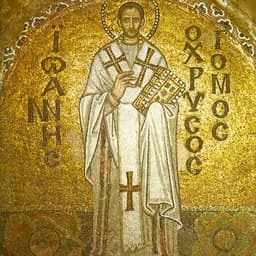
- St. John Chrysostom
- Homilies on Matthew, Hom. 4
- Homilies on Matthew, Hom. 5
- Origen of Alexandria
- Commentary on Matthew (on Matt 1:19)
Origen's Commentary on Matthew survives for chapter 1 only in fragments; the extract is Catena-preserved. Some of his speculations were condemned in 553, so he is quoted with care.
- Blessed Augustine of Hippo
- Sermons
- Enchiridion
Venerated in the East as Blessed; his exegesis of Matthew 1 is cited here through the Catena Aurea.
- St. Jerome
- Commentary on Matthew
- Against Helvidius
- St. Ambrose of Milan
- Exposition of the Gospel of Luke
- St. Peter Chrysologus
- Sermons
Read the sources: Chrysostom, Homilies on Matthew, Homily IV (CCEL) · Chrysostom, Homilies on Matthew, Homily V (CCEL) · Catena Aurea on Matthew, ch. 1 (CCEL)
The Angel Appears to Joseph in a Dream (Matthew 1:18–25)
The texts below are quoted verbatim from public-domain English translations; nothing is paraphrased.
St. John Chrysostom (c. 347–407)
Homilies on the Gospel of Matthew, Homilies IV–V (on Matthew 1:18–25) Source: trans. in the Nicene and Post-Nicene Fathers, First Series, Vol. 10. Public domain. Full text: https://www.ccel.org/ccel/schaff/npnf110.iii.IV_1.html
On what Scripture means by calling Joseph "a just man":
On Joseph's gentleness, that he would not grieve the Virgin even in small things:
On the deliverance signified by the name Jesus, "for he shall save his people from their sins":
On why the Evangelist wrote that Joseph "knew her not till she had brought forth" her Son:
On Joseph's obedience when he was raised from sleep:
Origen of Alexandria (c. 185–254)
Commentary on Matthew (on Matthew 1:19) As preserved in the Catena Aurea on Matthew. Public domain. Full text: https://www.ccel.org/ccel/aquinas/catena1.ii.i.html
(Origen's exposition of Matthew 1 survives only in fragments; this reading of Joseph's justice is preserved through the Catena.) On why Joseph sought to put Mary away, not from suspicion but from awe:
Blessed Augustine of Hippo (354–430)
Sermons and Enchiridion (on Matthew 1:19–20) As preserved in the Catena Aurea on Matthew. Public domain. Full text: https://www.ccel.org/ccel/aquinas/catena1.ii.i.html
On the mercy of the just man, who sought the benefit rather than the punishment of the one he suspected:
On the meaning of "conceived of the Holy Ghost," that the Spirit is not therefore the Father of Christ's manhood:
St. Jerome (c. 347–420)
Commentary on Matthew, and Against Helvidius (on Matthew 1:19–25) As preserved in the Catena Aurea on Matthew. Public domain. Full text: https://www.ccel.org/ccel/aquinas/catena1.ii.i.html
On Joseph's silence as a testimony to Mary's purity:
On the sign of Isaiah, which must be something new and wonderful:
On the two names, Emmanuel and Jesus:
On the word "until," which does not imply a change afterward:
St. Ambrose of Milan (c. 339–397)
Exposition of the Gospel of Luke (on Matthew 1:19–20) As preserved in the Catena Aurea on Matthew. Public domain. Full text: https://www.ccel.org/ccel/aquinas/catena1.ii.i.html
On how a righteous man ought to act toward his wife's supposed disgrace:
On what Joseph's very purpose to put her away confesses:
On the angel's calling Mary his wife:
St. Peter Chrysologus (c. 380–450)
Sermons (on Matthew 1:20–21) As preserved in the Catena Aurea on Matthew. Public domain. Full text: https://www.ccel.org/ccel/aquinas/catena1.ii.i.html
On why the betrothed husband is bidden "fear not":
On who it is that Mary bore, and from what he saves: