Judge Not
Matt 7:1–5; Luke 6:37–42 · Early ministry in Galilee
Scripture
Matthew 7:1–5
udge not, that ye be not judged. 2For with what judgment ye judge, ye shall be judged: and with what measure ye mete, it shall be measured to you again. 3And why beholdest thou the mote that is in thy brother’s eye, but considerest not the beam that is in thine own eye? 4Or how wilt thou say to thy brother, Let me pull out the mote out of thine eye; and, behold, a beam is in thine own eye? 5Thou hypocrite, first cast out the beam out of thine own eye; and then shalt thou see clearly to cast out the mote out of thy brother’s eye.
King James Version · public domain
Mateu 7:1–5
os gjykoni, që të mos gjykoneni; 2Sepse me ç’farë gjyqi gjykoni, dotë gjykoneni; edhe me ç’farë matësi matni, dot’u matetë edhe juve. 3Edhe përse shikon lëmishtenë që është ndë syt të t’yt vëllaj, edhe tranë që është ndë syt t’ënt nuk’ e ndjen? 4A si dot’i thuash t’yt vëllaj, Letë nxjer lëmishtenë nga syri yt, edhe ja trari tek është ndë syt t’ënt? 5Ipokrit, nxir më përpara tranë nga syri yt, edhe atëhere dotë shohç mirë të nxjerç lëmishtenë nga syri i t’yt vëllaj.
Kristoforidhi, Dhiata e Re Toskërisht 1879 · zotërim publik
In their own words
Nay, correct him, but not as a foe, nor as an adversary exacting a penalty, but as a physician providing medicines.
St. John Chrysostom, Homilies on the Gospel of Matthew, Homily 23 (on Matthew 7:1–5)
Patristic sources
- St. John Chrysostom
- Homilies on Matthew, Hom. 23
- St. Cyril of Alexandria
- Commentary on Luke, Sermons 29 and 33
- Blessed Augustine of Hippo
- Our Lord's Sermon on the Mount, Book II
Venerated in the East as Blessed; his exposition of the Sermon on the Mount is the fullest Latin treatment of Matt 7:1–5.
- St. Jerome
- Commentary on Matthew (Catena Aurea)
Catena-only in public-domain English.
- St. Hilary of Poitiers
- Commentary on Matthew (Catena Aurea)
Catena-only in public-domain English.
Read the sources: Chrysostom on Matthew, Homily 23 (CCEL) · Cyril on Luke, Sermons 26–38 (tertullian.org) · Augustine, Our Lord's Sermon on the Mount, Book II (CCEL) · Catena Aurea on Matthew, ch. 7 (CCEL)
Judge Not (Matthew 7:1–5; Luke 6:37–42)
The texts below are quoted verbatim from public-domain English translations; nothing is paraphrased.
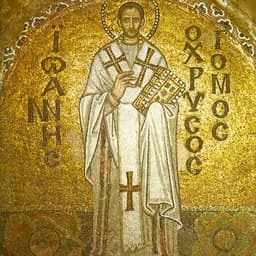
St. John Chrysostom (c. 347–407)
Homilies on the Gospel of Matthew, Homily 23 (on Matthew 7:1–5) Source: trans. in the Nicene and Post-Nicene Fathers, First Series, Vol. 10. Public domain. Full text: https://www.ccel.org/ccel/schaff/npnf110.iii.XXIII.html
That the Lord forbids not all judgment, but the bitter judging of small faults by men themselves full of great ones:
On "For with what judgment ye judge, ye shall be judged":
On correcting the sinner as a physician, not as an enemy:
On the beam that must be cast out first:
St. Cyril of Alexandria (c. 376–444)
Commentary on the Gospel of Luke, Sermons 29 and 33 (on Luke 6:37–42) Source: trans. R. Payne Smith, Library of Fathers, 1859. Public domain. Full text: https://www.tertullian.org/fathers/cyril_on_luke_03_sermons_26_38.htm
On "Judge not, and ye shall not be judged":
That compassion and prayer, not censure, are owed to the one overtaken in a fault:
On the mote and the beam:
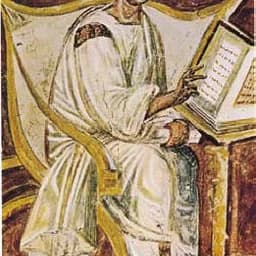
Blessed Augustine of Hippo (354–430)
Our Lord's Sermon on the Mount, Book II (on Matthew 7:1–5) Source: trans. in the Nicene and Post-Nicene Fathers, First Series, Vol. 6. Public domain. Full text: https://www.ccel.org/ccel/schaff/npnf106.v.iii.xviii.html and https://www.ccel.org/ccel/schaff/npnf106.v.iii.xix.html
On putting the better construction on doubtful actions:
That manifest sins may lawfully be judged:
On the difference between anger and hatred, as between a mote and a beam:
On casting the beam of hatred out first:
That common frailty should make pity, not hatred, go before rebuke:
St. Jerome (c. 347–420)
Commentary on Matthew (on Matthew 7:1–5) As preserved in the Catena Aurea on Matthew. Public domain. Full text: https://www.ccel.org/ccel/aquinas/catena1.ii.vii.html
That the prohibition does not abolish lawful correction, as Paul and Peter show:
On who is meant by the man with the beam:
St. Hilary of Poitiers (c. 310–367)
Commentary on Matthew (on Matthew 7:1–5) As preserved in the Catena Aurea on Matthew. Public domain. Full text: https://www.ccel.org/ccel/aquinas/catena1.ii.vii.html
On his reading, that where the matter is doubtful we begin to sin the moment we pronounce any judgment at all: