No One Can Serve Two Masters
Matt 6:24; Luke 16:13 · Early ministry in Galilee
Scripture
Matthew 6:24
o man can serve two masters: for either he will hate the one, and love the other; or else he will hold to the one, and despise the other. Ye cannot serve God and mammon.
King James Version · public domain
Mateu 6:24
snjë s’munt t’u shërbenjë dy zotërinjve; sepse a njërit dot’i ketë mëri, edhe tjatrinë dot’a dojë; a njërit dot’i ngjitetë prapa, edhe tjatërit dot’i kthenjë krahëtë. Nukë munt t’i shërbeni Perëndisë edhe Mammonajt.
Kristoforidhi, Dhiata e Re Toskërisht 1879 · zotërim publik
In their own words
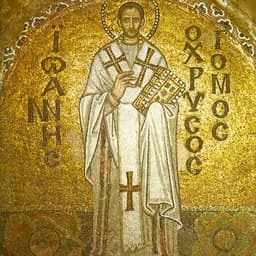
Tell me not of them that are rich, but of them that serve riches. Since Job also was rich, but he served not mammon, but possessed it and ruled over it, and was a master, not a slave.
St. John Chrysostom, Homilies on Matthew, Homily 21 (on Matt 6:24)
Patristic sources
- St. John Chrysostom
- Homilies on Matthew, Hom. 21
- St. Cyril of Alexandria
- Commentary on Luke, Sermon 109
Quoted on the Luke 16:13 parallel; his continuous Commentary on Luke is the Eastern spine for this saying.
- Blessed Augustine of Hippo
- Our Lord's Sermon on the Mount, Book II, ch. 14
Venerated in the East as Blessed; his Sermon on the Mount treats Matt 6:24 directly.
- St. Jerome
- Commentary on Matthew (on Matt 6:24)
Catena-only in public-domain English; quoted from the Catena Aurea on Matthew.
Read the sources: Chrysostom, Homilies on Matthew, Homily 21 (CCEL) · Cyril of Alexandria, Commentary on Luke, Sermons 99–109 (tertullian.org) · Augustine, Our Lord's Sermon on the Mount, Book II (CCEL) · Catena Aurea on Matthew 6 (CCEL)
No One Can Serve Two Masters (Matthew 6:24; Luke 16:13)
The texts below are quoted verbatim from public-domain English translations; nothing is paraphrased.
St. John Chrysostom (c. 347–407)
Homilies on the Gospel of Matthew, Homily 21 (on Matthew 6:24) Source: trans. in the Nicene and Post-Nicene Fathers, First Series, Vol. 10. Public domain. Full text: https://www.ccel.org/ccel/schaff/npnf110/npnf110.iii.XXI.html
On why the two masters are irreconcilable, and why the change to a better service is easy:
On the horror of setting the name of gold beside the name of God:
On the difference between possessing riches and serving them:
St. Cyril of Alexandria (c. 376–444)
Commentary on the Gospel of Luke, Sermon 109 (on Luke 16:13) Source: trans. R. Payne Smith, Library of Fathers, 1859. Public domain. Full text: https://www.tertullian.org/fathers/cyril_on_luke_10_sermons_99_109.htm
On the conclusion of the whole argument, that a slave of two contrary wills can please neither:
On the two opposite characters that the two services stamp upon a man:
Blessed Augustine of Hippo (354–430)
Our Lord's Sermon on the Mount, Book II, Chapter 14 (on Matthew 6:24) Source: trans. in the Nicene and Post-Nicene Fathers, First Series, Vol. 6. Public domain. Full text: https://www.ccel.org/ccel/schaff/npnf106/npnf106.v.iii.xiv.html
On who the two masters are:
On the hard and ruinous master that the servant of mammon does not even love:
On why the Lord said "despise" and not "hate" of God:
St. Jerome (c. 347–420)
Commentary on Matthew (on Matthew 6:24) As preserved in the Catena Aurea on Matthew. Public domain. Full text: https://www.ccel.org/ccel/aquinas/catena1.ii.vi.html
On the name mammon, and the covetous man who cannot serve both Christ and riches:
On the servant of riches, who is guarded by his money as a slave: