Raising of Jairus's daughter
Matt 9:18–26; Mark 5:21–43; Luke 8:40–56 · Later ministry in Galilee
Scripture
Matthew 9:18–26
hile he spake these things unto them, behold, there came a certain ruler, and worshipped him, saying, My daughter is even now dead: but come and lay thy hand upon her, and she shall live. 19And Jesus arose, and followed him, and so did his disciples. 20And, behold, a woman, which was diseased with an issue of blood twelve years, came behind him, and touched the hem of his garment: 21For she said within herself, If I may but touch his garment, I shall be whole. 22But Jesus turned him about, and when he saw her, he said, Daughter, be of good comfort; thy faith hath made thee whole. And the woman was made whole from that hour. 23And when Jesus came into the ruler’s house, and saw the minstrels and the people making a noise, 24He said unto them, Give place: for the maid is not dead, but sleepeth. And they laughed him to scorn. 25But when the people were put forth, he went in, and took her by the hand, and the maid arose. 26And the fame hereof went abroad into all that land.
King James Version · public domain
Mateu 9:18–26
ek po u fliste ay atyre këto, ja tek erdhi një i-parë, edhe i falej ati, dyke thënë, Se ime bijë vdiq tashti; po eja edhe vërë dorënë t’ënde mbi atë, edhe dotë rronjë. 19Edhe Jisuj ungrit e vate prapa ati, bashkë me nxënësit’ e ti. 20Edhe ja një grua që i rrithte gjak nga vetë-heja dy-mbë-dhjetë vjet, uafërua së-prapësmi, edh’ e preku anën’ e rrobës’ s’ati. 21Sepse thosh-te me vetëhen’ e saj, Vetëmë ndë prekça rrobën’ e ati, dotë shëronem. 22Edhe Jisuj kur ukthye, e pa atë, tha, Kij zëmërë, o bijë; besa jote të shpëtoj. Edhe gruaja shpëtoj që mb’atë herë. 23Edhe Jisuj passi erdhi ndë shtëpit të të-parit, edhe pa ata që u bininë fyejvet edhe gjindjenë dyke bërë gjëmë, u thot’ atyre, 24Ikëni; sepse vashëza s’ka vdekurë, po po fle. Po ata e përqeshnin’ atë. 25Edhe gjindja si unxuar jashtë, hyri edhe e zuri prej dore; edhe vashëza ungrit. 26Edhe ky zë dolli ndëpër gjith’atë dhe.
Kristoforidhi, Dhiata e Re Toskërisht 1879 · zotërim publik
In their own words
Thus He waited also on purpose for death to come on, and that then He should arrive; in order that the proof of the resurrection might be distinct.
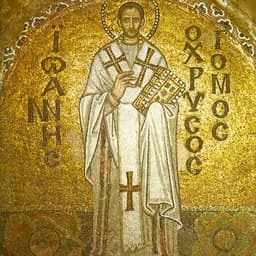
St. John Chrysostom, Homilies on the Gospel of St. Matthew, Homily XXXI (on Matt. ix. 18), section 2 — NPNF1 Vol. 10
Patristic sources
- St. John Chrysostom
- Homilies on Matthew, Hom. 31
- St. Cyril of Alexandria
- Commentary on Luke, on Luke 8
- St. Jerome
- Commentary on Matthew (Catena Aurea)
- Blessed Augustine of Hippo
- On the Harmony of the Evangelists (Catena Aurea)
- St. Hilary of Poitiers
- Commentary on Matthew (Catena Aurea)
- St. Ambrose of Milan
- Exposition of Luke (Catena Aurea)
- St. Gregory the Great
- Morals on the Book of Job (Catena Aurea)
- St. Bede the Venerable
- Catena Aurea on Matthew
Read the sources: Chrysostom on Matthew (CCEL)
The Raising of Jairus's Daughter (Matthew 9:18–26; Mark 5:21–43; Luke 8:40–56)
The texts below are quoted verbatim from public-domain English translations; nothing is paraphrased.
St. John Chrysostom (c. 347–407)
Homilies on the Gospel of Matthew, Homily 31 (on Matthew 9:18–26) Source: trans. in the Nicene and Post-Nicene Fathers, First Series, Vol. 10. Public domain. Full text: https://www.newadvent.org/fathers/200131.htm
On the ruler's terrible affliction, and the deed that overtook the words:
On the ruler's weak faith, corrected beforehand by the woman:
On the word He spoke to that ruler of the grosser sort:
On why He waited for death to come, that the proof of the resurrection might be unmistakable:
St. Cyril of Alexandria (c. 376–444)
Commentary on the Gospel of Luke (by cross-reference, in the sermons on the neighbouring miracles) Source: trans. R. Payne Smith, 1859. Public domain. On the widow's son of Nain (Luke 7): https://www.tertullian.org/fathers/cyril_on_luke_03_sermons_26_38.htm On faith and unbelief (Luke 9): https://www.tertullian.org/fathers/cyril_on_luke_05_sermons_47_56.htm
On Jairus's coming, and the reply that meets the news of death (within his treatment of faith):
On Jairus's daughter set among the proofs of the resurrection (within his sermon on the widow's son of Nain):
St. Jerome (c. 347–420)
As preserved in the Catena Aurea on Matthew. Public domain.
On how, as Christ goes to heal one, another is cured by the way:
On the tense of His word, "hath made thee whole":
On the mockers shut out from the mystery of the revival:
On the synagogue still lying dead, until the fulness of the Gentiles:
Blessed Augustine of Hippo (354–430)
On the Harmony of the Evangelists (De Consensu Evangelistarum) As preserved in the Catena Aurea on Matthew. Public domain.
On how the father looked rather to her being called back to life than to her mere recovery:
On the rule that we must regard a man's meaning, not merely his words:
St. Hilary of Poitiers (c. 310–367)
As preserved in the Catena Aurea on Matthew. Public domain.
On the ruler figuratively understood as the Law:
On the multitude put forth, and the few who are the elect:
St. Ambrose of Milan (c. 339–397)
As preserved in the Catena Aurea on Matthew. Public domain.
On the minstrels and the ancient custom of mourning the dead:
St. Gregory the Great (c. 540–604)
Morals on the Book of Job (Moralia in Iob) As preserved in the Catena Aurea on Matthew. Public domain.
On the crowd of worldly cares that must be banished before the soul can rise:
St. Bede the Venerable (c. 673–735)
As preserved in the Catena Aurea on Matthew. Public domain.
On how she who is dead to men sleeps only before God: