Teaching on Divorce and Marriage
Matt 19:1–12; Mark 10:1–12 · Journey to Jerusalem
Scripture
Matthew 19:1–12
nd it came to pass, that when Jesus had finished these sayings, he departed from Galilee, and came into the coasts of Judaea beyond Jordan; 2And great multitudes followed him; and he healed them there. 3The Pharisees also came unto him, tempting him, and saying unto him, Is it lawful for a man to put away his wife for every cause? 4And he answered and said unto them, Have ye not read, that he which made them at the beginning made them male and female, 5And said, For this cause shall a man leave father and mother, and shall cleave to his wife: and they twain shall be one flesh? 6Wherefore they are no more twain, but one flesh. What therefore God hath joined together, let not man put asunder. 7They say unto him, Why did Moses then command to give a writing of divorcement, and to put her away? 8He saith unto them, Moses because of the hardness of your hearts suffered you to put away your wives: but from the beginning it was not so. 9And I say unto you, Whosoever shall put away his wife, except it be for fornication, and shall marry another, committeth adultery: and whoso marrieth her which is put away doth commit adultery. 10His disciples say unto him, If the case of the man be so with his wife, it is not good to marry. 11But he said unto them, All men cannot receive this saying, save they to whom it is given. 12For there are some eunuchs, which were so born from their mother’s womb: and there are some eunuchs, which were made eunuchs of men: and there be eunuchs, which have made themselves eunuchs for the kingdom of heaven’s sake. He that is able to receive it, let him receive it.
King James Version · public domain
Mateu 19:1–12
dhe Jisuj kur mbaroj këto fjalë, ungrit nga Galilea, edhe erdhi ndë sinorët të Judhesë, përtej Jordhanit; 2Edhe i vanë pas ati shumë gjindje; edhe i shëroj ata atje. 3Edhe erthnë tek ay Farisenjtë dyke ngarë atë, e dyke thënë ati, A ësht’ e udhësë njeriu të lëshonjë gruan’ e ti për çdo farë ngaje? 4Edhe ay upërgjiq e u tha atyre, Nukë keni kënduarë, se ay që bëri ata që ndë kryet të herësë, mashkull edhe femërë i bëri ata, edhe tha, 5“Për këtë punë njeriu dotë lerë t’an’ e t’ëmënë, edhe dotë ngjitetë pas gruas’ së ti, edhe të dy dotë jenë një mish”? kaqë sa nukë janë më dy, po një mish. 6Atë pra që Perëndia e bëri par, njeri letë mos e ndanjë. 7I thon’ ati, Përse pra Moisiu ka porositurë t’i apë njeriu gruasë kartën’ e ndarjesë, edhe t’a lëshonjë? 8U thot’ atyre, Sepse Moisiu për zëmër-ashpërimnë t’uaj u dha juve lejë të lëshoni gratë t’uaj; po ndë kryet të herësë s’ka qenë kështu. 9Edhe po u them juve, se ay që të lëshonjë gruan’ e ti, përveç për punë kurvërie, edhe të martonetë me tjatërë, kurvëron; edhe ay që të martonetë me grua të-lëshuarë, kurvëron. 10Nxënësit’ e ti i thonë, Ndë qoftë kështu pun’ e njeriut me gruanë, nuk’ është mirë të martonetë. 11Edhe ay u thot’ atyre, Nukë munt t’a presënë këtë fjalë të-gjithë, po atyreve që u është dhënë. 12Sepse ka të-dredhurë që kanë lindurë kështu që nga barku i mëmësë; edhe ka të-dredhurë që udrothnë nga njerëzitë; edhe ka të-dredhurë që drothnë vetëhen’ e tyre për mbretërin’ e qiejvet. Ay që munt t’a presë këtë let’a presë.
Kristoforidhi, Dhiata e Re Toskërisht 1879 · zotërim publik
In their own words
But now both by the manner of the creation, and by the manner of lawgiving, He showed that one man must dwell with one woman continually, and never break off from her.
St. John Chrysostom, Homilies on Matthew, Homily 62 (on Matthew 19:4–6)
Patristic sources
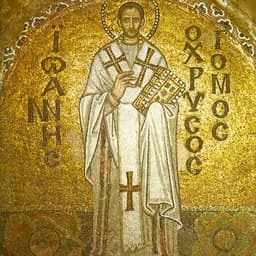
- St. John Chrysostom
- Homilies on the Gospel of Matthew, Hom. 62
- Origen of Alexandria
- Commentary on Matthew, Book XIV
Quoted with care: some of his speculations were condemned in 553; the exegesis here on the tempting question and the one flesh is uncontroversial.
- Theophylact of Ohrid
- Explanation of the Gospel of Mark
His Gospel commentary survives in public-domain English only through the Catena Aurea.
- Blessed Augustine of Hippo
- The City of God, Book XIV
- Against Faustus, Book XIX
Venerated in the East as Blessed; his witness against the Manichaeans confirms that God joined male and female.
- St. Jerome
- Commentary on Matthew
Catena-only in public-domain English.
- St. Bede the Venerable
- Commentary on Mark
His Gospel exegesis survives in public-domain English only through the Catena Aurea.
Read the sources: Chrysostom, Homilies on Matthew, Homily 62 (CCEL) · Origen, Commentary on Matthew, Book XIV (CCEL, ANF 9) · Catena Aurea on Matthew 19 (CCEL) · Catena Aurea on Mark 10 (CCEL)
Teaching on Divorce and Marriage (Matthew 19:1–12; Mark 10:1–12)
The texts below are quoted verbatim from public-domain English translations; nothing is paraphrased.
St. John Chrysostom (c. 347–407)
Homilies on the Gospel of Matthew, Homily 62 (on Matthew 19:1–12) Source: trans. in the Nicene and Post-Nicene Fathers, First Series, Vol. 10. Public domain. Full text: https://www.ccel.org/ccel/schaff/npnf110.iii.LIX.html
On the wisdom of answering, not with a bare prohibition, but from creation:
On one man and one woman, joined to dwell together and never break off:
On "What therefore God hath joined together," and the act that is against both nature and law:
On those who have made themselves eunuchs for the kingdom of heaven's sake:
Origen of Alexandria (c. 185–254)
Commentary on Matthew, Book XIV (on Matthew 19:1–12) Source: trans. in the Ante-Nicene Fathers, Vol. 9. Public domain. Full text: https://www.ccel.org/ccel/schaff/anf09.xvi.ii.vii.xvi.html
On the tempting question, and the teacher who must not be vexed at being tempted:
On the trap laid for Him whichever way He should answer:
On "What God hath joined together, let not man put asunder":
Theophylact of Ohrid (c. 1055–1107)
Explanation of the Gospel of Mark (on Mark 10:1–12) As preserved in the Catena Aurea on Mark. Public domain. Full text: https://www.ccel.org/ccel/aquinas/catena2.iii.x.html
On why He came to the borders of Judaea as the Passion drew near:
On the question set as a precipice on either side, which Very Wisdom evades:
Blessed Augustine of Hippo (354–430)
The City of God and Against Faustus (on Matthew 19:5–8) As preserved in the Catena Aurea on Matthew. Public domain. Full text: https://www.ccel.org/ccel/aquinas/catena1.ii.xix.html
On the one flesh, drawn from the woman taken out of the man's side:
On the books of Moses themselves proving that a wife may not be put away:
St. Jerome (c. 347–420)
Commentary on Matthew (on Matthew 19:3–11) As preserved in the Catena Aurea on Matthew. Public domain. Full text: https://www.ccel.org/ccel/aquinas/catena1.ii.xix.html
On how He evades the snare by Holy Writ and the law of nature:
On God's joining, which man may not put asunder but God only:
On "save they to whom it is given" — not fate, but grace sought from God:
St. Bede the Venerable (c. 673–735)
Commentary on Mark (on Mark 10:6–12) As preserved in the Catena Aurea on Mark. Public domain. Full text: https://www.ccel.org/ccel/aquinas/catena2.iii.x.html
On "male and female," not "females," binding man to the one wife:
On God alone, and not man, being able to separate what He conjoined:
On the one carnal cause and the one spiritual cause for parting: