The Annunciation to the Virgin Mary
Luke 1:26–38 · Infancy and childhood
Scripture
Luke 1:26–38
nd in the sixth month the angel Gabriel was sent from God unto a city of Galilee, named Nazareth, 27To a virgin espoused to a man whose name was Joseph, of the house of David; and the virgin’s name was Mary. 28And the angel came in unto her, and said, Hail, thou that art highly favoured, the Lord is with thee: blessed art thou among women. 29And when she saw him, she was troubled at his saying, and cast in her mind what manner of salutation this should be. 30And the angel said unto her, Fear not, Mary: for thou hast found favour with God. 31And, behold, thou shalt conceive in thy womb, and bring forth a son, and shalt call his name JESUS. 32He shall be great, and shall be called the Son of the Highest: and the Lord God shall give unto him the throne of his father David: 33And he shall reign over the house of Jacob for ever; and of his kingdom there shall be no end. 34Then said Mary unto the angel, How shall this be, seeing I know not a man? 35And the angel answered and said unto her, The Holy Ghost shall come upon thee, and the power of the Highest shall overshadow thee: therefore also that holy thing which shall be born of thee shall be called the Son of God. 36And, behold, thy cousin Elisabeth, she hath also conceived a son in her old age: and this is the sixth month with her, who was called barren. 37For with God nothing shall be impossible. 38And Mary said, Behold the handmaid of the Lord; be it unto me according to thy word. And the angel departed from her.
King James Version · public domain
Lluka 1:26–38
dhe mbë të-gjashtinë muaj, ëngjëlli Gavriil udërgua prej Perëndisë ndë një qytet të Galilesë, që e kishte emërinë Nazaret, 27Te një virgjëreshë, që ishte vluarë me një burrë, që quhej Josif, prej shtëpis’ së Dhavidhit; edhe emër’ i virgjëreshësë ishte Mariam. 28Edhe ëngjëlli kur hyri tek ajo, tha, gëzohu, o e-mbushurë me hire; Zoti është bashkë me ty; e-bekuarë je ti ndë mest të gravet. 29Edhe ajo, kur pa, utrumbullua për falën’ e ati; edhe mendonej ç’dotë jetë vallë këta të-përshëndoshurë? 30Edhe ëngjëlli i tha, Mos utrëmp, Mariamë; sepse gjete hir përanë Perëndisë. 31Edhe na tek dotë mbarsesh ndë bark, edhe dotë pjellç djalë, edhe dot’j’a quanjç emërinë Jisu. 32Ky dotë jet’ i-math, edhe Bir i të-Lartit dotë quhetë; edhe Zoti Perëndia dot’i apë ati fron’ e Dhavidhit, atit t’ati; 33Edhe dotë mbretëronjë ndë shtëpit të Jakovit ndë jetët të jetëvet, edhe mbretëria e ati nukë dotë ketë të-mbaruarë. 34Edhe Mariama i tha ëngjëllit, Qysh dotë jetë këjo punë, sepse unë burrë s’njoh? 35Edhe ëngjëlli upërgjeq e i tha, Frym’ e-Shënjtëruarë dotë vinjë mbë ty, edhe fuqi’ e të-Lartit dotë të hiesonjë; përandaj edhe ajo foshnj’ e-shënjtëruarë që len prej teje dotë quhetë Bir Perëndie. 36Edhe na Elisaveta, far’ e fisi yt, edhe ajo umbars me bir ndë pleqërit të saj, edhe ky muaj ësht’ i-gjashti i asaj që quhetë beronjë. 37Sepse s’ka punë që të jet’ e-pamundurë te Perëndia. 38Edhe Mariama tha, Na shërbëtoreja e Zotit; ubëftë mbë mua pas fjalësë s’ate. Edhe ëngjëlli iku prej asaj.
Kristoforidhi, Dhiata e Re Toskërisht 1879 · zotërim publik
In their own words
Far different then to the news formerly addressed to the woman, is the announcement now made to the Virgin. In the former, the cause of sin was punished by the pains of childbirth; in the latter, through gladness, sorrow is driven away.
St. Gregory of Nyssa, as preserved in the Catena Aurea on Luke (on Luke 1:28)
Patristic sources
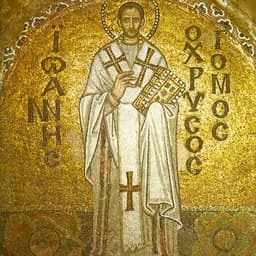
- St. John Chrysostom
- Homilies (as preserved in the Catena Aurea on Luke)
- St. Cyril of Alexandria
- As preserved in the Catena Aurea on Luke
- St. Basil the Great
- As preserved in the Catena Aurea on Luke
- St. Gregory of Nyssa
- As preserved in the Catena Aurea on Luke
- St. Gregory Thaumaturgus
- The Third Homily on the Annunciation to the Holy Virgin Mary (ANF Vol. 6)
The four homilies on the Annunciation are printed among his works in the Ante-Nicene Fathers, Vol. 6, but the editors class them under "Dubious or Spurious Writings"; the attribution is traditional and the authorship uncertain.
- Blessed Augustine of Hippo
- On Holy Virginity (as preserved in the Catena Aurea on Luke)
Venerated in the East as Blessed.
- St. Ambrose of Milan
- Exposition of the Gospel according to Luke (as preserved in the Catena Aurea on Luke)
- St. Gregory the Great
- As preserved in the Catena Aurea on Luke
- St. Bede the Venerable
- As preserved in the Catena Aurea on Luke
Read the sources: Catena Aurea on Luke — Oxford ed., archive.org scan · Gregory Thaumaturgus, Homilies on the Annunciation — ANF Vol. 6 (CCEL)
The Annunciation to the Virgin Mary (Luke 1:26–38)
The texts below are quoted verbatim from public-domain English translations; nothing is paraphrased.
St. John Chrysostom (c. 347–407)
Homilies, as preserved in the Catena Aurea on Luke (on Luke 1:26–35) Trans. J. H. Newman, Oxford 1841–1845. Public domain. Full text: https://archive.org/details/CatenaAureaNewEdV4
On the angel appearing before the conception, in visible shape:
On "How shall this be, seeing I know not a man?":
On the Sun of righteousness taking a pure body from the Virgin:
St. Cyril of Alexandria (c. 376–444)
As preserved in the Catena Aurea on Luke (on Luke 1:31–32) Trans. J. H. Newman, Oxford 1841–1845. Public domain. Full text: https://archive.org/details/CatenaAureaNewEdV4
On "shalt call his name JESUS":
On the throne of David and the descent of Christ:
St. Basil the Great (c. 330–379)
As preserved in the Catena Aurea on Luke (on Luke 1:34–35) Trans. J. H. Newman, Oxford 1841–1845. Public domain. Full text: https://archive.org/details/CatenaAureaNewEdV4
On "seeing I know not a man":
On "that holy thing which shall be born of thee", and St. Paul's word "born of a woman":
St. Gregory of Nyssa (c. 335–395)
As preserved in the Catena Aurea on Luke (on Luke 1:28–35) Trans. J. H. Newman, Oxford 1841–1845. Public domain. Full text: https://archive.org/details/CatenaAureaNewEdV4
On "Hail", and how the greeting reverses the sentence once spoken to Eve:
On the womb made the receptacle of the Holy Spirit:
St. Gregory Thaumaturgus (c. 213–270)
The Third Homily on the Annunciation to the Holy Virgin Mary (on Luke 1:26–27) Ascribed to Gregory Thaumaturgus and printed among his works in the Ante-Nicene Fathers, Vol. 6; the editors there class it among the "Dubious or Spurious Writings," so its authorship is uncertain. Trans. in the Ante-Nicene Fathers, Vol. 6, 1886. Public domain. Full text: https://www.ccel.org/ccel/schaff/anf06.iii.iv.v.iii.html
On the angel sent to the Virgin, that the serpent might no more deceive the woman:
On the sending of Gabriel:
Blessed Augustine of Hippo (354–430)
On Holy Virginity, as preserved in the Catena Aurea on Luke (on Luke 1:27) Trans. J. H. Newman, Oxford 1841–1845. Public domain. Full text: https://archive.org/details/CatenaAureaNewEdV4
On "To a virgin", and why Christ was born of a virgin:
St. Ambrose of Milan (c. 339–397)
Exposition of the Gospel according to Luke, as preserved in the Catena Aurea on Luke (on Luke 1:27–38) Trans. J. H. Newman, Oxford 1841–1845. Public domain. Full text: https://archive.org/details/CatenaAureaNewEdV4
On why she was both espoused and a virgin:
On "Behold the handmaid of the Lord; be it unto me according to thy word":
St. Gregory the Great (c. 540–604)
As preserved in the Catena Aurea on Luke (on Luke 1:35–38) Trans. J. H. Newman, Oxford 1841–1845. Public domain. Full text: https://archive.org/details/CatenaAureaNewEdV4
On "the power of the Highest shall overshadow thee", and the two natures signified:
On the Virgin as both handmaid and mother of the Lord:
St. Bede the Venerable (c. 673–735)
As preserved in the Catena Aurea on Luke (on Luke 1:32–33) Trans. J. H. Newman, Oxford 1841–1845. Public domain. Full text: https://archive.org/details/CatenaAureaNewEdV4
On "the Son of the Highest" and "his father David", against Nestorius: