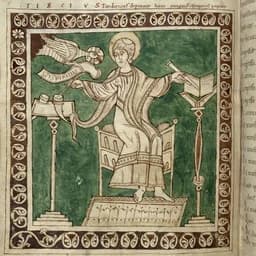
All entriesdiscourse

The Ascension

Luke 24:50–53; Acts 1:9–11 · Post-Resurrection

Luke 24:50–53

nd he led them out as far as to Bethany, and he lifted up his hands, and blessed them. 51And it came to pass, while he blessed them, he was parted from them, and carried up into heaven. 52And they worshipped him, and returned to Jerusalem with great joy: 53And were continually in the temple, praising and blessing God. Amen.

King James Version · public domain

Lluka 24:50–53

astaj i nxori jashtë gjer ndë Vithani; edhe ngriti duart’ e tia e i bekoj. 51Edhe ay dyke bekuar’ ata unda nga ata, edhe birej lart ndë qiellt. 52Edhe ata si i ufalnë ati, ukthyenë ndë Jerusalim me gëzim të-math. 53Edhe ishinë gjithënjë ndë hieroret, dyke lavduruarë e dyke bekuarë Perëndinë. Amin.

Kristoforidhi, Dhiata e Re Toskërisht 1879 · zotërim publik

Summary

Christ ascends in the flesh, and the wonder the Fathers return to is that He carries human nature with Him to the throne of God: what fell in Adam is now seated at the right hand of the Father. St. John of Damascus draws this out plainly: it is the deified humanity that is enthroned, not laid aside but glorified, so that what is lifted up is the firstfruits of our own destiny. The same flesh that was nailed and buried is now above the heavens, and our nature, once exiled from paradise, is welcomed into the presence of God.

Reading Luke 24, St. Cyril of Alexandria sees in the Ascension the reconciliation of earth and heaven: Christ goes up as firstfruits of the race, opening a way that had been shut, so that the things on earth and the things in heaven are gathered again into one. St. John Chrysostom presses the marvel further: the nature the angels could once scarcely look upon is now offered to the Father and received, and so the long enmity is ended and peace is made. He notes too the gentleness of the parting, for in Luke the Lord ascends while blessing His disciples, who return full of joy.

The angels' word that He will come again "in like manner" binds the Ascension to the hope of His return: He who went up visibly in the flesh will come again visibly. St. Gregory the Theologian sets the day within the whole economy of the feasts, the going up that prepares the coming down of the Spirit at Pentecost; the Lord withdraws His visible presence that the Comforter may be sent and the Church clothed with power. So the economy of salvation reaches its summit: our nature enthroned, and the promise given that where the Head has gone the body will follow.

In their own words

Moreover, His ascent from earth to heaven, and again, His descent from heaven to earth, are manifestations of the energies of His circumscribed body.

St. John of Damascus, An Exact Exposition of the Orthodox Faith, Book IV, Chapter I (Concerning what followed the Resurrection); NPNF2 Vol. 9

The Ascension (Luke 24:50–53; Acts 1:9–11)

Public-Domain Patristic Commentary

Forty days after the Resurrection, the Lord brought his disciples out toward Bethany, on the Mount of Olives. Luke closes his Gospel with the scene: "And he led them out as far as to Bethany, and he lifted up his hands, and blessed them. And it came to pass, while he blessed them, he was parted from them, and carried up into heaven. And they worshipped him, and returned to Jerusalem with great joy." Luke opens the Acts of the Apostles with the same event, told more fully: "While they beheld, he was taken up; and a cloud received him out of their sight. And while they looked stedfastly toward heaven as he went up, behold, two men stood by them in white apparel; which also said, Ye men of Galilee, why stand ye gazing up into heaven? this same Jesus, which is taken up from you into heaven, shall so come in like manner as ye have seen him go into heaven."

This is the crown of the Lord's earthly work and the close of the forty days. The Fathers gather its meaning under several heads. They dwell on the lifting of the hands in blessing, the priestly farewell; on the cloud, not a borrowed chariot like Elijah's but the very symbol of the divine glory, and on the Lord ascending by his own power; on the angels who interpret the sight and turn the disciples from gazing to mission, with the promise that he will come again as he went; on the session at the right hand, understood not as a place for human limbs but as the power and blessedness of God; and above all on the exaltation of our own nature, for it is human flesh that is carried above the angels and seated with the Father, so that the Ascension of the Head is the lifting up of the whole Body. Gathered below are five Fathers, two from the East and three from the West, each quoted verbatim from a public-domain translation. Because the event is told twice by Luke and briefly by Mark, the Fathers are gathered across these accounts, as the note at the end explains.


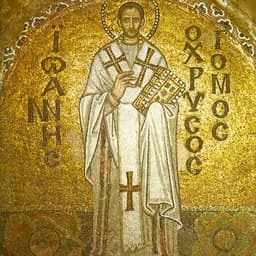
St. John Chrysostom (c. 347–407)

From his Homilies on the Acts of the Apostles (Homily 2, on Acts 1:9–11), NPNF translation. Public domain.

On the most stupendous thing the disciples learned, that flesh is enthroned:

they learned ... that when He ascended He sat on the right hand of God; and what is still more stupendous, that Flesh is seated in heaven, and adored by Angels, and that He will come again.

On the Ascension being seen, where the Resurrection itself was not:

Not while they beheld did He rise from the dead, but while they beheld, He was taken up ... in the Resurrection they saw the end, but not the beginning, and in the Ascension they saw the beginning, but not the end.

On why a cloud, and not a fiery chariot, received him:

But why did a cloud receive Him? This too was a sure sign that He went up to Heaven. Not fire, as in the case of Elijah, nor fiery chariot, but a cloud received Him; which was a symbol of Heaven, as the Prophet says; Who makes the clouds His chariot.

On the angels who turned their gaze to the promise of his return:

behold, two men stood by them in white apparel; which also said, You men of Galilee, why stand ye gazing up into heaven? This same Jesus, which is taken up from you into heaven ... shall ... come in like manner as you have seen Him going into heaven.


St. Cyril of Jerusalem (c. 313–386)

From his Catechetical Lectures (Lecture 14, on the Resurrection and Ascension), NPNF translation. Public domain.

On the Lord ascending by his own power, where the prophets were carried:

For when they speak against the ascension of the Saviour, as being impossible, remember the account of the carrying away of Habakkuk: for if Habakkuk was transported by an Angel, being carried by the hair of his head, much rather was the Lord of both Prophets and Angels, able by His own power to make His ascent into the Heavens on a cloud from the Mount of Olives.

On the descent to Bethlehem and the ascent from Olivet, and the witnesses:

For from heaven He descended to Bethlehem, but to heaven He ascended from the Mount of Olives; at the former place beginning His conflicts among men, but in the latter, crowned after them ... you have also the place of the Ascension towards the east; you have also for witnesses the Angels which there bore testimony; and the cloud on which He went up.

On the eternal session, not gained as a reward after the Ascension:

neither let us endure those who falsely say, that it was after His Cross and Resurrection and Ascension into heaven, that the Son began to sit on the right hand of the Father. For the Son gained not His throne by advancement; but throughout His being (and His being is by an eternal generation) He also sits together with the Father.


St. Leo the Great (c. 400–461)

From his Sermons on the Lord's Ascension (Sermons 73 and 74), NPNF translation. Public domain.

On human nature carried above the angels to the throne of the Father:

great and unspeakable was their cause for joy, when in the sight of the holy multitude, above the dignity of all heavenly creatures, the Nature of mankind went up, to pass above the angels' ranks and to rise beyond the archangels' heights, and to have Its uplifting limited by no elevation until, received to sit with the Eternal Father, It should be associated on the throne with His glory, to Whose Nature It was united in the Son.

On the Ascension as the uplifting of the whole Body:

Since then Christ's Ascension is our uplifting, and the hope of the Body is raised, whither the glory of the Head has gone before, let us exult, dearly-beloved, with worthy joy and delight in the loyal paying of thanks.

On gaining through Christ more than was lost through the devil:

For today not only are we confirmed as possessors of paradise, but have also in Christ penetrated the heights of heaven, and have gained still greater things through Christ's unspeakable grace than we had lost through the devil's malice. For us, whom our virulent enemy had driven out from the bliss of our first abode, the Son of God has made members of Himself and placed at the right hand of the Father.

On sight giving way to faith when the visible became sacramental:

And so that which till then was visible of our Redeemer was changed into a sacramental presence, and that faith might be more excellent and stronger, sight gave way to doctrine, the authority of which was to be accepted by believing hearts enlightened with rays from above.

On the apostles' fear turned wholly into joy:

the blessed Apostles themselves also, who ... had yet been panic-stricken by the horrors of the Lord's Passion and had not accepted the truth of His resurrection without hesitation, made such progress after the Lord's Ascension that everything which had previously filled them with fear was turned into joy. For they had lifted the whole contemplation of their mind to the Godhead of Him that sat at the Father's right hand.


Blessed Augustine of Hippo (354–430)

From his exposition of the Creed, as compiled in the Catena Aurea on Mark (on Mark 16:19). Public domain.

On what it means that he sat at the right hand of God:

Let us not therefore understand this sitting as though He were placed there in human limbs, as if the Father sat on the left, the Son on the right, but by the right hand itself we understand the power which He as man received from God, that He should come to judge, who first had come to be judged.

On the right hand as the blessedness where there is no misery:

believe that Christ dwells at the right hand of God the Father. For He is blessed and dwells in blessedness, which is called the right hand of the Father; for all is right hand there, since there is no misery.


St. Gregory the Great (c. 540–604)

From his Homilies on the Gospels, as compiled in the Catena Aurea on Mark (on Mark 16:19). Public domain.

On the Lord borne above all by his own power, unlike Elijah's chariot:

But our Redeemer, as we read, was not carried up by a chariot, not by angels, because He who had made all things was borne over all by His own power.


Note on sources and other Fathers

The Ascension is unusual in being narrated twice by the same writer, at the end of Luke's Gospel and again at the opening of his Acts, and touched briefly by Mark, so the Fathers below are gathered across those accounts. Chrysostom is quoted from his Homily 2 on Acts, where he dwells on the marvel that flesh is now enthroned and adored, on the cloud as the symbol of heaven rather than a chariot like Elijah's, and on the angels who turn the gazing disciples toward the promise of the Lord's return. Cyril of Jerusalem, from his fourteenth Catechetical Lecture, sets the Ascension among its prophecies and against the lesser raptures of Habakkuk and Elijah, and guards the truth that the Son's session at the right hand is eternal, not a reward won after the Cross. Leo the Great, the great Western preacher of this feast, gives the theme that binds the rest: that human nature itself is carried above the angels, so that the Ascension of the Head is the uplifting of the Body, and that sight gave way to a stronger faith. Augustine and Gregory speak to the session at the right hand, Augustine that the "right hand" is not a bodily place but the power and blessedness of God, and Gregory that the Lord, unlike Elijah in his chariot, was borne above all things by his own power.

Two honest notes on the sourcing. First, when I introduced this item I named Augustine and Gregory, and both are here, but not from where a reader might expect: Augustine's beloved Ascension sermon, "let our hearts ascend with him," survives chiefly in modern translations that remain under copyright, so I have used instead his public-domain comment on the session at the right hand, preserved in the Catena Aurea on Mark; and Gregory's line on the Ascension likewise comes from the Catena Aurea on Mark, his Gospel Homilies having no public-domain English translation of their own. Second, as with the Resurrection, Cyril of Alexandria's commentary on Luke is fragmentary at its very end, so the Alexandrian voice gives way here to Cyril of Jerusalem, whose catechesis on the Ascension is whole and rich. Quotations are verbatim from the editions named in each attribution.

Patristic sources