The Baptism of Jesus
Matt 3:13–17; Mark 1:9–11; Luke 3:21–22 · Beginning of the ministry
Scripture
Matthew 3:13–17
hen cometh Jesus from Galilee to Jordan unto John, to be baptized of him. 14But John forbad him, saying, I have need to be baptized of thee, and comest thou to me? 15And Jesus answering said unto him, Suffer it to be so now: for thus it becometh us to fulfil all righteousness. Then he suffered him. 16And Jesus, when he was baptized, went up straightway out of the water: and, lo, the heavens were opened unto him, and he saw the Spirit of God descending like a dove, and lighting upon him: 17And lo a voice from heaven, saying, This is my beloved Son, in whom I am well pleased.
King James Version · public domain
Mateu 3:13–17
tëhere Jisuj vjen nga Galilea ndë Jordhant te Joani, që të pagëzonetë prej ati. 14Po Joani e ndalonte atë, dyke thënë, Unë kam nevojë të pagëzonem prej teje, e ti vjen tek unë? 15Edhe Jisuj upërgjeq e i tha, Le tashi; sepse kështu gjan neve të mbushmë ç’do drejtëri. Atëhere e le atë. 16Edhe Jisuj si upagëzua për-një-herë dolli nga ujët; edhe ja tek uhapnë qiejtë, edhe pa Frymën’ e Perëndisë dyke zbriturë possi pëllump, e dyke ardhurë mbi atë. 17Edhe ja një zë nga qiejtë që thoshte, Ky është biri im i-dashurë, që e kam pëlqyerë.
Kristoforidhi, Dhiata e Re Toskërisht 1879 · zotërim publik
In their own words
And the Spirit also again came down as at a second commencement of our race: and upon Christ first, Who received it not so much for His own sake as for ours: for by Him and in Him are we enriched with all things.
St. Cyril of Alexandria, Commentary on Luke, Sermon 11 (on Luke 3:21–22)
Patristic sources
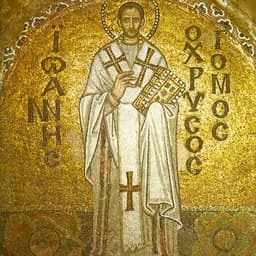
- St. John Chrysostom
- Homilies on Matthew, Hom. 12
- St. Cyril of Alexandria
- Commentary on Luke, Sermon 11
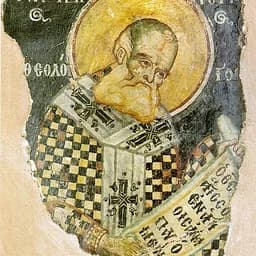
- St. Gregory Nazianzen
- Oration 39, On the Holy Lights
The Theologian; his Oration on the Holy Lights is the classic Eastern homily on the Theophany.
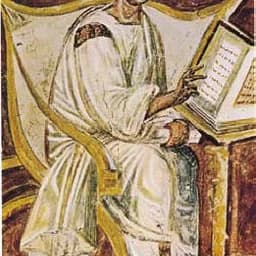
- Blessed Augustine of Hippo
- Tractates on the Gospel of John
- On the Trinity
Venerated in the East as Blessed; quoted here through the Catena Aurea's condensation of his works.
- St. Jerome
- Commentary on Matthew
- St. Hilary of Poitiers
- Commentary on Matthew
Read the sources: Chrysostom on Matthew, Homily 12 (CCEL) · Cyril on Luke, Sermon 11 (tertullian.org) · Gregory Nazianzen, Oration 39 On the Holy Lights (CCEL) · Catena Aurea on Matthew 3 (CCEL)
The Baptism of Jesus (Matthew 3:13–17)
The texts below are quoted verbatim from public-domain English translations; nothing is paraphrased.
St. John Chrysostom (c. 347–407)
Homilies on the Gospel of Matthew, Homily 12 (on Matthew 3:13–17) Source: trans. in the Nicene and Post-Nicene Fathers, First Series, Vol. 10. Public domain. Full text: https://www.ccel.org/ccel/schaff/npnf110.iii.XII.html
On the Lord's word to the Baptist, "thus it becometh," rather than "thus it is just":
On why the heavens were opened at the baptism:
On why the Spirit appeared in the fashion of a dove:
On the dove of Noah, now the herald of a greater deliverance:
St. Cyril of Alexandria (c. 376–444)
Commentary on the Gospel of Luke, Sermon 11 (on Luke 3:21–22) Source: trans. R. Payne Smith, Library of Fathers, 1859. Public domain. Full text: https://www.tertullian.org/fathers/cyril_on_luke_01_sermons_01_11.htm
On the sinless One numbered among sinners, fulfilling all righteousness for our sake:
On Christ beginning the work Himself, and praying after His baptism:
On the Spirit descending upon Christ first, as at a second beginning of our race:
St. Gregory Nazianzen (c. 329–390)
Oration 39, On the Holy Lights (on Matthew 3:16–17) Source: trans. in the Nicene and Post-Nicene Fathers, Second Series, Vol. 7. Public domain. Full text: https://www.ccel.org/ccel/schaff/npnf207.iii.xxii.html
On Jesus going up from the water and opening the heaven that Adam had shut:
On the Spirit bearing witness to His Godhead, and the dove that of old proclaimed the end of the flood:
Blessed Augustine of Hippo (354–430)
Tractates on the Gospel of John and On the Trinity (on Matthew 3:13–17) As preserved in the Catena Aurea on Matthew. Public domain. Full text: https://www.ccel.org/ccel/aquinas/catena1.ii.iii.html
On the Lord baptized by His servant (Tractate 5 on John):
On the dove, a visible appearance created for the moment (On the Trinity, Book II):
On the Father's voice, "in whom I am well pleased" (Tractate 14 on John):
St. Jerome (c. 347–420)
Commentary on Matthew (on Matthew 3:13–17) As preserved in the Catena Aurea on Matthew. Public domain. Full text: https://www.ccel.org/ccel/aquinas/catena1.ii.iii.html
On the word "now," and the baptism John must yet receive from Christ:
On the mystery of the Trinity shown in the Jordan:
On the dove resting upon the head of Jesus:
St. Hilary of Poitiers (c. 310–367)
Commentary on Matthew (on Matthew 3:13–17) As preserved in the Catena Aurea on Matthew. Public domain. Full text: https://www.ccel.org/ccel/aquinas/catena1.ii.iii.html
On John forbidding Him as God, and being taught to baptize Him as man:
On the water, the Spirit, and the Father's voice given also to us: