The Birth and Naming of John the Baptist
Luke 1:57–66 · Infancy and childhood
Scripture
Luke 1:57–66
ow Elisabeth’s full time came that she should be delivered; and she brought forth a son. 58And her neighbours and her cousins heard how the Lord had shewed great mercy upon her; and they rejoiced with her. 59And it came to pass, that on the eighth day they came to circumcise the child; and they called him Zacharias, after the name of his father. 60And his mother answered and said, Not so; but he shall be called John. 61And they said unto her, There is none of thy kindred that is called by this name. 62And they made signs to his father, how he would have him called. 63And he asked for a writing table, and wrote, saying, His name is John. And they marvelled all. 64And his mouth was opened immediately, and his tongue loosed, and he spake, and praised God. 65And fear came on all that dwelt round about them: and all these sayings were noised abroad throughout all the hill country of Judaea. 66And all they that heard them laid them up in their hearts, saying, What manner of child shall this be! And the hand of the Lord was with him.
King James Version · public domain
Lluka 1:57–66
dhe Elisavetës’ i umbush koha për të pjellë; edhe polli djalë. 58Edhe fqinjt’ e farëfisasit’ e asaj dëgjuanë, se Zoti madhëroj përdëllimn’ e ti tek ajo; edhe gëzoneshinë bashkë me atë. 59Edhe mbë të-tettënë ditë erdhe, që të rrethpresënë djalënë, edhe e quaninë Zahari, mb’emërit të t’et. 60Po e ëma upërgjeq e tha, Jo, po dotë quhetë Joan. 61Edhe ata i than’ asaj, Se s’ka ndonjë ndë fist t’ënt që të quhetë me këtë emërë. 62Edhe bëninë me shënja t’et t’ati, ç’emërë donte t’i epetë ati. 63Edhe ay kërkoj një dërrasë të-shkruari, edhe shkroj, dyke thënë, Joan ësht’ emër’ i ati. Edhe të-gjith’ uçuditnë, 64Edhe për-një-here u hap goj’ e ati edhe gjuh’ e ati; edhe fliste dyke bekuarë Perëndinë. 65Edhe ra frikë mbë gjith’ ata që rrininë rrotull’ atyre. Edhe të-gjitha këto fjalë fliteshinë ndëpër gjithë malësit të Judhësë. 66Edhe gjith’ ata që i dëgjuanë i vunë këto ndë zëmërat të tyre, dyke thënë, Vallë ç’dotë jetë ky djalë? Edhe dor’ e Zotit ishte bashkë me atë.
Kristoforidhi, Dhiata e Re Toskërisht 1879 · zotërim publik
In their own words
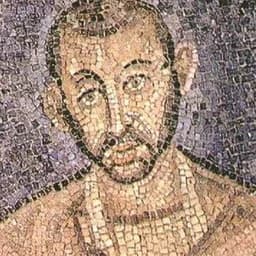
Let us then also believe, in order that our tongue, which has been bound by the chains of unbelief, may be loosed by the voice of reason.
St. Ambrose of Milan, Exposition of the Gospel of Luke (Catena Aurea)
Patristic sources
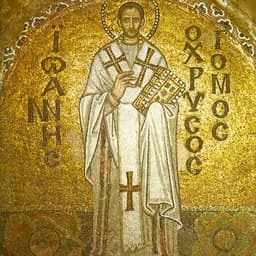
- St. John Chrysostom
- Homilies as preserved in the Catena Aurea on Luke (on Luke 1:57–64)
- Theophylact of Ohrid
- Explanation of Luke, as preserved in the Catena Aurea on Luke (on Luke 1:63–66)
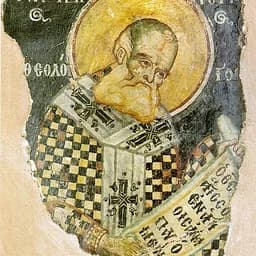
- St. Gregory the Theologian
- As preserved in the Catena Aurea on Luke (on Luke 1:64)
St. Gregory Nazianzen; heading uses the Nazianzen form, both alias-resolve to the same saint.
- Origen of Alexandria
- As preserved in the Catena Aurea on Luke (on Luke 1:63)
Quoted with care; some of his later speculations were condemned in 553, but this etymological note stands within the received tradition.
- St. Ambrose of Milan
- Exposition of the Gospel of Luke, as preserved in the Catena Aurea on Luke (on Luke 1:57–64)
- St. Bede the Venerable
- As preserved in the Catena Aurea on Luke (on Luke 1:59–66)
Read the sources: Catena Aurea on Luke, ch. 1 (isidore.co)
The Birth and Naming of John the Baptist (Luke 1:57–66)
The texts below are quoted verbatim from public-domain English translations; nothing is paraphrased.
St. John Chrysostom (c. 347–407)
As preserved in the Catena Aurea on Luke. Public domain. Full text: https://isidore.co/aquinas/english/CALuke.htm
On why the Lord kept back the delivery of Elisabeth:
On the circumcision that ceased through Christ, John being circumcised first:
On the meaning of the name John:
Theophylact of Ohrid (c. 1055–1107)
As preserved in the Catena Aurea on Luke. Public domain. Full text: https://isidore.co/aquinas/english/CALuke.htm
On the wonder that both parents agreed upon a name found in no kinsman:
On why these things were ordained:
St. Gregory Nazianzen (c. 329–390)
As preserved in the Catena Aurea on Luke. Public domain. Full text: https://isidore.co/aquinas/english/CALuke.htm
On the birth of John breaking the silence of Zacharias:
Origen of Alexandria (c. 185–254)
As preserved in the Catena Aurea on Luke. Public domain. Full text: https://isidore.co/aquinas/english/CALuke.htm
On the names Zacharias and John:
St. Ambrose of Milan (c. 339–397)
As preserved in the Catena Aurea on Luke. Public domain. Full text: https://isidore.co/aquinas/english/CALuke.htm
On the fullness of time reserved for the birth of the righteous:
On Elisabeth naming the child by the same Spirit that named him to the Angel:
On the loosing of the tongue that unbelief had bound:
St. Bede the Venerable (c. 673–735)
As preserved in the Catena Aurea on Luke. Public domain. Full text: https://isidore.co/aquinas/english/CALuke.htm
On John's birth as the beginning of the grace of the New Covenant:
On the fore-running signs that prepare the way for the forerunner: