The Calling of the First Disciples
John 1:35–42 · Beginning of the ministry
Scripture
John 1:35–42
gain the next day after John stood, and two of his disciples; 36And looking upon Jesus as he walked, he saith, Behold the Lamb of God! 37And the two disciples heard him speak, and they followed Jesus. 38Then Jesus turned, and saw them following, and saith unto them, What seek ye? They said unto him, Rabbi, (which is to say, being interpreted, Master,) where dwellest thou? 39He saith unto them, Come and see. They came and saw where he dwelt, and abode with him that day: for it was about the tenth hour. 40One of the two which heard John speak, and followed him, was Andrew, Simon Peter’s brother. 41He first findeth his own brother Simon, and saith unto him, We have found the Messias, which is, being interpreted, the Christ. 42And he brought him to Jesus. And when Jesus beheld him, he said, Thou art Simon the son of Jona: thou shalt be called Cephas, which is by interpretation, A stone.
King James Version · public domain
Joani 1:35–42
dë të-nesërmet përsëri Joani ishte dyke ndënjurë, edhe dy prej nxënëset të ti; 36Edhe kur shtyri sytë e pa Jisunë dyke ecurë, thotë, Na Qëngji i Perëndisë. 37Edhe të dy nxënësitë dëgjuanë atë dyke folurë, edhe vanë pas Jisujt. 38Edhe Jisuj kur ukthye, edhe pa ata dyke vaturë pas ati, u thot’ atyre, Ç’kërkoni? Edhe ata i thanë, Ravvi, (që e-kthyerë do me thënë, Mësonjës,) ku e ke të-ndënjuritë? 39U thot’ atyre, Ejani edhe shihni. Erthnë edhe panë ku e kishte të-ndënjuritë; edhe mbetnë përan’ ati atë ditë; edhe ora ishte sindonja dhjetë. 40Andhreu, i vëllaj i Simon Pjetrit, ishte njëri nga ata të dy që dëgjuanë prej Joanit për atë, edhe vanë pas ati. 41Ky më përpara gjen të vëllan’ e ti Simoninë, edhe i thotë, gjetmë Messinë, që e-kthyerë domethënë Krishti. 42Edhe e pruri te Jisuj. Edhe Jisuj shtyri sytë mb’atë, edhe tha, Ti je Simoni, i bir’ i Jonajt; ti dotë quhesh Qifa, që e-kthyerë domethënë Pjetër (gur).
Kristoforidhi, Dhiata e Re Toskërisht 1879 · zotërim publik
In their own words
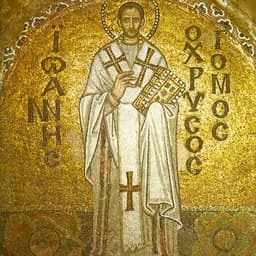
Andrew, after having tarried with Jesus and learned what He did, kept not the treasure to himself, but hastens and runs quickly to his brother, to impart to him of the good things which he had received.
St. John Chrysostom, Homilies on the Gospel of John, Homily 19 (on John 1:41–42)
Patristic sources
- St. John Chrysostom
- Homilies on the Gospel of John, Hom. 18–19
- St. Cyril of Alexandria
- Commentary on the Gospel of John, Book 2
- Theophylact of Ohrid
- Explanation of the Gospel of John
His Gospel exposition survives in public-domain English only through the Catena Aurea.
- Origen of Alexandria
- Commentary on the Gospel of John
Quoted with care; some of his speculations were condemned in 553. Here preserved through the Catena Aurea.
- Blessed Augustine of Hippo
- Tractates on the Gospel of John, Tractate 7
Venerated in the East as Blessed; his Johannine tractates are cited in later Byzantine catenae.
- St. Bede the Venerable
- Commentary on the Gospel of John
His Gospel exegesis survives in public-domain English only through the Catena Aurea.
Read the sources: Chrysostom on John, Homily 18 (CCEL) · Chrysostom on John, Homily 19 (CCEL) · Cyril of Alexandria on John, Book 2 (tertullian.org) · Augustine, Tractate 7 on John (CCEL) · Catena Aurea on John (isidore.co)
The Calling of the First Disciples (John 1:35–42)
The texts below are quoted verbatim from public-domain English translations; nothing is paraphrased.
St. John Chrysostom (c. 347–407)
Homilies on the Gospel of John, Homilies 18–19 (on John 1:35–42) Source: trans. in the Nicene and Post-Nicene Fathers, First Series, Vol. 14. Public domain. Full text: https://www.ccel.org/ccel/schaff/npnf114/npnf114.iv.xx.html
On the Baptist, the friend of the Bridegroom, who gives his disciples over to Christ:
On "What seek ye?", and the good resolution that God meets when once it begins:
On Andrew, who kept not the treasure to himself:
On the naming of Simon, where the present guarantees the future:
On why the full word of the rock is withheld until a later hour:
St. Cyril of Alexandria (c. 376–444)
Commentary on the Gospel of John, Book 2 (on John 1:35–42) Source: trans. P. E. Pusey, Library of Fathers, 1874. Public domain. Full text: https://www.tertullian.org/fathers/cyril_on_john_02_book2.htm
On the second "Behold the Lamb of God," by which the Baptist sends his own to Christ:
On "What seek ye?", asked not out of ignorance:
On "Come and see," and the search that brooks no delay:
On Andrew, who declares the whole mystery to his brother in a brief summary:
On the untaught knowledge of Christ, who names Simon anew:
Theophylact of Ohrid (c. 1055–1107)
Explanation of the Gospel of John (on John 1:36–38) As preserved in the Catena Aurea on John. Public domain. Full text: https://isidore.co/aquinas/english/CAJohn.htm
On the Baptist looking upon Jesus as he spoke:
On why the Lord turned to those who were following Him:
Origen of Alexandria (c. 185–254)
Commentary on the Gospel of John (on John 1:38–39) As preserved in the Catena Aurea on John. Public domain. Full text: https://isidore.co/aquinas/english/CAJohn.htm
On the Lord's question, coming after the Baptist's testimonies:
On the twofold "Come and see":
Blessed Augustine of Hippo (354–430)
Tractates on the Gospel of John, Tractate 7 (on John 1:38–42) Source: trans. in the Nicene and Post-Nicene Fathers, First Series, Vol. 7. Public domain. Full text: https://www.ccel.org/ccel/schaff/npnf107/npnf107.iii.viii.html
On the blessed day and night the two disciples spent with the Lord:
On the tenth hour, and the law that was to be fulfilled by love:
On the foreknowledge that named the father of Peter:
On the change from Simon to Peter, and the rock that is the Church:
St. Bede the Venerable (c. 673–735)
Homilies and Commentary on the Gospel of John (on John 1:41–42) As preserved in the Catena Aurea on John. Public domain. Full text: https://isidore.co/aquinas/english/CAJohn.htm
On what it is truly to find the Lord:
On the eye of the Godhead that beheld Simon: