The Darkness over the Land
Matt 27:45; Mark 15:33; Luke 23:44–45 · Passion week in Jerusalem
Scripture
Matthew 27:45
ow from the sixth hour there was darkness over all the land unto the ninth hour.
King James Version · public domain
Mateu 27:45
dhe që mbë të-gjashttën’ orë ubë një errësirë mbi gjithë dhenë gjer mbë të-nënttën’ orë.
Kristoforidhi, Dhiata e Re Toskërisht 1879 · zotërim publik
In their own words
As soon as the Lord of all had been given up to be crucified, the whole framework of the world bewailed its rightful Master, and the light was darkened at mid-day, which was a manifest token that the souls of those who crucified Him would suffer darkness.
St. Cyril of Alexandria, Commentary on Luke (Catena Aurea)
Patristic sources
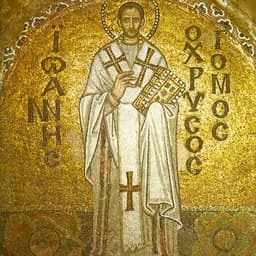
- St. John Chrysostom
- Homilies on Matthew, Hom. 88
- St. Cyril of Alexandria
- Commentary on Luke
His Luke exposition survives here in the Catena Aurea condensation; his standalone commentary is fragmentary at the Passion sermons.
- Origen of Alexandria
- Commentary on Matthew
Quoted for his exegesis of the miracle, not his condemned speculations; his Matthew commentary is public domain only through the Catena at this verse.
- Blessed Augustine of Hippo
- Harmony of the Gospels
Venerated in the East as Blessed; his Gospel harmony is cited here as preserved in the Catena Aurea on Luke.
- St. Ambrose of Milan
- Exposition of the Gospel of Luke
Catena-only in public-domain English on this passage.
Read the sources: Chrysostom on Matthew, Homily 88 (CCEL) · Catena Aurea on Matthew (CCEL) · Catena Aurea on Luke (isidore.co)
The Darkness over the Land (Matthew 27:45)
The texts below are quoted verbatim from public-domain English translations; nothing is paraphrased.
St. John Chrysostom (c. 347–407)
Homilies on the Gospel of Matthew, Homily 88 (on Matthew 27:45) Source: trans. in the Nicene and Post-Nicene Fathers, First Series, Vol. 10. Public domain. Full text: https://www.ccel.org/ccel/schaff/npnf110.iii.LXXXIV.html
On the darkness as a token of wrath, not an eclipse, because it endured three hours:
On the hour chosen, at midday, that all the earth might see and be converted:
St. Cyril of Alexandria (c. 376–444)
Commentary on the Gospel of Luke (on Luke 23:44–45) As preserved in the Catena Aurea on Luke. Public domain. Full text: https://isidore.co/aquinas/english/CALuke.htm
On creation mourning its Master, the light failing at midday:
Origen of Alexandria (c. 185–254)
Commentary on Matthew (on Matthew 27:45) As preserved in the Catena Aurea on Matthew. Public domain. Full text: https://www.ccel.org/ccel/aquinas/catena1.ii.xxvii.html
On why this darkness was no natural eclipse, the Passover falling at the full moon:
On the darkness over Judaea as a judgment, the reverse of the light Israel kept in Egypt:
Blessed Augustine of Hippo (354–430)
Harmony of the Gospels (on Luke 23:44–45) As preserved in the Catena Aurea on Luke. Public domain. Full text: https://isidore.co/aquinas/english/CALuke.htm
On Luke adding the cause, that the sun itself was darkened:
On the proof that this was no ordinary eclipse, the Passover falling at the full moon:
St. Ambrose of Milan (c. 339–397)
Exposition of the Gospel of Luke (on Luke 23:44–45) As preserved in the Catena Aurea on Luke. Public domain. Full text: https://isidore.co/aquinas/english/CALuke.htm
On the sun withdrawing from the sacrilege, that the light of faith might dawn: