The Genealogy of Jesus
Matt 1:1–17; Luke 3:23–38 · Infancy and childhood
Scripture
Matthew 1:1–17
he book of the generation of Jesus Christ, the son of David, the son of Abraham. 2Abraham begat Isaac; and Isaac begat Jacob; and Jacob begat Judas and his brethren; 3And Judas begat Phares and Zara of Thamar; and Phares begat Esrom; and Esrom begat Aram; 4And Aram begat Aminadab; and Aminadab begat Naasson; and Naasson begat Salmon; 5And Salmon begat Booz of Rachab; and Booz begat Obed of Ruth; and Obed begat Jesse; 6And Jesse begat David the king; and David the king begat Solomon of her that had been the wife of Urias; 7And Solomon begat Roboam; and Roboam begat Abia; and Abia begat Asa; 8And Asa begat Josaphat; and Josaphat begat Joram; and Joram begat Ozias; 9And Ozias begat Joatham; and Joatham begat Achaz; and Achaz begat Ezekias; 10And Ezekias begat Manasses; and Manasses begat Amon; and Amon begat Josias; 11And Josias begat Jechonias and his brethren, about the time they were carried away to Babylon: 12And after they were brought to Babylon, Jechonias begat Salathiel; and Salathiel begat Zorobabel; 13And Zorobabel begat Abiud; and Abiud begat Eliakim; and Eliakim begat Azor; 14And Azor begat Sadoc; and Sadoc begat Achim; and Achim begat Eliud; 15And Eliud begat Eleazar; and Eleazar begat Matthan; and Matthan begat Jacob; 16And Jacob begat Joseph the husband of Mary, of whom was born Jesus, who is called Christ. 17So all the generations from Abraham to David are fourteen generations; and from David until the carrying away into Babylon are fourteen generations; and from the carrying away into Babylon unto Christ are fourteen generations.
King James Version · public domain
Mateu 1:1–17
ivll’e gjeneallogjis’së Jisu Krishtit, të birit të Dhavidhit, të birit t’Avraamit. 2Avraamit i lindi Isaaku; edhe Isaakut i lindi Jakovi; edhe Jakovit i lindi Judha edhe të vëllezërit’ e ti; 3Edhe Judhësë i lindi Faresi edhe Zaraj nga Thamara; edhe Faresit i lindi Esromi; edhe Esromit i lindi Arami; 4Edhe Aramit i lindi Aminadhavi; edhe Aminadhavit i lindi Naassoni; edhe Naassonit i lindi Sallmoni; 5Edhe Sallmonit i lindi Voozi nga Rahava; edhe Voozit i lindi Ovidhi nga Rutha; edhe Ovidhit i lindi Jesseu; 6Edhe Jesseut i lindi Dhavidhi mbreti. Edhe mbretit Dhavidh i lindi Sollomoni nga gruaja e Uriut; 7Edhe Sollomonit i lindi Rovoami; edhe Rovoamit i lindi Aviaj; edhe Aviajt i lindi Asaj; 8Edhe Asajt i lindi Josafati; edhe Josafatit i lindi Jorami; edhe Joramit i lindi Ozia; 9Edhe Ozisë i lindi Joathami; edhe Joathamit i lindi Ahazi; edhe Ahazit i lindi Ezeqia; 10Edhe Ezeqisë i lindi Manassiu; edhe Manassiut i lindi Amoni; edhe Amonit i lindi Josia; 11Edhe Josisë i lindi Jehonia edhe të vëllezërit’ e ti, mbë të-çpërngulurit të Babillonësë. 12Edhe pas të-çpërngulurit të Babillonësë, Jehonisë i lindi Sallathieli; edhe Sallathielit i lindi Zorobabeli; 13Edhe Zorobabelit i lindi Aviudhi; edhe Aviudhit i lindi Eliaqimi; edhe Eliaqimit i lindi Azori; 14Edhe Azorit i lindi Saduku; edhe Sadukut i lindi Aqimi; edhe Aqimit i lindi Eliudhi; 15Edhe Eliudhit i lindi Eleazari; edhe Eleazarit i lindi Matthani; edhe Matthanit i lindi Jakovi; 16Edhe Jakovit i lindi Josifi, burr’ i Marisë, prej së-cilësë lindi Jisuj që thuhetë Krisht. 17Gjithë brezatë pra që nga Avraami e gjer mbë ditët të Dhavidhit janë katër-mbë-dhjetë breza; edhe që nga Dhavidhi e gjer mbë të çpërngulurit të Babillonësë janë katër-mbë-dhjetë breza; edhe nga të çpërngulurit’ e Babillonësë e gjer mbë ditët të Krishtit janë katër-mbë-dhjetë breza.
Kristoforidhi, Dhiata e Re Toskërisht 1879 · zotërim publik
In their own words
For this end he hath mentioned Ruth also and Rahab, the one an alien, the other an harlot, that thou mayest learn that He came to do away with all our ills. For He hath come as a Physician, not as a Judge.
St. John Chrysostom, Homilies on the Gospel of Matthew, Homily 3 (on Matthew 1:3)
Patristic sources
- St. John Chrysostom
- Homilies on the Gospel of Matthew, Hom. 2
- Homilies on the Gospel of Matthew, Hom. 3
- St. Cyril of Alexandria
- Commentary on Luke, Sermon 1
- St. Jerome
- Commentary on Matthew
His Commentary on Matthew survives in public-domain English only through the Catena Aurea.
- St. Ambrose of Milan
- Exposition of the Gospel of Luke, Book 3
The Matthew Catena cites his Luke exposition (in Luc.); available in public-domain English only through the Catena Aurea.
- Blessed Augustine of Hippo
- The Harmony of the Gospels, Book 2
Venerated in the East as Blessed; the Catena excerpts his de Consensu Evangelistarum on the two genealogies.
- Remigius of Auxerre
- Commentary on Matthew
A later Western compiler; his Matthew commentary survives only through the Catena Aurea.
Read the sources: Chrysostom, Homilies on Matthew, Hom. 2 (CCEL, NPNF1-10) · Chrysostom, Homilies on Matthew, Hom. 3 (CCEL, NPNF1-10) · Cyril of Alexandria, Commentary on Luke, Sermons 1–11 (tertullian.org) · Catena Aurea on Matthew, ch. 1 (CCEL)
The Genealogy of Jesus (Matthew 1:1–17; Luke 3:23–38)
The texts below are quoted verbatim from public-domain English translations; nothing is paraphrased.
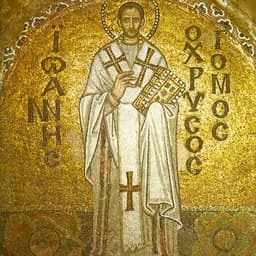
St. John Chrysostom (c. 347–407)
Homilies on the Gospel of Matthew, Homilies 2 and 3 (on Matthew 1:1) Source: trans. in the Nicene and Post-Nicene Fathers, First Series, Vol. 10. Public domain. Full text: https://www.ccel.org/ccel/schaff/npnf110.iii.v.html
On why the Only-begotten suffered Himself to be traced through a human pedigree:
On why Matthew names David before Abraham, and so descends where Luke ascends:
On beginning from David, the more known, and running up toward Abraham:
On why the four women are woven into the line — Thamar, Rahab, Ruth, and the wife of Urias:
On why Joseph, who had no part in the birth, is nonetheless given the genealogy:
St. Cyril of Alexandria (c. 376–444)
Commentary on the Gospel of Luke, Sermon 1 (on Luke 2:1–7) Source: trans. R. Payne Smith, Library of Fathers, 1859. Public domain. Full text: https://www.tertullian.org/fathers/cyril_on_luke_01_sermons_01_11.htm
On how tracing the line through Joseph proves the Virgin herself to be of David's house:
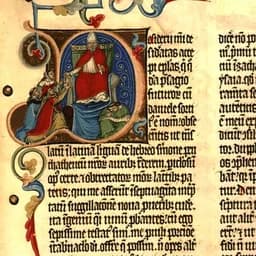
St. Jerome (c. 347–420)
Commentary on Matthew (on Matthew 1:1) As preserved in the Catena Aurea on Matthew. Public domain. Full text: https://www.ccel.org/ccel/aquinas/catena1.ii.i.html
On Isaiah's "Who shall declare His generation?" — that the Prophet speaks of the divine generation, the Evangelist of the human:
On why the order of the two names is inverted:
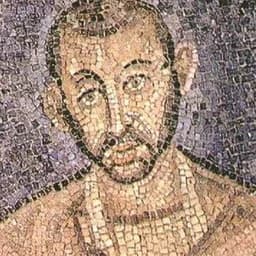
St. Ambrose of Milan (c. 339–397)
Exposition of the Gospel of Luke, Book 3 (on Matthew 1:1) As preserved in the Catena Aurea on Matthew. Public domain. Full text: https://www.ccel.org/ccel/aquinas/catena1.ii.i.html
On the two to whom the promise was made — Abraham and David — named as the authors of His birth:
On the seventeen kings between David and Jeconiah reckoned as fourteen:
Blessed Augustine of Hippo (354–430)
The Harmony of the Gospels, Book 2 (on Matthew 1:1–17) As preserved in the Catena Aurea on Matthew. Public domain. Full text: https://www.ccel.org/ccel/aquinas/catena1.ii.i.html
On how Matthew's descending line and Luke's ascending line answer to one another:
On why Luke sets the ancestry at the Baptism and carries it up by adoption to Adam and to God:
Remigius of Auxerre (c. 841–908)
Commentary on Matthew (on Matthew 1:1–17) As preserved in the Catena Aurea on Matthew. Public domain. (Remigius is a later Western compiler, included here for the reckoning of the fourteens.) Full text: https://www.ccel.org/ccel/aquinas/catena1.ii.i.html
On the mystical sense of the three sets of fourteen:
On why Bathsheba alone among the women is left unnamed, called only the wife of Urias: