The Inscription and the Dividing of His Garments
Matt 27:35–37; Mark 15:24–26; Luke 23:34, 38; John 19:18–24 · Passion week in Jerusalem
Scripture
Matthew 27:35–37
nd they crucified him, and parted his garments, casting lots: that it might be fulfilled which was spoken by the prophet, They parted my garments among them, and upon my vesture did they cast lots. 36And sitting down they watched him there; 37And set up over his head his accusation written, THIS IS JESUS THE KING OF THE JEWS.
King James Version · public domain
Mateu 27:35–37
dhe si e kryqëzuanë, hothnë shortë, e ndanë rrobat’ e ati; që të mbushetë ç’është thënë nga profiti, “Ndanë rrobat’ e mia ndë mest të tyre, edhe mbi të-veshurit t’im hothnë shortë”. 36Edhe dyke ndënjurë e ruanin’ atë atje. 37Edhe vunë sipërë krejs’ s’ati punën’ e ati të-shkruarë, Ky është Jisuj mbreti i Judhenjvet.
Kristoforidhi, Dhiata e Re Toskërisht 1879 · zotërim publik
In their own words
But the coat, on which lots were cast, signifies the unity of all the parts, which is contained in the bond of charity.
Blessed Augustine of Hippo, Tractates on the Gospel of John, Tractate 118 (on John 19:23–24)
Patristic sources
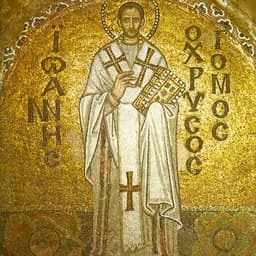
- St. John Chrysostom
- Homilies on the Gospel of St. John, Hom. 85
- St. Cyril of Alexandria
- Commentary on the Gospel of John, Book 12
- Theophylact of Ohrid
- Explanation of the Gospel of John
His Gospel exegesis survives in public-domain English only through the Catena Aurea.
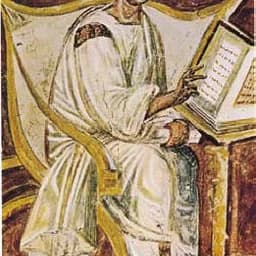
- Blessed Augustine of Hippo
- Tractates on the Gospel of John, Tractates 117–118
Venerated in the East as Blessed; his Johannine tractates are cited in later Byzantine catenae.
- St. Bede the Venerable
- Commentary on the Gospel of John
Catena-only in public-domain English; the extract is collated against the 1845 Oxford printing.
Read the sources: Chrysostom on John, Homily 85 (CCEL) · Cyril of Alexandria on John, Book 12 (tertullian.org) · Augustine, Tractates on John 117–118 (CCEL) · Catena Aurea on John (isidore.co)
The Inscription and the Dividing of His Garments (John 19:18–24; Matthew 27:35–37)
The texts below are quoted verbatim from public-domain English translations; nothing is paraphrased.
St. John Chrysostom (c. 347–407)
Homilies on the Gospel of St. John, Homily 85 (on John 19:18–24) Source: trans. in the Nicene and Post-Nicene Fathers, First Series, Vol. 14. Public domain. Full text: https://www.ccel.org/ccel/schaff/npnf114.iv.lxxxvii.html
On the title set over the Cross like the inscription on a trophy of victory, proclaimed in three tongues:
On the soldiers parting the garments but casting lots for the coat, wherein the prophecy is fulfilled to the letter:
On the coat woven from the top throughout:
St. Cyril of Alexandria (c. 376–444)
Commentary on the Gospel of John, Book 12 (on John 19:20–24) Source: trans. T. Randell, Library of Fathers, 1885. Public domain. Full text: https://www.tertullian.org/fathers/cyril_on_john_12_book12.htm
On the title written in three languages as the firstfruits of the confession of all nations and tongues:
On the dividing of the garments and the whole coat kept uncut, that the word of the Psalmist might not fail:
Theophylact of Ohrid (c. 1055–1107)
Explanation of the Gospel of John (on John 19:19–24) As preserved in the Catena Aurea on John. Public domain. Full text: https://isidore.co/aquinas/english/CAJohn.htm
On the title in three languages proclaiming Him King of the whole world:
On the coat without seam as the indivisible body of Christ, woven from above:
Blessed Augustine of Hippo (354–430)
Tractates on the Gospel of John, Tractates 117–118 (on John 19:19–24) Source: trans. in the Nicene and Post-Nicene Fathers, First Series, Vol. 7. Public domain. Full text: https://www.ccel.org/ccel/schaff/npnf107.iii.cxviii.html
On why the title was set forth in the three tongues (Tractate 117):
On Pilate's "What I have written I have written" as an unwitting confession (Tractate 117):
On the coat without seam as the unity of the Church, held in the bond of charity (Tractate 118):
St. Bede the Venerable (c. 673–735)
Commentary on the Gospel of John (on John 19:19–22) As preserved in the Catena Aurea on John. Public domain. Full text: https://isidore.co/aquinas/english/CAJohn.htm
On the title proclaiming that His kingdom was not destroyed but strengthened: