The leaven (yeast)
Matt 13:33; Luke 13:20–21 · Later ministry in Galilee
Scripture
Matthew 13:33
nother parable spake he unto them; The kingdom of heaven is like unto leaven, which a woman took, and hid in three measures of meal, till the whole was leavened.
King James Version · public domain
Mateu 13:33
jë tjatërë paravoli u foli atyre. Mbretëri e qiejvet gjan me brumë, të-cilin’ e mori një grua, edhe e fshehu ndë tri masa mjelli, gjersa umbrujt gjithë.
Kristoforidhi, Dhiata e Re Toskërisht 1879 · zotërim publik
Summary
The Kingdom works like leaven hidden in the dough: silently, from within, until the whole is transformed. The Fathers note first the smallness of the thing and the greatness of what it accomplishes. As Chrysostom observes, the leaven is little and the dough much, yet the little overcomes the much; so the Gospel, carried first by a handful of apostles, worked through the whole world. The power lies not in the size of the beginning but in the strength hidden within. As leaven buried in the meal is not unseed by it but draws the dough into its own nature, so grace in the believer is not overcome by the world but conquers and transfigures it.
The woman who hides the leaven the tradition reads as the Church, or the wisdom of God, kneading the Gospel into mankind. The three measures of flour the Fathers read variously: as body, soul, and spirit leavened by grace, so the whole person is sanctified; or as the race descended from the three sons of Noah, into which the one Gospel is mixed until no part is untouched. Cyril, reading in Luke, draws out the Christological depth: the leaven of grace mingled with our nature, so what was earthly is raised and made new.
The hiding is gradual and unseen, as Origen draws out, for the Kingdom works within the soul not by observation, until at last the change appears in the whole. The Fathers are careful, too, with leaven, which elsewhere in Scripture images corruption: "the leaven of the Pharisees," "the old leaven" of malice. The same thing is good or evil by what is hidden and into what; here the leaven is the Gospel and the grace of God, its end not corruption but the rising of the whole into life.
Patristic sources
- St. John Chrysostom
- Homilies on Matthew, Hom. 46
- Origen of Alexandria
- Commentary on Matthew, Book X
- Theophylact of Ohrid
- Commentary on Matthew, on Matt 13
- St. Cyril of Alexandria
- Commentary on Luke, on Luke 13
The Parable of the Leaven (Matthew 13:33; Luke 13:20–21)
Public-Domain Patristic Commentary
The kingdom of heaven, Christ says, is like leaven, which a woman takes and hides in three measures of meal until the whole is leavened. In both Matthew and Luke this parable stands beside the mustard seed, and teaches the same lesson from the other direction: where the mustard seed shows a small thing growing visibly outward into a great tree, the leaven shows a small thing working invisibly inward until it has changed the whole lump. The texts below are quoted verbatim from public-domain English translations, including the Catena Aurea of St. Thomas Aquinas (trans. J. H. Newman, 1841). Nothing is paraphrased. A note on sources, including a gap that recurs from the mustard seed, follows at the end.
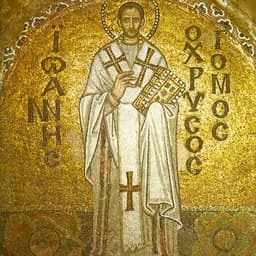
St. John Chrysostom (c. 347–407)
Homilies on the Gospel of Matthew, Homily 46 (on Matthew 13:33) Source: trans. in the Nicene and Post-Nicene Fathers, First Series, Vol. 10. Public domain. Full text: https://www.newadvent.org/fathers/200146.htm
On the leaven as the power by which a few disciples would change the whole world:
On the leaven being mixed and buried, yet transforming all into its own condition:
St. Cyril of Alexandria (c. 376–444)
Commentary on the Gospel of St. Luke, Sermon XCVIII (on Luke 13:20–21) Source: trans. R. Payne Smith, 1859. Public domain. Full text: https://www.tertullian.org/fathers/cyril_on_luke_09_sermons_89_98.htm
On how the kingdom likened to leaven, though small, lays hold of the whole:
On the word of God working inwardly to make the believer holy and spiritual:
On receiving the divine leaven so that we ourselves are found spiritually unleavened:
Blessed Augustine of Hippo (354–430)
Questions on the Gospels (Quaestiones Evangeliorum) I.12 (on the leaven) Source: as preserved in the Catena Aurea of St. Thomas Aquinas, trans. J. H. Newman, 1841. Public domain.
On the leaven as love, the woman as wisdom, and the three measures as the whole person:
St. Jerome (c. 347–420)
From his Commentary on Matthew, as preserved in the Catena Aurea on Matthew. Public domain.
On the woman as the Apostolic preaching or the Church, hiding the understanding of the Scriptures in spirit, soul, and body:
On the three parts of the soul rightly ordered by the leaven of Holy Scripture:
On the woman as the Church mingling the faith of the Trinity, with a caution against building dogma on parables:
St. Hilary of Poitiers (c. 310–367)
As preserved in the Catena Aurea on Matthew. Public domain.
On the Lord Himself as the leaven that communicates its received power to its own kind:
On the three measures as the Law, the Prophets, and the Gospels made one:
Note on sources and other Fathers
The readings face in complementary directions. Chrysostom looks outward and sees the leaven as the gospel hidden in the mass of the world, so that the very thing that looks like being overwhelmed, mixing with the multitude, is in fact how the few prevail. Augustine looks inward and sees the leaven as love hidden in the person, working through heart and soul and mind until the whole is changed. Jerome reads the woman as the Apostolic preaching or the Church, hiding the understanding of the Scriptures so that spirit, soul, and body are made one, and orders the three parts of the soul, reason, anger, and desire, by the evangelic leaven, while warning that parables cannot of themselves establish dogma. Hilary turns the figure Christward, making the Lord Himself the leaven and the three measures the Law, the Prophets, and the Gospels brought into a single fulfilment. The single detail they all lean on is that the woman "hid" the leaven rather than merely placing it: its power is in being buried and mixed, not destroyed.
The same gap noted for the mustard seed applies here. St. Cyril of Alexandria's exposition of Luke's leaven (Luke 13:20–21) does not survive in the public-domain English of R. Payne Smith, since the extant sermons pass from Luke 13:9 directly to Luke 13:22. The Augustine, Jerome, and Hilary passages above come through the public-domain Catena Aurea, since these works have no public-domain English editions of their own; Chrysostom's homily is the one primary public-domain source for this parable. The Catena also preserves a note of Rabanus Maurus, that the love implanted in our mind ought to grow until it changes the whole soul into its own perfection, which is begun here but completed hereafter; it is not quoted above as a medieval Western gloss. St. Ambrose, the Venerable Bede, and others also comment, but in modern copyrighted translations.