The New Commandment
John 13:31–35 · Passion week in Jerusalem
Scripture

John 13:31–35
herefore, when he was gone out, Jesus said, Now is the Son of man glorified, and God is glorified in him. 32If God be glorified in him, God shall also glorify him in himself, and shall straightway glorify him. 33Little children, yet a little while I am with you. Ye shall seek me: and as I said unto the Jews, Whither I go, ye cannot come; so now I say to you. 34A new commandment I give unto you, That ye love one another; as I have loved you, that ye also love one another. 35By this shall all men know that ye are my disciples, if ye have love one to another.
King James Version · public domain
Joani 13:31–35
i dolli pra ay, Jisuj thotë, Ndashti ulavdurua i Bir’ i njeriut, edhe Perëndia ulavdurua nd’atë. 32Ndë ulavdurua Perëndia nd’atë, edhe Perëndia dot’a lavduronjë mbë vetëhet të ti, edhe për-një-here dot’a lavduronjë. 33Djemthit’ e mi, edhe pakëzë jam bashkë me ju. Dotë më kërkoni; edhe sikundrë u thashë Judhenjet, Se, ku vete unë, ju s’munt të vini, po edhe juve u’a them ndashti. 34Një porosi të-re u lë juve, Të doni njëri tjatërinë; sikundrë un’ u desha juve, edhe ju të doni njëri tjatërinë. 35Prej kësaj dot’u njohënë juve të-gjithë, se jeni nxënësit’ e mi, ndë qoftë se kini dashuri njëri mbë tjatërinë.
Kristoforidhi, Dhiata e Re Toskërisht 1879 · zotërim publik
In their own words
This is the love that renews us, making us new men, heirs of the New Testament, singers of the new song.
Blessed Augustine of Hippo, Tractates on the Gospel of John, Tractate 65 (on John 13:34–35)
Patristic sources
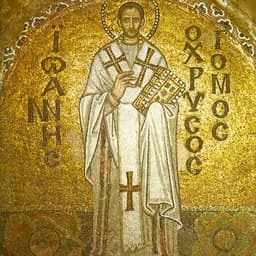
- St. John Chrysostom
- Homilies on the Gospel of St. John, Hom. 72
- St. Cyril of Alexandria
- Commentary on the Gospel of John, Book IX
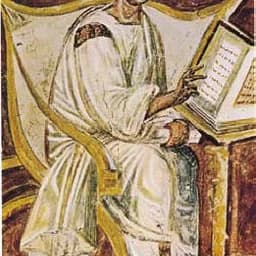
- Blessed Augustine of Hippo
- Tractates on the Gospel of John, Tractate 65
Venerated in the East as Blessed; his Johannine tractates are cited in later Byzantine catenae.
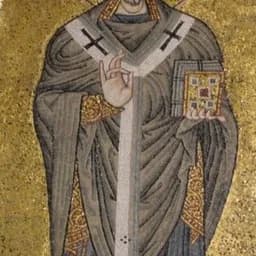
- St. Hilary of Poitiers
- On the Trinity, Book IX
Read the sources: Chrysostom on John, Homily 72 (CCEL) · Cyril on John, Book IX (tertullian.org) · Augustine, Tractates on John, Tractate 65 (CCEL) · Hilary, On the Trinity, Book IX (CCEL)
The New Commandment (John 13:31–35)
The texts below are quoted verbatim from public-domain English translations; nothing is paraphrased.
St. John Chrysostom (c. 347–407)
Homilies on the Gospel of St. John, Homily 72 (on John 13:31–35) Source: trans. in the Nicene and Post-Nicene Fathers, First Series, Vol. 14. Public domain. Full text: https://www.ccel.org/ccel/schaff/npnf114.iv.lxxiv.html
On "Now is the Son of man glorified" (the Cross named as glory):
On the glory of being able to conquer even after death:
On why the new commandment is given here, as the disciples' safeguard:
On why the old commandment of love is called new:
On "By this shall all men know that ye are my disciples" (love as the distinguishing token):
On love as the foundation of all virtue:
St. Cyril of Alexandria (c. 376–444)
Commentary on the Gospel of John, Book IX (on John 13:31–35) Source: trans. T. Randell, Library of Fathers, 1885. Public domain. Full text: https://www.tertullian.org/fathers/cyril_on_john_09_book9.htm
On the one Christ who is glorified, undivided before and after the incarnation:
On why the consummation of His glory is His suffering for the world:
On the newness of the commandment, since Christ makes us new:
On the measure of the new love, which surpasses loving thy neighbour as thyself:
On "By this shall all men know that ye are my disciples" (love as the mark set upon them):
On love as the sum of all the commandments:
Blessed Augustine of Hippo (354–430)
Tractates on the Gospel of John, Tractate 65 (on John 13:34–35) Source: trans. in the Nicene and Post-Nicene Fathers, First Series, Vol. 7. Public domain. Full text: https://www.ccel.org/ccel/schaff/npnf107.iii.lxvi.html
On why a commandment so old is called new:
On the love that alone renews, marked off by "as I have loved you":
On this love as our renewal:
On what Christ loves in us, as a physician loves the health of the sick:
On "By this shall all men know that ye are my disciples" (love, not the gifts shared even by outsiders):
St. Hilary of Poitiers (c. 310–367)
On the Trinity, Book IX (on John 13:31–32) Source: trans. in the Nicene and Post-Nicene Fathers, Second Series, Vol. 9. Public domain. Full text: https://www.ccel.org/ccel/schaff/npnf209.ii.v.ii.ix.html
On "Now is the Son of man glorified" (the glory of the assumed manhood):
On "And God is glorified in Him" (the mystery of the unity of Father and Son):