The Olivet Discourse
Matt 24; Mark 13; Luke 21:5–38 · Passion week in Jerusalem
Scripture
Matthew 24:1–14
nd Jesus went out, and departed from the temple: and his disciples came to him for to shew him the buildings of the temple. 2And Jesus said unto them, See ye not all these things? verily I say unto you, There shall not be left here one stone upon another, that shall not be thrown down. 3And as he sat upon the mount of Olives, the disciples came unto him privately, saying, Tell us, when shall these things be? and what shall be the sign of thy coming, and of the end of the world? 4And Jesus answered and said unto them, Take heed that no man deceive you. 5For many shall come in my name, saying, I am Christ; and shall deceive many. 6And ye shall hear of wars and rumours of wars: see that ye be not troubled: for all these things must come to pass, but the end is not yet. 7For nation shall rise against nation, and kingdom against kingdom: and there shall be famines, and pestilences, and earthquakes, in divers places. 8All these are the beginning of sorrows. 9Then shall they deliver you up to be afflicted, and shall kill you: and ye shall be hated of all nations for my name’s sake. 10And then shall many be offended, and shall betray one another, and shall hate one another. 11And many false prophets shall rise, and shall deceive many. 12And because iniquity shall abound, the love of many shall wax cold. 13But he that shall endure unto the end, the same shall be saved. 14And this gospel of the kingdom shall be preached in all the world for a witness unto all nations; and then shall the end come.
King James Version · public domain
Mateu 24:1–14
dhe Jisuj dolli e iku nga hieroreja; edhe nxënësit’ e ati i erthnë përanë që t’i dëftenjënë ndërtesat’ e hieroresë. 2Po Jisuj u tha atyre, A nuk’ i shihni gjithë këto? Me të-vërtetë po u them juve, se nukë dotë mbetetë këtu gur mbi gur që të mos rrëzohetë. 3Edhe ay tek ishte dyke ndënjurë mbi malt të Ullinjet, nxënësit’ i uafëruanë mbë nj’anë, dyke thënë, thuaj-na, kur dotë bënenë këto? Edhe cila është shënja e të-ardhurit t’ënt edhe e të-mbaruarit të jetësë? 4Edhe Jisuj upërgjeq e u tha atyre, Shikoni, mos u gënjenjë juve ndonjë; 5Sepse shumë veta dotë vinjënë mb’emërit t’im, dyke thënë Unë jam Krishti, edhe dotë gënjenjënë shumë veta. 6Edhe dotë dëgjoni luftëra e zëre luftërash; shikoni, mos trumbullohi, sepse të-gjitha këto gjan të bënenë; po e-pastajmja edhe nuk’ është. 7Sepse dotë ngrihetë komp kundrë kombi, edhe mbretëri kundrë mbretërie; edhe dotë jenë zira e murtaja, edhe tërmete vënt mbë vënt. 8Po gjithë këto janë të-nisurit’ e të-dhëmburavet. 9Atëhere dot’u apënë juve ndër duar për shtrëngim, edhe dot’u vrasënë juve; edhe dot’u kenë mëri juve gjithë kombetë për emërinë t’im. 10Edhe atëhere dotë skandhalisenë shumë veta, edhe dotë tradhëtonjënë njeri tjatërinë, edhe dotë kenë mëri njëri tjatërit. 11Edhe shumë profitër të-rrem dotë ngrihenë, edhe dotë gënjenjënë shumë veta; 12Edhe passi të shumonetë panomia, dashuria e të-shumëvet dotë ftohetë. 13Po kush të duronjë gjer ndë funt, ky dotë shpëtonjë. 14Edhe ky ungjilli i mbretërisë dotë leçitetë ndëpër gjithë botënë, për dëshmim mbë gjithë kombet; edhe atëhere dotë vinjë fundi.
Kristoforidhi, Dhiata e Re Toskërisht 1879 · zotërim publik
In their own words
When then He describes the signs which shall attend these three events, we must carefully consider which signs belong to which events, lest perchance we refer to one that which belongs to another.
Blessed Augustine of Hippo, Letter 199 to Hesychius (Catena Aurea)
Patristic sources
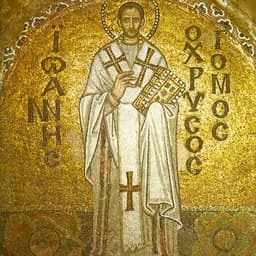
- St. John Chrysostom
- Homilies on Matthew, Hom. 75
- Homilies on Matthew, Hom. 76
- St. Cyril of Alexandria
- Commentary on Luke, Sermon 139
- Origen of Alexandria
- Commentary on Matthew (Catena Aurea)
Quoted only from the Catena Aurea; some of his speculations were condemned in 553, so his exegesis is received in the East with care.
- St. Hilary of Poitiers
- Commentary on Matthew (Catena Aurea)
- St. Jerome
- Commentary on Matthew (Catena Aurea)
- Blessed Augustine of Hippo
- Letter 199, to Hesychius (Catena Aurea)
Venerated in the East as Blessed; his letter on the end of the world is preserved here through the Catena Aurea.
Read the sources: Chrysostom, Homilies on Matthew, Homily 75 (CCEL) · Chrysostom, Homilies on Matthew, Homily 76 (CCEL) · Cyril of Alexandria on Luke, Sermons 135–145 (tertullian.org) · Catena Aurea on Matthew 24 (CCEL)
The Olivet Discourse (Matthew 24; Mark 13; Luke 21:5–38)
The texts below are quoted verbatim from public-domain English translations; nothing is paraphrased.
St. John Chrysostom (c. 347–407)
Homilies on the Gospel of Matthew, Homilies 75 and 76 (on Matthew 24:1–31) Source: trans. in the Nicene and Post-Nicene Fathers, First Series, Vol. 10. Public domain. Full text: https://www.ccel.org/ccel/schaff/npnf110.iii.LXXII.html
On "there shall not be left here one stone upon another":
On the twofold war that must first come, of the deceivers and of the enemies:
On why Jerusalem is destroyed only after the Gospel has been preached in all the world:
On why the coming of the Son of man, unlike the deceivers, cannot be hidden:
On "immediately after the tribulation of those days shall the sun be darkened":
St. Cyril of Alexandria (c. 376–444)
Commentary on the Gospel of Luke, Sermon 139 (on Luke 21:5–28) Source: trans. R. Payne Smith, Library of Fathers, 1859. Public domain. Full text: https://www.tertullian.org/fathers/cyril_on_luke_13_sermons_135_145.htm
On the temple thrown down by the Romans as retribution for the slaying of the Lord:
On how the discourse interweaves the fall of Jerusalem and the end of the world:
On "they shall see the Son of man coming in a cloud with power and great glory":
On the elect lifting up their heads at His coming:
Origen of Alexandria (c. 185–254)
Commentary on Matthew (on Matthew 24:1–31) As preserved in the Catena Aurea on Matthew. Public domain. Full text: https://www.ccel.org/ccel/aquinas/catena1.ii.xxiv.html
On the Lord going out from the temple He had upheld:
On the sign of the Son of man in heaven as the power of the cross:
On the gathering of the elect from the four winds:
St. Hilary of Poitiers (c. 310–367)
Commentary on Matthew (on Matthew 24:3–29) As preserved in the Catena Aurea on Matthew. Public domain. Full text: https://www.ccel.org/ccel/aquinas/catena1.ii.xxiv.html
On the threefold question answered according to distinct times:
On the darkening of the heavenly lights as the glory of His coming:
St. Jerome (c. 347–420)
Commentary on Matthew (on Matthew 24:2–30) As preserved in the Catena Aurea on Matthew. Public domain. Full text: https://www.ccel.org/ccel/aquinas/catena1.ii.xxiv.html
On the three things the disciples ask:
On the overthrow of the temple read as the passing of the Law:
On the Gospel preached in all the world as the sign of the second coming:
Blessed Augustine of Hippo (354–430)
Letter 199, to Hesychius, on the End of the World (on Matthew 24:6–30) As preserved in the Catena Aurea on Matthew. Public domain. Full text: https://www.ccel.org/ccel/aquinas/catena1.ii.xxiv.html
On the three events folded into the one answer:
On the care needed to sort the signs to their events:
On the Son of man coming to judge in the very body in which He ascended: