The Prediction of Peter's Denial
Matt 26:31–35; Mark 14:27–31; Luke 22:31–34; John 13:36–38 · Passion week in Jerusalem
Scripture
Matthew 26:31–35
hen saith Jesus unto them, All ye shall be offended because of me this night: for it is written, I will smite the shepherd, and the sheep of the flock shall be scattered abroad. 32But after I am risen again, I will go before you into Galilee. 33Peter answered and said unto him, Though all men shall be offended because of thee, yet will I never be offended. 34Jesus said unto him, Verily I say unto thee, That this night, before the cock crow, thou shalt deny me thrice. 35Peter said unto him, Though I should die with thee, yet will I not deny thee. Likewise also said all the disciples.
King James Version · public domain
Mateu 26:31–35
tëhere Jisuj u thot’ atyre, Gjithë ju dotë skandhaliseni mbë mua këtë natë; sepse është shkruarë, “Dot’ i bie bariut, edhe dhënt’ e tufësë dotë përndahenë”. 32Edhe passi të ngjallem unë, dotë vete përpara jush ndë Galilet. 33Edhe Pjetri upërgjeq e i tha, Edhe të-gjithë ndë uskandhalisçinë mbë ty, unë nukë dotë skandhalisem kurrë. Jisuj i tha, 34Me të-vërtetë po të them, se këtë natë, para se të këndonjë këndesi, tri herë dotë më mohonjç. 35Pjetri i thotë, Edhe ndë u ndashtë të vdes unë bashkë me ty, nukë dotë të mohonj. Kështu thanë edhe gjithë nxënësitë.
Kristoforidhi, Dhiata e Re Toskërisht 1879 · zotërim publik
In their own words
O what great and incomparable kindness! The disciple had not yet sickened with the malady of faithlessness, and already he has received the medicine of forgiveness: not yet had the sin been committed, and he receives pardon: not yet had he fallen, and the saving hand is held out: not yet had he faltered, and he is confirmed
St. Cyril of Alexandria, Commentary on Luke, Sermon 144 (on Luke 22:31–34)
Patristic sources
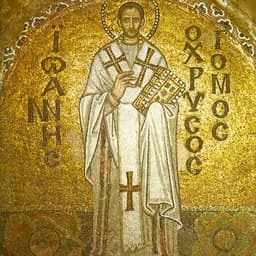
- St. John Chrysostom
- Homilies on the Gospel of Matthew, Hom. 82
Greek spine of the entry; his full homily on Matthew 26:31-35 anchors the reading of Peter's over-confidence.
- St. Cyril of Alexandria
- Commentary on the Gospel of Luke, Sermon 144
Payne Smith's 1859 translation, the standing public-domain source for Cyril on Luke; treats the Luke 22:31-34 strand (Satan hath desired to sift you).
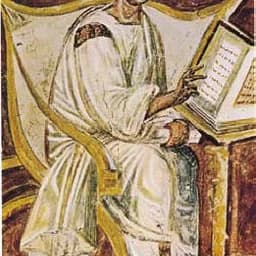
- Blessed Augustine of Hippo
- The Harmony of the Gospels, Book III
Venerated in the East as Blessed. Quoted here as condensed in the Catena Aurea on Matthew; harmonizes the four Gospel accounts of the forewarning.
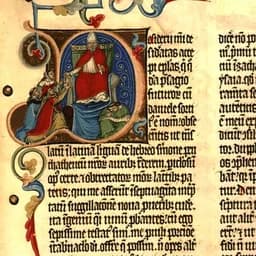
- St. Jerome
- Commentary on Matthew
Catena-only in public-domain English on the Gospels.
- St. Hilary of Poitiers
- Commentary on Matthew
Catena-only in public-domain English on the Gospels.
- Remigius
- Commentary on Matthew
Later Western compiler; his Gospel exposition survives in English only through the Catena Aurea.
Read the sources: Chrysostom, Homilies on Matthew, Homily 82 (CCEL) · Cyril of Alexandria, Commentary on Luke, Sermon 144 (tertullian.org) · Catena Aurea on Matthew, ch. 26 (CCEL)
The Prediction of Peter's Denial (Matthew 26:31–35; Luke 22:31–34; John 13:36–38)
The texts below are quoted verbatim from public-domain English translations; nothing is paraphrased.
St. John Chrysostom (c. 347–407)
Homilies on the Gospel of Matthew, Homily 82 (on Matthew 26:31–35) Source: trans. in the Nicene and Post-Nicene Fathers, First Series, Vol. 10. Public domain. Full text: https://www.ccel.org/ccel/schaff/npnf110/npnf110.iii.LXXVIII.html
On why He sets a prophecy before them, "I will smite the shepherd, and the sheep shall be scattered abroad":
On Peter's over-confidence, where he should rather have prayed:
On "I have prayed for thee, that thy faith fail not":
St. Cyril of Alexandria (c. 376–444)
Commentary on the Gospel of Luke, Sermon 144 (on Luke 22:31–34) Source: trans. R. Payne Smith, Library of Fathers, 1859. Public domain. Full text: https://www.tertullian.org/fathers/cyril_on_luke_13_sermons_135_145.htm
On why Christ passes by the rest and turns to Peter the foremost:
On the medicine of forgiveness granted before the wound, and the surpassing greatness of the divine gentleness:
On Peter's error, that he should have asked for strength instead of contradicting the Lord:
Blessed Augustine of Hippo (354–430)
The Harmony of the Gospels, Book III (on Matthew 26:31–35) As preserved in the Catena Aurea on Matthew. Public domain. Full text: https://www.ccel.org/ccel/aquinas/catena1.ii.xxvi.html
On the differences between the four accounts of the forewarning:
On how Mark's "before the cock crow twice" agrees with the rest:
St. Jerome (c. 347–420)
Commentary on Matthew (on Matthew 26:31–35) As preserved in the Catena Aurea on Matthew. Public domain. Full text: https://www.ccel.org/ccel/aquinas/catena1.ii.xxvi.html
On the Shepherd smitten that the flocks might be made one:
On Peter's protest, which sprang not from wilfulness but from love:
St. Hilary of Poitiers (c. 310–367)
Commentary on Matthew (on Matthew 26:31–35) As preserved in the Catena Aurea on Matthew. Public domain. Full text: https://www.ccel.org/ccel/aquinas/catena1.ii.xxvi.html
On the zeal that carried Peter past the weakness of his own flesh:
Remigius (c. 841–908)
Commentary on Matthew (on Matthew 26:33–35) As preserved in the Catena Aurea on Matthew. Public domain. Full text: https://www.ccel.org/ccel/aquinas/catena1.ii.xxvi.html
On the lesson for all who are confident in the warmth of their faith: