The Prologue: In the Beginning Was the Word
John 1:1–18 · Beginning of the ministry
Scripture
John 1:1–18
n the beginning was the Word, and the Word was with God, and the Word was God. 2The same was in the beginning with God. 3All things were made by him; and without him was not any thing made that was made. 4In him was life; and the life was the light of men. 5And the light shineth in darkness; and the darkness comprehended it not. 6There was a man sent from God, whose name was John. 7The same came for a witness, to bear witness of the Light, that all men through him might believe. 8He was not that Light, but was sent to bear witness of that Light. 9That was the true Light, which lighteth every man that cometh into the world. 10He was in the world, and the world was made by him, and the world knew him not. 11He came unto his own, and his own received him not. 12But as many as received him, to them gave he power to become the sons of God, even to them that believe on his name: 13Which were born, not of blood, nor of the will of the flesh, nor of the will of man, but of God. 14And the Word was made flesh, and dwelt among us, (and we beheld his glory, the glory as of the only begotten of the Father,) full of grace and truth. 15John bare witness of him, and cried, saying, This was he of whom I spake, He that cometh after me is preferred before me: for he was before me. 16And of his fulness have all we received, and grace for grace. 17For the law was given by Moses, but grace and truth came by Jesus Christ. 18No man hath seen God at any time; the only begotten Son, which is in the bosom of the Father, he hath declared him.
King James Version · public domain
Joani 1:1–18
ë përpara herësë ishte Fjala, edhe Fjala ishte me Perëndinë, edhe Fjala ishte Perëndi, 2Këjo ishte që përpara herësë me Perëndinë. 3Të-gjitha u bënë me anë t’asaj; edhe pa atë nuk’ ubë as ndonjë gjë që është bërë. 4Nd’atë ishte jetë, edhe jeta ishte drita e njerësvet. 5Edhe drita ndrit nd’errësirët edhe errësira nuk’ e kupëtoj. 6Qe një njeri dërguarë nga Perëndia, i-cili e kishte emërinë Joan. 7Ky erdhi për dëshmim, që të apë dëshmim Dritënë, që të besonjënë të-gjithë me anë t’ati. 8Ay nuk’ ishte Drita, po qe dërguarë që të apë dëshmim për Dritënë. 9Ishte Drita e-vërtetë, që ndrit çdo njeri, kur vjen ndë botët. 10Ishte ndë botët, edhe bota ubë me anë t’ati; po bota nuk’ e njohu atë. 11Erdhi ndë të-tijt, edhe të-tijtë nuk’ e pritnë atë. 12Edhe sa e pritnë, atyre u dha pushtet të bënenë bij Perëndie, atyreve që besonjënë me anë t’ati; 13Ata nukë lintnë prej gjakesh, as prej dashurimi mishi, as prej dashurimi burri, po prej Perëndie. 14Edhe Fjala ubë mish, edhe ndënji ndër ne, (edhe pamë lavdin’ e ati, lavdi posi të-vetëmlinduri prej Atit,) plot me hir e me të-vërtetë. 15Joani ep dëshmim për atë, edhe bërtiti, dyke thënë, Ky është ay për të-cilinë thashë, Ay që vjen pas meje është më i-math se unë, sepse ishte përpara meje. 16Edhe të-gjithë ne muarmë prej të-mbushurit t’ati, edhe hir ndë vënt hiri. 17Sepse nomi udha me anë të Moisiut, po hiri edhe e-vërteta ubë me anë të Jisu Krishtit. 18Asndonjë kurrë s’e ka parë Perëndinë; veç i-Vetëmlinduri Bir, që është ndë gjit të Atit ay na e dëfteu.
Kristoforidhi, Dhiata e Re Toskërisht 1879 · zotërim publik
In their own words
Why, then, dost thou marvel that men are born of God? Consider God Himself born of men: "And the Word was made flesh, and dwelt among us."
Blessed Augustine of Hippo, Tractates on the Gospel of St. John, Tractate II (on John 1:14)
Patristic sources
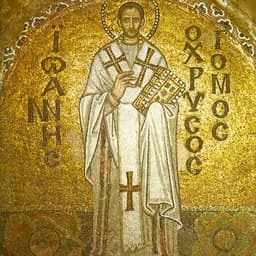
- St. John Chrysostom
- Homilies on the Gospel of St. John, Homilies IV and XI
- St. Cyril of Alexandria
- Commentary on the Gospel of St. John, Book I
A major dogmatic exposition of the Prologue against Arius; trans. P. E. Pusey, Library of Fathers, 1874.
- St. Basil the Great
- Catena Aurea on John (on John 1:1)
No standalone public-domain English of his Prologue material; preserved through the Catena Aurea.
- Theophylact of Ohrid
- Catena Aurea on John (on John 1:1)
Catena-only in public-domain English; the modern Stade translation is copyright-locked.
- Blessed Augustine of Hippo
- Tractates on the Gospel of St. John, Tractate II
Venerated in the East as Blessed; his Johannine tractates are cited in later Byzantine catenae.
- St. Bede the Venerable
- Catena Aurea on John (on John 1:1)
Catena-only in public-domain English for his Gospel exegesis.
Read the sources: Chrysostom, Homilies on John (CCEL, NPNF1-14) · Cyril of Alexandria, Commentary on John, Book 1 (tertullian.org, Pusey 1874) · Augustine, Tractates on John (CCEL, NPNF1-7) · Catena Aurea on John (isidore.co, Oxford ed. J. H. Newman)
The Prologue: In the Beginning Was the Word (John 1:1–18)
The texts below are quoted verbatim from public-domain English translations; nothing is paraphrased.
St. John Chrysostom (c. 347–407)
Homilies on the Gospel of St. John, Homilies IV and XI (on John 1:1–14) Source: trans. in the Nicene and Post-Nicene Fathers, First Series, Vol. 14. Public domain. Full text: https://www.ccel.org/ccel/schaff/npnf114.toc.html
On why John, unlike the other Evangelists, begins from the eternal generation, and on the co-eternity of the Word with the Father:
On the warning not to think the Word a creature or a mere spoken word:
On why the Evangelist says the Word "was made" flesh, against those who deny the reality of His flesh:
On the very word "was made":
St. Cyril of Alexandria (c. 376–444)
Commentary on the Gospel of St. John, Book I (on John 1:1) Source: trans. P. E. Pusey, Library of Fathers, 1874. Public domain. Full text: https://www.tertullian.org/fathers/cyril_on_john_01_book1.htm
On "And the Word was God," that the Son is God by nature and consubstantial with the Father:
On the Word's being God from eternity, not becoming God in time:
St. Basil the Great (c. 330–379)
As preserved in the Catena Aurea on John. Public domain. Full text: https://isidore.co/aquinas/english/CAJohn.htm
On "the Word," that it is no human or created word, but the Only-Begotten Himself:
Theophylact of Ohrid (c. 1055–1107)
As preserved in the Catena Aurea on John. Public domain. Full text: https://isidore.co/aquinas/english/CAJohn.htm
On how "the Word was with God" overthrows Sabellius, who confounded the Persons:
Blessed Augustine of Hippo (354–430)
Tractates on the Gospel of St. John, Tractate II (on John 1:14) Source: trans. in the Nicene and Post-Nicene Fathers, First Series, Vol. 7. Public domain. Full text: https://www.ccel.org/ccel/schaff/npnf107.toc.html
On "the Word was made flesh," set beside our being born of God:
On the humility of His flesh as the eye-salve that heals our sight:
St. Bede the Venerable (c. 673–735)
As preserved in the Catena Aurea on John. Public domain. Full text: https://isidore.co/aquinas/english/CAJohn.htm
On how John's opening answers the other Evangelists point for point: