The Reinstatement of Peter
John 21:15–23 · Post-Resurrection
Scripture
John 21:15–23
o when they had dined, Jesus saith to Simon Peter, Simon, son of Jonas, lovest thou me more than these? He saith unto him, Yea, Lord; thou knowest that I love thee. He saith unto him, Feed my lambs. 16He saith to him again the second time, Simon, son of Jonas, lovest thou me? He saith unto him, Yea, Lord; thou knowest that I love thee. He saith unto him, Feed my sheep. 17He saith unto him the third time, Simon, son of Jonas, lovest thou me? Peter was grieved because he said unto him the third time, Lovest thou me? And he said unto him, Lord, thou knowest all things; thou knowest that I love thee. Jesus saith unto him, Feed my sheep. 18Verily, verily, I say unto thee, When thou wast young, thou girdedst thyself, and walkedst whither thou wouldest: but when thou shalt be old, thou shalt stretch forth thy hands, and another shall gird thee, and carry thee whither thou wouldest not. 19This spake he, signifying by what death he should glorify God. And when he had spoken this, he saith unto him, Follow me. 20Then Peter, turning about, seeth the disciple whom Jesus loved following; which also leaned on his breast at supper, and said, Lord, which is he that betrayeth thee? 21Peter seeing him saith to Jesus, Lord, and what shall this man do? 22Jesus saith unto him, If I will that he tarry till I come, what is that to thee? follow thou me. 23Then went this saying abroad among the brethren, that that disciple should not die: yet Jesus said not unto him, He shall not die; but, If I will that he tarry till I come, what is that to thee?
King James Version · public domain
Joani 21:15–23
assi udrekuanë pra, Jisuj i thotë Simon Pjetrit, Simon i bir’ i Jonajt, A më do më tepërë se këta? I thotë, Po, Zot; ti e di se të dua. I thot’ ati, kullot shqerat’ e mi. 16I thotë prapë për-së-dyti, Simon i bir’ i Jonajt, a më do? I thotë, Po, Zot; ti e di se të dua. I thotë, Ruaj dhënt’ e mia. 17I thotë për-së-treti, A më do? edhe i tha, Zot, ti i di të-gjitha; ti e di se të dua. Jisuj i thotë, Kullot dhënt’ e-mia. 18Me të-vërtetë, me të-vërtetë po të them, Kur ishnje ti më i-ri, ngjishnje vetëhenë t’ënde, edhe ecënje ku të donje; po kur të mblakesh, dotë ndejsh duart’ e tua, edhe tjatërë njeri dotë të ngjeshnjë ty, edhe dotë të shpjerë ku të mos duash. 19Edhe tha këtë, dyke shënuarë me ç’farë vdekjeje kishte për të lavduruarë Perëndinë. 20Edhe si tha këtë, i thotë, Eja pas meje. Edhe Pjetri ukthye, edhe sheh atë nxënësinë që donte Jisuj dyke ardhurë prapa, i-cili ndë darkët i pat rënë mbë krahëruart, e i tha, Zot, cili ësht’ ay që të trathëton? 21Pjetri pra kur pa këtë, i thotë Jisujt, Zot, po ky ç’dotë bënetë? 22Jisuj i thotë, Ndë dua të mbesë ay gjersa të vinj unë, ti ç’ke? ti eja pas meje. 23Dolli pra këjo fjalë ndër vëllezërit, se ay nxënësi nukë vdes. Po Jisuj nuk’ i tha, se nukë vdes; po, Ndë dua të mbesë gjersa të vinj unë, ti ç’ke?
Kristoforidhi, Dhiata e Re Toskërisht 1879 · zotërim publik
In their own words
Let it be the office of love to feed the Lord's flock, if it was the signal of fear to deny the Shepherd.
Blessed Augustine of Hippo, Tractates on the Gospel of John, Tractate 123 (on John 21:15–19)
Patristic sources
- St. John Chrysostom
- Homilies on the Gospel of John, Hom. 88
- St. Cyril of Alexandria
- Commentary on the Gospel of John, Book 12
- Theophylact of Ohrid
- Explanation of the Gospel of John, as preserved in the Catena Aurea on John
His Gospel exegesis survives in public-domain English only through the Catena Aurea.
- Origen of Alexandria
- Commentary on Matthew, as preserved in the Catena Aurea on John
Quoted with the caution due one whose broader speculations were later censured (553); this cross-reference on martyrdom carries no such difficulty.
- Blessed Augustine of Hippo
- Tractates on the Gospel of John, Tractates 123–124
Venerated in the East as Blessed; his Johannine tractates are drawn on in later Byzantine catenae.
Read the sources: Chrysostom on John, Homily 88 (CCEL) · Cyril of Alexandria on John, Book 12 (tertullian.org) · Augustine, Tractate 123 on John (CCEL) · Augustine, Tractate 124 on John (CCEL) · Catena Aurea on John (isidore.co)
The Reinstatement of Peter (John 21:15–23)
The texts below are quoted verbatim from public-domain English translations; nothing is paraphrased.
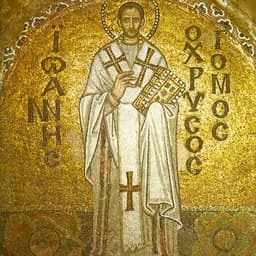
St. John Chrysostom (c. 347–407)
Homilies on the Gospel of John, Homily 88 (on John 21:15–23) Source: trans. in the Nicene and Post-Nicene Fathers, First Series, Vol. 14. Public domain. Full text: https://www.ccel.org/ccel/schaff/npnf114.iv.xc.html
On "lovest thou Me more than these", and why the charge is laid upon Peter alone:
On the threefold question, and the price the Lord sets upon His sheep:
On "signifying by what death he should glorify God":
On "If I will that he tarry till I come, what is that to thee":
St. Cyril of Alexandria (c. 376–444)
Commentary on the Gospel of John, Book XII (on John 21:15–19) Source: trans. T. Randell, Library of Fathers, 1885. Public domain. Full text: https://www.tertullian.org/fathers/cyril_on_john_12_book12.htm
On the thrice-repeated confession that answers the thrice-repeated denial:
On "Feed My lambs" as the renewing of the apostleship:
On the charge as a lesson for all who teach and shepherd in the Church:
Theophylact of Ohrid (c. 1055–1107)
As preserved in the Catena Aurea on John. Public domain.
On the commission given to Peter when the meal was ended:
On the difference between the lambs and the sheep:
Origen of Alexandria (c. 185–254)
As preserved in the Catena Aurea on John. Public domain.
On "when thou shalt be old ... another shall gird thee":
Blessed Augustine of Hippo (354–430)
Tractates on the Gospel of John, Tractates 123–124 (on John 21:15–23) Source: trans. in the Nicene and Post-Nicene Fathers, First Series, Vol. 7. Public domain. Full text: https://www.ccel.org/ccel/schaff/npnf107.iii.cxxiv.html
On the denier and lover brought at last to a perfected love:
On the threefold confession that answers the threefold denial:
On "Lovest thou me? Feed my sheep", and the shepherd who must not feed himself:
On "If I will that he tarry till I come", read of the two lives, action and contemplation: