All entriesmiracle

The Resurrection

Matt 28; Mark 16; Luke 24; John 20 · Post-Resurrection

Matthew 28:1–10

n the end of the sabbath, as it began to dawn toward the first day of the week, came Mary Magdalene and the other Mary to see the sepulchre. 2And, behold, there was a great earthquake: for the angel of the Lord descended from heaven, and came and rolled back the stone from the door, and sat upon it. 3His countenance was like lightning, and his raiment white as snow: 4And for fear of him the keepers did shake, and became as dead men. 5And the angel answered and said unto the women, Fear not ye: for I know that ye seek Jesus, which was crucified. 6He is not here: for he is risen, as he said. Come, see the place where the Lord lay. 7And go quickly, and tell his disciples that he is risen from the dead; and, behold, he goeth before you into Galilee; there shall ye see him: lo, I have told you. 8And they departed quickly from the sepulchre with fear and great joy; and did run to bring his disciples word. 9And as they went to tell his disciples, behold, Jesus met them, saying, All hail. And they came and held him by the feet, and worshipped him. 10Then said Jesus unto them, Be not afraid: go tell my brethren that they go into Galilee, and there shall they see me.

King James Version · public domain

Mateu 28:1–10

dhe si shkoj e-shëtuna, dyke gdhir’ e Djelë, që ësht’ e para dit’ e javësë, erdhi Maria Magdhalini, edhe Maria tjatërë, që të shihninë varrë. 2Edhe ja tek ubë një tëmet i-math; sepse ëngjëll’ i Zotit sbriti nga qielli, edhe erdhi e rrukullisi gurinë nga dera e varrit, edhe rrinte sipër’ ati. 3Edhe faqeja e ati ishte posi vetëtimë, edhe rroba e ati e-bardhë posi dëborë. 4Edhe ata që ruanin’ utrëmpnë nga frik’ e ati, edhe ubënë posi të-vdekurë. 5Edhe ëngjëlli upërgjeq e u tha gravet, Mos kini frikë; sepse e di se kërkoni Jisunë që ukryqëzua. 6Nukë është këtu; sepse ungjall, sindëkur pat thënë. Ejani, shihni vëndinë ku dergjej Zoti. 7Edhe shkoni shpejt e u thoni nxënësvet t’ati, se ungjall nga të-vdekuritë; edhe ja tek po vete ay më përpara se ju ndë Galilet; atje dot’a shihni atë; ja tek u thashë juve. 8Edhe ato duallnë shpejt nga varri me frikë edhe me gëzim të-math, edhe usulnë t’u apënë zë nxënësvet t’ati. 9Edhe dyke vaturë t’u epninë zë nxënësvet t’ati, ja Jisuj tek upoq me ato, e u tha, Gëzohi. Edhe ato i erthnë përanë, e i zunë këmbëtë, edhe i ufalnë. 10Atëhere Jisuj u tha atyre, Mos kini frikë, shkoni, ep-u-ni zë vëllezërvet të mi, që të shkonjënë ndë Galilet, edhe atje dotë më shohënë.

Kristoforidhi, Dhiata e Re Toskërisht 1879 · zotërim publik

Summary

The foundation of the faith. By His death Christ tramples death, and by rising raises human nature with Him: "Christ is risen from the dead, trampling down death by death." The Resurrection is not one miracle but the meaning of all, the seal of the Cross, proof that the One who died was God, and the first day of the new creation.

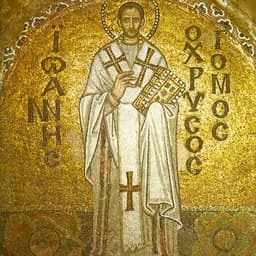
The great texts, read every Pascha, are St. Gregory the Theologian's Paschal Oration and St. John Chrysostom's Catechetical Homily. Gregory sees the rising as descent completed: the Word who emptied Himself now lifts the nature He assumed, the feast a true Pascha, a passage from death to life. Chrysostom notes the grave-clothes in order and the napkin folded apart, no thief having come; in the empty tomb and angel's "He is not here, He is risen" he hears the gates of Hades broken and death's reign ended.

The tradition also reads it through the Old Testament: Jonah three days in the deep, which Christ Himself names, foreshadows the three days in the heart of the earth, and the Passover lamb and Red Sea crossing are fulfilled in this true exodus from death. Where the first Adam by disobedience drew all into corruption, the new Adam by obedience raises all, "the firstborn from the dead" and our firstfruits. St. Cyril of Alexandria presses the bond between Head and members, since the life-giving flesh of the Word could not be held by death; St. John of Damascus confesses the Resurrection of the whole Christ, soul reunited to the incorrupt body, the pledge of the general resurrection; and St. Ephrem the Syrian sings of the tomb giving back the Living One and death swallowed up. So the Church receives the risen Christ as firstfruits of her immortality and beginning of theosis.

In their own words

but today we are celebrating the Resurrection itself, no longer as an object of expectation, but as having already come to pass, and gathering the whole world unto itself.

St. Gregory the Theologian (Nazianzen), Oration XLV: The Second Oration on Easter, Section II; NPNF2 Vol. 7

The Resurrection (Luke 24:1–12)

Public-Domain Patristic Commentary

This is the miracle on which all the others rest, and the foundation of the Christian faith: "if Christ be not risen, then is our preaching vain." Luke tells it through the women who came to the tomb at first light. "Now upon the first day of the week, very early in the morning, they came unto the sepulchre, bringing the spices which they had prepared. And they found the stone rolled away from the sepulchre. And they entered in, and found not the body of the Lord Jesus." Then the two men in shining garments stood by them, and spoke the words that are the heart of the Gospel: "Why seek ye the living among the dead? He is not here, but is risen." The women remembered his words, returned, and told the eleven, who held it for an idle tale, until Peter ran to the tomb and saw the linen clothes laid by themselves.

The Fathers gather many threads from this scene. They dwell on the women's love and zeal, that brought them first to the tomb; on the empty grave and the angels as the proofs of the Resurrection; on the women as the first heralds, the sex that once carried death now carrying the news of life, so that the curse of Eve is reversed; on the very disbelief of the apostles as, paradoxically, a confirmation of the truth, since men so slow to believe could not have invented it; on the third day as the proof that the death was real and the body incorrupt; and on the deeper figure of the tomb, the spices, and the rolled-back stone. Gathered below are seven Fathers, four from the East and three from the West, each quoted verbatim from a public-domain translation. A note on the sourcing follows, since this passage is preserved for several of them only through the Catena Aurea, and since Chrysostom, who wrote no commentary on Luke, is heard here through his homily on Matthew's parallel account.


St. John Chrysostom (c. 347–407)

From his Homilies on the Gospel of Matthew (Homily 89, on Matthew 27:62–28:10), NPNF translation. Public domain. Chrysostom comments here on Matthew's account of the same events.

On how the enemies of Christ, against their will, established the truth:

Everywhere deceit recoils upon itself, and against its will supports the truth ... It was necessary for it to be believed that He died, and that He rose again, and that He was buried, and all these things are brought to pass by His enemies.

On the sealed and guarded tomb, which made the Resurrection incontrovertible:

For because it was sealed, there was no unfair dealing. But if there was no unfair dealing, and the sepulchre was found empty, it is manifest that He is risen, plainly and incontrovertibly.

On why the disciples could not have feigned a resurrection:

For if the chief of them endured not the speech of a woman keeping the door, and if all the rest too, on seeing Him bound, were scattered abroad, how should they have thought to run to the ends of the earth, and plant a feigned tale of a resurrection?

On why the angel rolled away the stone, and the women became witnesses:

After the resurrection came the angel. Why then came he, and took away the stone? Because of the women ... that they might believe that He was risen again, they see the sepulchre void of the body ... Therefore also He had led them to the sight, that they might become witnesses of both things, both of His tomb, and of His resurrection.

On Christ honoring, through the women, the sex that had been dishonored:

Mark how He Himself sends good tidings to His disciples by these women, bringing to honor, as I have often said, that sex, which was most dishonored, and to good hopes; and healing that which was diseased.


St. Cyril of Alexandria (c. 376–444)

From his Commentary on Luke, as compiled in the Catena Aurea on Luke (Cyril's own text is fragmentary here). Public domain.

On the women, perplexed at the empty tomb, found worthy of the angels:

When then they found not the body of Christ which was risen, they were distracted by various thoughts, and for their love of Christ and the tender care they had shewn Him, were thought worthy of the vision of angels.

On the woman as the first herald of the Resurrection, and the reversal of the curse:

For woman who was once the minister of death, is now the first to receive and tell the awful mystery of the resurrection. The female race has obtained therefore both deliverance from reproach, and the withdrawal of the curse.


Theophylact of Ohrid (c. 1055–1107)

From his Explanation of the Gospel of Luke, as compiled in the Catena Aurea on Luke. Public domain.

On the Resurrection as naturally past belief, and the apostles' first response:

Now the miracle of the resurrection is naturally incredible to mankind. Hence it follows, And their words seemed to them as idle tales.

On Peter running to the tomb, and his wonder at the grave-clothes:

Peter, as soon as he heard this, delays not, but runs to the sepulchre; for fire when applied to matter knows no delay ... wondering in himself at the way in which it had happened, how the linen clothes had been left behind, since the body was anointed with myrrh.


St. Athanasius the Great (c. 296–373)

From his On the Incarnation of the Word, as compiled in the Catena Aurea on Luke. Public domain.

On why the Lord waited until the third day to rise:

He might indeed at once have raised His body from the dead. But some one would have said that He was never dead, or that death plainly had never existed in Him ... In order therefore to shew His body to be dead, He suffered the interval of one day, and on the third day manifested His body to be without corruption.


St. Ambrose of Milan (c. 339–397)

From his Exposition of the Gospel of Luke, as compiled in the Catena Aurea on Luke. Public domain.

On why the women, not permitted to teach, are sent to those at home:

It is not allowed to women to teach in the church, but they shall ask their husbands at home. To those then who are at home is the woman sent.

On the woman who once carried sin now carrying grace (preserved in Bede's citation of Ambrose):

For that the woman might not endure the everlasting reproach of guilt from men, she who had transfused sin into the man, now also transfuses grace.


St. Bede the Venerable (c. 673–735)

From his Exposition of the Gospel of Luke, as compiled in the Catena Aurea on Luke. Public domain.

On the women's zeal and love, and where the living is not to be sought:

By the women coming to the sepulchre very early in the morning, is manifested their great zeal and fervent love of seeking and finding the Lord ... But not in the sepulchre, which is the place of the dead, was He to be sought, who rose from the dead to life.

On the mystical meaning of the tomb, the spices, and the rolled-back stone:

For that sepulchre also bore the figure of the Altar of the Lord, wherein the mysteries of Christ's Body, not in silk or purple cloth, but in pure white linen ... ought to be consecrated ... But the spices which the women bring, signify the odour of virtue, and the sweetness of prayers by which we ought to approach the Altar. The rolling back of the stone alludes to the unclosing of the Sacraments which were concealed by the veil of the letter of the law.


St. Gregory the Great (c. 540–604)

From his Homilies on the Gospels, as preserved in Bede's citation in the Catena Aurea on Luke. Public domain.

On the disbelief of the apostles as, in the end, our own strengthening:

Which was not so much their weakness, as so to speak our strength. For the resurrection itself was demonstrated to those who doubted by many proofs, which while we read and acknowledge we are through their doubts confirmed in the truth.


Note on sources and other Fathers

This passage draws on an unusually full chain, and the balance of voices is worth marking. The two great pillars are Chrysostom and Cyril. Chrysostom, since he wrote no commentary on Luke, is quoted here from his Homily 89 on Matthew, where he treats the parallel account with his characteristic apologetic force: the enemies' own sealing and watching of the tomb prove the Resurrection, the fearful and scattered disciples could not have feigned it, and the risen Lord honors the once-dishonored sex by making the women the first witnesses of both the empty tomb and the rising. Cyril's commentary on Luke survives only in fragments through the Passion and Resurrection, so his words come through the Catena Aurea, and they carry the great theme of the woman who, once "the minister of death," becomes "the first to receive and tell the awful mystery of the resurrection." Theophylact adds that the Resurrection is "naturally incredible," and that Peter ran to the tomb because "fire knows no delay." Athanasius supplies the dogmatic reason for the third day, that the death might be shown real and the body incorrupt. From the West, Ambrose marks the women sent home and the grace now transfused through the woman, Bede the women's fervent love and the rich figure of the tomb as the altar and the spices as the odour of virtue, and Gregory the paradox that the apostles' doubt becomes our strength.

Three further voices in the same Catena are noted here rather than quoted at length: Eusebius, who reads the angels' shining garments as tokens of joy, set against the sun darkened at the Passion; Augustine, whose comment here is chiefly the careful harmonizing of the four accounts of the angels and of Peter and John at the tomb; and the lines marked in the Catena as Bede's citations of Ambrose and of Gregory, which are attributed above to those Fathers, since the words are theirs as Bede hands them on. Quotations are verbatim: Chrysostom from his Homily 89, and the rest through the Catena Aurea on Luke, as marked in each attribution. Because Luke's account is the chosen center, the parallel narratives in Matthew, Mark, and John are present only as the Fathers themselves bring them in, chiefly to harmonize the timing, the number of the angels, and the order of Peter and John at the tomb.

Patristic sources