The Scourging, Crown of Thorns, and Mocking
Matt 27:27–31; Mark 15:16–20; John 19:1–3 · Passion week in Jerusalem
Scripture
Matthew 27:27–31
hen the soldiers of the governor took Jesus into the common hall, and gathered unto him the whole band of soldiers. 28And they stripped him, and put on him a scarlet robe. 29And when they had platted a crown of thorns, they put it upon his head, and a reed in his right hand: and they bowed the knee before him, and mocked him, saying, Hail, King of the Jews! 30And they spit upon him, and took the reed, and smote him on the head. 31And after that they had mocked him, they took the robe off from him, and put his own raiment on him, and led him away to crucify him.
King James Version · public domain
Mateu 27:27–31
tëhere ushtëtarët’ e qivernitarit muarnë me vetëhe Jisunë ndë pretorët (guvernatore), edhe mblothnë mbi atë gjithë tufën’ e ushtëtarëve. 28Edhe e sveshnë, e i veshnë ati një rrobë të-gjatë të-kuqe. 29Edhe gërshetuanë një kurorë ferrash, e j’a vunë mbi kryet, edhe i dhanë një kallam ndë dorët të-djathtë; edhe ranë mbë gjunjë përpara ati, edhe e përqeshninë, dyke thënë, Gëzohu, o mbret i Judhenjvet. 30Edhe si e pshtynë, muarnë kallamin’ e i bininë krejt t’ati. 31Edhe passi e përqeshnë, i sveshnë rrobat’ e tia; edhe e shpunë t’a kryqëzonjënë.
Kristoforidhi, Dhiata e Re Toskërisht 1879 · zotërim publik
In their own words
In the scarlet robe He bears the bloody works of the Gentiles; by the crown of thorns He takes away the ancient curse; with the reed He destroys poisonous animals; or He held the reed in His hand wherewith to write down the sacrilege of the Jews.
St. Jerome, Commentary on Matthew (Catena Aurea)
Patristic sources
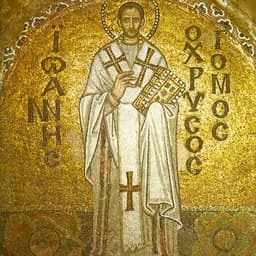
- St. John Chrysostom
- Homilies on Matthew, Hom. 87
- Homilies on John, Hom. 84
- Origen of Alexandria
- Commentary on Matthew (Catena Aurea)
Gospel exegesis at this verse survives only as excerpted in the Catena Aurea; quoted with care, as some of his wider speculations were condemned in 553.
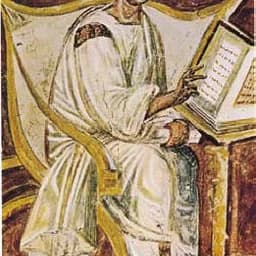
- Blessed Augustine of Hippo
- Harmony of the Gospels (Catena Aurea)
Venerated in the East as Blessed.
- St. Jerome
- Commentary on Matthew (Catena Aurea)
- St. Hilary of Poitiers
- Commentary on Matthew (Catena Aurea)
- Remigius of Auxerre
- Commentary on Matthew (Catena Aurea)
A later Western compiler; the Catena is the only public-domain English text of his Gospel gloss.
Read the sources: Chrysostom, Homily 87 on Matthew (CCEL, NPNF1-10) · Chrysostom, Homily 84 on John (CCEL, NPNF1-14) · Catena Aurea on Matthew 27 (CCEL)
The Scourging, Crown of Thorns, and Mocking (Matthew 27:27–31; Mark 15:16–20; John 19:1–3)
The texts below are quoted verbatim from public-domain English translations; nothing is paraphrased.
St. John Chrysostom (c. 347–407)
Homilies on the Gospel of Matthew, Homily 87 (on Matthew 27:27–29) Source: trans. in the Nicene and Post-Nicene Fathers, First Series, Vol. 10. Public domain. Full text: https://www.ccel.org/ccel/schaff/npnf110/npnf110.iii.LXXXIII.html
On the whole body made an object of insolence, and what plea we can have for resenting injuries after Christ suffered thus:
In the Homilies on the Gospel of John (Homily 84, on John 18:37–19:3; Nicene and Post-Nicene Fathers, First Series, Vol. 14), on beholding the King of the world and of all Angels mocked, and bearing all silently:
Origen of Alexandria (c. 185–254)
As preserved in the Catena Aurea on Matthew. Public domain. Full text: https://www.ccel.org/ccel/aquinas/catena1.ii.xxvii.html
(Origen's Matthew exegesis survives at this verse only as excerpted in the Catena; some of his wider speculations were later condemned in 553, but the readings below are the Catena's mystical glosses on the reed and the thorns.)
On the reed of the world's kingdoms, which Christ took to triumph over it by the wood of the cross:
On the ancient thorns of ours, now taken away:
Blessed Augustine of Hippo (354–430)
As preserved in the Catena Aurea on Matthew. Public domain. Full text: https://www.ccel.org/ccel/aquinas/catena1.ii.xxvii.html
On why Mark says "purple" where Matthew says "scarlet":
St. Jerome (c. 347–420)
As preserved in the Catena Aurea on Matthew. Public domain. Full text: https://www.ccel.org/ccel/aquinas/catena1.ii.xxvii.html
On the mock royalty of cloak, crown, and reed:
On the same insults understood mystically, the crown of thorns taking away the ancient curse:
St. Hilary of Poitiers (c. 310–367)
As preserved in the Catena Aurea on Matthew. Public domain. Full text: https://www.ccel.org/ccel/aquinas/catena1.ii.xxvii.html
On the scarlet robe, the crown of thorns, and the reed borne for the Gentiles:
Remigius of Auxerre (c. 841–908)
As preserved in the Catena Aurea on Matthew. Public domain. (A later Western compiler, included for his brief gloss.) Full text: https://www.ccel.org/ccel/aquinas/catena1.ii.xxvii.html
On the scarlet robe as the Lord's flesh, reddened by His blood, and the crown of thorns as our sins: