The ten virgins
Matt 25:1–13 · Passion week in Jerusalem
Scripture
Matthew 25:1–13
hen shall the kingdom of heaven be likened unto ten virgins, which took their lamps, and went forth to meet the bridegroom. 2And five of them were wise, and five were foolish. 3They that were foolish took their lamps, and took no oil with them: 4But the wise took oil in their vessels with their lamps. 5While the bridegroom tarried, they all slumbered and slept. 6And at midnight there was a cry made, Behold, the bridegroom cometh; go ye out to meet him. 7Then all those virgins arose, and trimmed their lamps. 8And the foolish said unto the wise, Give us of your oil; for our lamps are gone out. 9But the wise answered, saying, Not so; lest there be not enough for us and you: but go ye rather to them that sell, and buy for yourselves. 10And while they went to buy, the bridegroom came; and they that were ready went in with him to the marriage: and the door was shut. 11Afterward came also the other virgins, saying, Lord, Lord, open to us. 12But he answered and said, Verily I say unto you, I know you not. 13Watch therefore, for ye know neither the day nor the hour wherein the Son of man cometh.
King James Version · public domain
Mateu 25:1–13
tëhere mbretëri’ e qiejvet dotë gjanjë me dhjetë virgjëresha, të-cilatë muarnë llambat’ e tyre, e duallnë të presënë dhëndërrinë. 2Edhe nga ato pesë ishinë të-mënçime, edhe pesë të-marra. 3Ato të-marratë, kur muarnë llambat’ e tyre, nukë muarnë vaj me vetëhe; 4Po të-mënçimetë muarnë vaj ndë enët të tyre bashkë me llambat’ e tyre. 5Edhe dhëndërri si uvonua, i zuri gjumi të-gjitha edhe flininë. 6Edhe ndë mest të natësë ubë një të-thirrurë, Ja dhëndëri tek po vjen; dilni për të-pritur’ atë. 7Atëhere, gjith’ ato virgjëreshat’ ungritnë, edhe ndreqnë llambat’ e tyre. 8Po të-marrat’ u thanë të-mënçimevet, Ep-na-ni nga vaji juaj; sepse po na shuhenë llambatë. 9Edhe të-mënçimetë upërgjiqnë, dyke thënë, Mos nukë dotë na dalë neve edhe juve; po më mirë shkoni tek ata që shesënë, edhe blini për vetëhenë t’uaj. 10Edhe kur vanë të blenë, dhëndërri erdhi; edhe ato që ishinë gati hynë bashkë me atë ndë dasmët, edhe umbyll dera. 11Po pastaj vijn’ edhe virgjëreshat’ e-tjera, e thonë, Zot, Zot, hap-na. 12Po ay upërgjeq e tha, Me të-vërtetë po u them juve, nuk u njoh juve. 13Rrini sgjuarë pra, sepse nuk’ e dini ditën’ as orënë, ndë të-cilët vjen i Bir’ i njeriut.
Kristoforidhi, Dhiata e Re Toskërisht 1879 · zotërim publik
Summary
All ten are virgins, and all carry lamps: the parable concerns not the world against the Church but a division within the called, between those whose virtue is alive and those whose virtue has gone cold. All slumber and sleep, for sleep, in the older reading, is the death that overtakes wise and foolish alike; the difference shows only when the cry sounds at midnight. The Fathers read the oil as what cannot be borrowed at the last hour: the works of mercy, the grace of the Spirit, the virtue laid up over a lifetime. The delay of the Bridegroom is the time before the Parousia, and the shut door the finality of judgment.
Chrysostom presses this with force: the five who failed had kept their bodies pure, yet were shut out for lack of mercy, so that even the lamp of virginity gutters out without almsgiving. No one can lend us his works at the door, and each must answer with his own. St. Methodius built an entire treatise upon this parable, his Symposium (the Banquet of the Ten Virgins), praising virginity as the highest discipline.
St. Ephrem and the wider tradition draw out the bridal and ascetical sense: the soul betrothed to Christ keeps vigil with a trimmed lamp, and watchfulness is the whole art of keeping oil in the vessel. Origen and the tradition read the parable inwardly, the oil as teaching and good deeds that sustain the light of the mind, while Theophylact notes that the closing word "Watch" stands because the day and hour are hidden. So the Church keeps the parable in Holy Week, in the Bridegroom services, where the troparion "Behold, the Bridegroom comes at midnight" turns the warning into prayer: that we be found watching, our lamps burning, lest the door be shut.
In their own words
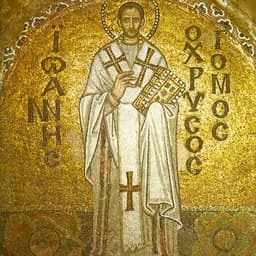
But by lamps here, He meaneth the gift itself of virginity, the purity of holiness; and by oil, humanity, almsgiving, succor to them that are in need.
St. John Chrysostom, Homilies on the Gospel of St. Matthew, Homily LXXVIII (on Matt. XXV. 1-30), NPNF1 Vol. 10
Patristic sources
- St. Methodius of Olympus
- The Symposium (The Banquet of the Ten Virgins), a whole treatise on this parable
- St. John Chrysostom
- Homilies on Matthew, Hom. 78
- Theophylact of Ohrid
- Commentary on Matthew, on Matt 25
- St. Ephrem the Syrian
- Hymns on Virginity
- Origen of Alexandria
- Commentary on Matthew, Book XVII
Read the sources: Methodius, The Banquet (ANF, CCEL) · Chrysostom on Matthew (CCEL)
The Ten Virgins (Matthew 25:1–13)
Public-Domain Patristic Commentary
The kingdom of heaven is likened to ten virgins who take their lamps and go forth to meet the bridegroom. Five are wise and five foolish: the foolish take their lamps but no oil, while the wise take oil in their vessels along with their lamps. The bridegroom tarries, and they all slumber and sleep. At midnight a cry is made: "Behold, the bridegroom cometh; go ye out to meet him." All the virgins rise and trim their lamps, but the foolish find theirs going out and say to the wise, "Give us of your oil." The wise answer, "Not so; lest there be not enough for us and you: but go ye rather to them that sell, and buy for yourselves." While they go to buy, the bridegroom comes; they that are ready go in with him to the marriage, and the door is shut. Afterward the other virgins come, saying, "Lord, Lord, open to us." But he answers, "Verily I say unto you, I know you not." "Watch therefore, for ye know neither the day nor the hour wherein the Son of man cometh."
This parable is found only in Matthew. The Fathers read the bridegroom as Christ and the ten virgins as the whole company of those who profess the faith, the mixed Church in which good and bad are gathered together. The lamps are the profession itself, the purity of holiness, the natural faculties turned toward God; and the oil is what must fill them from within: good works, and above all, as Chrysostom presses, mercy and almsgiving. The wise are those whose profession is backed by works; the foolish are those who have the lamp of profession but not the oil to keep it burning. The tarrying of the bridegroom is the long interval before the coming; the shut door is the finality of judgment; "I know you not" is the rejection of those found empty; and "Watch" is the warning that closes it. Gathered below are five Fathers, two from the East and three from the West, each quoted verbatim from a public-domain translation.
St. John Chrysostom (c. 347–407)
From his Homilies on the Gospel of Matthew (Homily 78, on Matthew 25:1–30), NPNF translation. Public domain.
On what the lamps and the oil signify:
On virginity destitute of mercy:
On the tarrying, and that death is a sleep:
On the folly of seeking oil out of season:
On why no one can lend us oil at that hour:
On who it is that sells the oil:
On the shut door and the fearful word:
Origen (c. 185–254)
From his Commentary on Matthew, as compiled in the Catena Aurea on Matthew. Public domain.
On the virgins and their lamps:
On why all must be wise or all foolish:
St. Gregory the Great (c. 540–604)
From his Homilies on the Gospels, as compiled in the Catena Aurea on Matthew. Public domain.
On the one thing the foolish lack:
On why the lamps of the foolish go out:
St. Jerome (c. 347–420)
From his Commentary on Matthew, as compiled in the Catena Aurea on Matthew. Public domain.
On who the virgins with oil are:
On why the wise will not share, and why no virtue can be borrowed:
Blessed Augustine of Hippo (354–430)
From his Questions on the Gospels, as compiled in the Catena Aurea on Matthew. Public domain.
On why both wise and foolish are called virgins:
On the habit that betrays the foolish:
Note on sources and other Fathers
The Fathers agree closely here, and their differences are differences of emphasis on a single point: the oil. Chrysostom gives the boldest reading, that the oil is mercy and almsgiving, so that virginity itself, lacking it, "is cast out with the harlots," and the poor are the very merchants from whom the oil must be bought, here and not hereafter. Origen reads the lamps as the natural faculties carried out of the world to meet the Saviour, and notes that the virtues are so linked that one must be wholly wise or wholly foolish. Gregory observes that all have lamps but not all have oil, and that the works of the foolish, bright outwardly, are dimmed within at the coming of the Judge. Jerome names the oil as good works added to faith, and draws the sobering conclusion that no one's virtue can be lent to another at the judgment, "for each man shall receive the recompense of his own works." Augustine adds the inward turn: the same continence may be kept to please God in the joy of a good conscience, or only to win the applause of men, and the foolish are those who sought their witness from men rather than from God.
Hilary of Poitiers read the oil likewise as "the fruit of good works" stored in the vessels of the body, and identified the sellers as the poor; his words are noted here rather than quoted, as is the Eastern line of Theophylact on this Matthean text. Chrysostom, Origen, Gregory, Jerome, and Augustine are the five quoted, with Chrysostom verbatim from his Homily 78 and the rest through the Catena Aurea, as marked in each attribution.