The two sons
Matt 21:28–32 · Passion week in Jerusalem
Scripture
Jump to a Father
Matthew 21:28–32
ut what think ye? A certain man had two sons; and he came to the first, and said, Son, go work to day in my vineyard. 29He answered and said, I will not: but afterward he repented, and went. 30And he came to the second, and said likewise. And he answered and said, I go, sir: and went not. 31Whether of them twain did the will of his father? They say unto him, The first. Jesus saith unto them, Verily I say unto you, That the publicans and the harlots go into the kingdom of God before you. 32For John came unto you in the way of righteousness, and ye believed him not: but the publicans and the harlots believed him: and ye, when ye had seen it, repented not afterward, that ye might believe him.
King James Version · public domain
Mateu 21:28–32
dhe qysh u duketë juve? Një njeri kishte dy bij; edhe erdhi tek i-pari e i tha, Bir, shko sot e puno ndë vreshtët t’im. 29Edhe ay upërgjeq e tha, Nukë dua; po pastaj upendua, edhe vate. 30Edhe erdhi tek i-dyti, e i tha po ashtu; Edhe ay upërgjeq e tha, unë vete Zot; edhe nukë vate. 31Cili nga këta të dy bëri dashurimn’ e t’et? I thonë, I-pari. Jisuj u thot’ atyre, Me të-vërtetë po u them juve, se kumerqarët’ edhe kurvatë venë më përpara se ju ndë mbretërit të Perëndisë. 32Sepse Joani erdhi te ju ndë udhë drejtërie, edhe nuk’ i besuatë; po kumerqarët’ e kurvatë i besuanë; edhe ju si patë, nuk’ upenduatë pastaj, që t’i besoni.
Kristoforidhi, Dhiata e Re Toskërisht 1879 · zotërim publik
Summary
A father tells his two sons to go work in the vineyard. The first refuses outright but later repents and goes; the second answers respectfully, "I go, sir," and does not go. When the Lord asks the chief priests and elders which of the two did the father's will, they are forced to condemn themselves, and He draws the conclusion plainly: the tax collectors and harlots enter the kingdom of God before them.
The Fathers read the two sons as two responses to the call of God. The first stands for the sinners, the tax collectors and harlots, who lived in open refusal of the Law but were moved to repentance by the preaching of John and of Christ; some extend this also to the Gentiles. The second stands for the leaders of the people, who professed obedience and prided themselves on the Law yet withheld the obedience of deeds. The point, as the Fathers stress, is that the Father seeks the work, not the word: it is doing His will, not the fair-sounding promise, that counts. St. John Chrysostom presses how the rulers are made to pass sentence on themselves out of their own mouths, so that their condemnation is shown to be just.
The vineyard the tradition takes as the service of God, the keeping of His commandments, the same vineyard that runs through the parables of this chapter and back to Isaiah's song of the vineyard. Origen reads the parable in its moral and inward sense, finding in it the soul's own divided will, the no that hardens and the no that turns to yes; what saves is not the first impulse but the turning, the metanoia that makes the deed follow. The closing word, that the rulers saw John's righteousness and "did not afterward repent," warns that empty profession hardens, while late repentance outruns it and opens the kingdom.
Patristic sources
- St. John Chrysostom
- Homilies on Matthew, Hom. 67
- Theophylact of Ohrid
- Commentary on Matthew, on Matt 21
- Origen of Alexandria
- Commentary on Matthew, Book XVII
The Two Sons (Matthew 21:28–32)
Public-Domain Patristic Commentary
A man has two sons and bids each go work in his vineyard. The first answers, "I will not," but afterward repents and goes; the second says, "I go, sir," and goes not. "Whether of them twain did the will of his father?" When the chief priests and elders answer, "The first," they pronounce sentence on themselves, and the Lord drives it home: "The publicans and the harlots go into the kingdom of God before you. For John came unto you in the way of righteousness, and ye believed him not; but the publicans and the harlots believed him; and ye, when ye had seen it, repented not afterward, that ye might believe him."
This parable is found only in Matthew, set within the Lord's exchange with the priests over His authority. The Fathers read the two sons in two complementary ways: as the Gentiles (who refused God in idolatry, then repented and labored) and the Jews (who promised obedience at Sinai, then failed); or simply as sinners (who repented at John's preaching) and the self-righteous (who professed the law but rejected John). Either way the lesson is one: it is the doer, not the sayer, who does the Father's will. Gathered below are four Fathers, two from the East and two from the West, each quoted verbatim from a public-domain translation, several as preserved in the Catena Aurea on Matthew (St. Thomas Aquinas, trans. J. H. Newman, 1841).
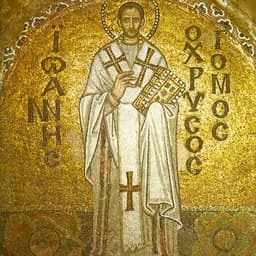
St. John Chrysostom (c. 347–407)
From his Homilies on the Gospel of Matthew (Homily 67, on Matthew 21:28–32), NPNF translation. Public domain.
On the two sons as the Gentiles and the Jews:
On how the law itself condemns them, and how He makes them self-condemned:
On why the Lord spoke of harlots, and the charge He adds:
On how the harlots entered, not as harlots, but by repentance:
On the hope this holds for everyone, that none should despair:
Origen (c. 185–254)
As preserved in the Catena Aurea on Matthew. Public domain.
On whom the Lord addresses in the parable:
On the Jews not being shut out forever:
St. Jerome (c. 347–420)
From his Commentary on Matthew, both directly and as compiled in the Catena Aurea on Matthew. Public domain.
On the purpose of the parable:
On the first son as the Gentiles and the second as the Jews:
On the second reading, of the sinners and the self-righteous:
On the true reading of the text, by which they condemn themselves:
St. Rabanus Maurus (c. 780–856)
From his Commentary on Matthew, as compiled in the Catena Aurea on Matthew. Public domain.
On the kingdom understood as the present Church:
On John preaching the way of righteousness:
Note on sources and other Fathers
The Fathers agree on the lesson and divide gently on the allegory. All read the parable as the Lord's trap of mercy: He draws the verdict from the priests' own mouths so that, as Chrysostom says, "He might make them even self-condemned," and only then unfolds the hard word about the publicans and harlots. On the two sons, Chrysostom and Jerome both give the reading of Gentiles and Jews: the first son refused (the Gentiles in idolatry) yet repented and worked, while the second promised at Sinai ("All that the Lord hath said we will do") yet failed. Jerome adds the second, simpler reading, of the sinners who repented at John's baptism against the Pharisees who despised it, and notes the textual point that the priests must answer "The first," sealing their own condemnation. Origen draws out both the moral aim of the parable, that it is the doer and not the boaster who is approved, and the wider hope of Romans, that the Jews are not shut out forever but shall be saved when the fulness of the Gentiles has come in. Chrysostom closes with the hope that runs through the whole parable, that no one "sunk down to the extremity of wickedness" should despair, since Rahab, the thief on the cross, Matthew the publican, and Paul the persecutor were all changed.
The Catena on Matthew carries a long series of comments under the name of Chrysostom that belong in fact to the Opus Imperfectum in Matthaeum, a later work not by Chrysostom himself; because that attribution is uncertain, those passages are not quoted here, and the genuine Chrysostom above is taken from his Homily 67. Gregory the Great also touched this parable.