All entriesparable

The unmerciful servant

Matt 18:21–35 · Journey to Jerusalem

Matthew 18:21–35

hen came Peter to him, and said, Lord, how oft shall my brother sin against me, and I forgive him? till seven times? 22Jesus saith unto him, I say not unto thee, Until seven times: but, Until seventy times seven. 23Therefore is the kingdom of heaven likened unto a certain king, which would take account of his servants. 24And when he had begun to reckon, one was brought unto him, which owed him ten thousand talents. 25But forasmuch as he had not to pay, his lord commanded him to be sold, and his wife, and children, and all that he had, and payment to be made. 26The servant therefore fell down, and worshipped him, saying, Lord, have patience with me, and I will pay thee all. 27Then the lord of that servant was moved with compassion, and loosed him, and forgave him the debt. 28But the same servant went out, and found one of his fellowservants, which owed him an hundred pence: and he laid hands on him, and took him by the throat, saying, Pay me that thou owest. 29And his fellowservant fell down at his feet, and besought him, saying, Have patience with me, and I will pay thee all. 30And he would not: but went and cast him into prison, till he should pay the debt. 31So when his fellowservants saw what was done, they were very sorry, and came and told unto their lord all that was done. 32Then his lord, after that he had called him, said unto him, O thou wicked servant, I forgave thee all that debt, because thou desiredst me: 33Shouldest not thou also have had compassion on thy fellowservant, even as I had pity on thee? 34And his lord was wroth, and delivered him to the tormentors, till he should pay all that was due unto him. 35So likewise shall my heavenly Father do also unto you, if ye from your hearts forgive not every one his brother their trespasses.

King James Version · public domain

Mateu 18:21–35

tëhere i erdhi përanë Pjetri, e tha, Zot, sa herë të më fëjenjë im vëlla, edhe t’j’a fal ati? gjer mbë shtatë herë? 22Jisuj i thot ati, Nukë të them, gjer mbë shtatë herë, po gjer mbë shtatë-dhjetë herë nga shtatë. 23Përandaj mbretëri’ e qiejvet gjau me një njeri mbret, që deshi të shohë llogari, me shërbëtorët’ e ti. 24Edhe kur zuri të shohë llogari, i prunë një detuar që i kishte detyrë dhjetë mijë tallanda. 25Edhe ay passi nukë kishte t’i lanjë, i zoti urdhëroj të shitet’ ay, edhe gruaj’ e ati, edhe të bijtë, edhe gjithë ç’kishte, edhe të lahetë detyra. 26Po shërbëtori i ra ndër këmbë, e i lutej, dyke thënë, Zot, bënu zëmërëgjerë mbë mua, edhe dotë t’i lanj të-gjitha. 27Edhe të zott si i udhëmp për atë shërbëtuar, e lëshoj, edhe j’a la detyrënë. 28Po ay shërbëtuar si dolli, gjeti një nga shokët’ e ti shërbëtorë që i kishte detyrë ati një qint dinare; edhe si e zuri, e mbyste, dyke thënë, Laj-më ç’detyrë më ke. 29Atëhere pra shoku i ti shërbëtuar i ra ndër këmbë, e i lutej, dyke thënë, Bënu zëmërë-gjerë mbë mua, edhe dotë t’i lanj të-gjitha. 30Edhe ay nukë donte, po shkoj edhe e vuri ndë burk, gjersa t’i lante detyrënë. 31Edhe shokët’ e ti shërbëtorë, kur panë se ç’ubë, u helmuanë fort; edhe erthnë e i rrëfyenë të zott gjithë sa ubënë. 32Atëhere i zoti e thirri përanë, e i tha, Shërbëtuar i-lik, gjith’ atë detyrë t’a lashë ty, sepse m’ulute; 33Nukë duhej edhe ti t’a përdëllenje shoknë t’ënt shërbëtuar, sindëkur të përdëlleva edhe unë ty? 34Edhe i zoti uzemërua, edhe e dha ndër duart t’atyre që mundojnë, gjer sa të lanjë gjithë detyrënë që i kishte ati. 35Kështu edhe im Atë qiellori dot’u’a bënjë juve, ndë mos u’a falçi prej zëmërësë s’uaj gjithë-si-cili të vëllat të ti fajet’ e atyre.

Kristoforidhi, Dhiata e Re Toskërisht 1879 · zotërim publik

Summary

Peter asks how often he must forgive, offering seven times as if it were generous; the Lord answers "seventy times seven," meaning without counting at all, and tells this parable to show why. The servant forgiven a debt beyond reckoning who then seizes a fellow servant over a trifle is, the Fathers say, every one of us before God: our sins against Him are the ten thousand talents, the wrongs seed to us the hundred denarii. The tradition dwells on this disproportion deliberately, for what we are forgiven is past all paying while what we are asked to forgive is small, and the man who will not release a little after being released of everything condemns himself out of his own mouth.

The withdrawal of the king's pardon teaches that God's mercy toward us is bound to our mercy toward others. "Forgive us as we forgive" is not a metaphor but a condition: the debt already cancelled is reimposed when the servant proves merciless. Chrysostom dwells on the peril of an unforgiving heart, which undoes even forgiveness already received and hands a man over to the tormentors; he notes that the king punished not the first debt but the cruelty that came after it, so that it is our own hardness, not God's reluctance, that shuts the door.

Origen reads the reckoning more inwardly, taking the settling of accounts as the judgment in which every soul is examined, the prison and tormentors as consequences a man draws upon himself, and the long-suffering of the lord as divine patience that waits for repentance. Theophylact, following Chrysostom, presses that forgiveness must be "from the heart," not in word only, for the Lord ends with that very phrase. Set beside the Lord's Prayer, the parable becomes a daily examination: we ask to be forgiven only as we have forgiven.

In their own words

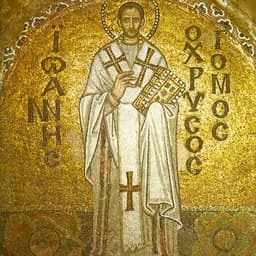
Two things therefore doth He here require, both to condemn ourselves for our sins, and to forgive others; and the former for the sake of the latter, that this may become more easy (for he who considers his own sins is more indulgent to his fellow-servant); and not merely to forgive with the lips, but from the heart.

St. John Chrysostom, Homilies on the Gospel of St. Matthew, Homily LXI (61), section 5; NPNF1 Vol. 10

The Parable of the Unmerciful Servant (Matthew 18:21–35)

Public-Domain Patristic Commentary

When Peter asks how often he must forgive a brother, "till seven times?", Christ answers, "Until seventy times seven," and tells a parable. A king settling accounts finds a servant who owes ten thousand talents and cannot pay; ordered to be sold with his family, the servant falls down and begs, and the king, moved with compassion, forgives the whole debt. But that same servant goes out, seizes a fellow servant who owes him a hundred pence, takes him by the throat, and casts him into prison. When the king hears of it, he calls him "wicked servant" and delivers him to the tormentors, "till he should pay all." The parable closes: "So likewise shall my heavenly Father do also unto you, if ye from your hearts forgive not every one his brother."

The parable is found only in Matthew. Chrysostom's homily on the chapter is the primary voice below, joined by Origen, Blessed Augustine, Jerome, and Remigius as gathered in the Catena Aurea on Matthew (St. Thomas Aquinas, trans. J. H. Newman, 1841). All texts are quoted verbatim from public-domain translations.


St. John Chrysostom (c. 347–407)

Homilies on the Gospel of Matthew, Homily 61 (on Matthew 18:21–35) Source: trans. in the Nicene and Post-Nicene Fathers, First Series, Vol. 10. Public domain. Full text: https://www.ccel.org/ccel/schaff/npnf110/npnf110.iii.LVIII.html

On "seventy times seven" as a number without limit:

What then saith Christ, the good God, who is loving towards man? "I say not unto thee, until seven times, but, until seventy times seven," not setting a number here, but what is infinite and perpetual and forever... So that He hath not limited the forgiveness by a number, but hath declared that it is to be perpetual and forever.

On the distance between the two debts:

Seest thou how great the difference between sins against man and against God? As great as between ten thousand talents, and a hundred pence, or rather even much more. And this arises both from the difference of the persons, and the constant succession of our sins. For when a man looks at us, we stand off and shrink from sinning: but when God sees us every day, we do not forbear.

On why the king first threatened to sell him:

"He commanded him to be sold, and his wife, and his children." Wherefore, I pray thee? Not of cruelty, nor of inhumanity (for the loss came back again upon himself, for she too was a slave), but of unspeakable tenderness. For it is His purpose to alarm him by this threat, that He might bring him to supplication, not that he should be sold.

On the gift that exceeded the request:

Seest thou again surpassing benevolence? The servant asked only for delay and putting off the time, but He gave more than he asked, remission and forgiveness of the entire debt. For it had been his will to give it even from the first, but he did not desire the gift to be his only, but also to come of this man's entreaty, that he might not go away uncrowned.

On revenge as a wound to oneself:

Let us hearken also, the merciless, and the cruel, for not to others are we cruel, but to ourselves. When then thou art minded to be revengeful, consider that against thyself art thou revengeful, not against another; that thou art binding up thine own sins, not thy neighbors.

On why the Lord says "my Father," not "your Father," at the close:

He saith not "your Father," but "my Father." For it is not meet for God to be called the Father of such a one, who is so wicked and malicious.

On the two things the parable requires:

Two things therefore doth He here require, both to condemn ourselves for our sins, and to forgive others; and the former for the sake of the latter, that this may become more easy (for he who considers his own sins is more indulgent to his fellow-servant); and not merely to forgive with the lips, but from the heart.


Origen (c. 185–254)

As preserved in the Catena Aurea on Matthew, trans. J. H. Newman, 1841. Public domain.

On the King's reckoning as the judgment of our whole life:

The King takes account of our whole life then, when "we must all be presented before the judgment-seat of Christ." ... For God, when He will scrutinize the minds of all, will by some undescribable power cause every thing that every man has done to pass speedily before the mind of each.

On the difference between the two who fell down:

The servant who owed many talents fell down, and worshipped the king; he who owed the hundred denarii falling down, did not worship, but besought his fellow servant, saying, "Have patience." But the ungrateful servant did not even respect the very words which had saved himself.

On the lesson of clemency:

He seeks to instruct us, that we should be ready to shew clemency to those who have done us harm, especially if they offer amends, and plead to have forgiveness.


Blessed Augustine of Hippo (354–430)

Sermon 83, as preserved in the Catena Aurea on Matthew, trans. J. H. Newman, 1841. Public domain. Full text: https://www.ccel.org/ccel/aquinas/catena1.ii.xviii.html

On forgiving without counting:

I am bold to say, that if he shall sin seventy-eight times, thou shouldest forgive him; yea, and if a hundred; and how oft soever he sin against thee, forgive him. For if Christ found a thousand sins, yet forgave them all, do not you withdraw your forgiveness.

On the ten thousand talents as the whole reach of the Law:

Therefore let us say, that because the Law is set forth in ten precepts, the ten thousand talents which he owed denote all sins which can be done under the Law.


St. Jerome (c. 347–420)

As preserved in the Catena Aurea on Matthew, trans. J. H. Newman, 1841. Public domain.

On why the Lord teaches by parable:

For it is customary with the Syrians, especially they of Palestine, to add a parable to what they speak; that what their hearers might not retain simply, and in itself, the instance and similitude may be the means of retaining.

Against reading the great debtor as the devil:

But how the Lord remits to the devil ten thousand talents, and how he would not remit ten denarii to us his fellow servants, of this there is no ecclesiastical interpretation, nor is it to be admitted by thoughtful men.

On the condition under which our greater sins are remitted:

If any one of you shall have committed an adultery, a homicide, or a sacrilege, these greater sins of ten thousand talents shall be remitted when you beg for it, if you also shall remit lesser offences to those that trespass against you.


Remigius of Auxerre (c. 841–908)

As preserved in the Catena Aurea on Matthew, trans. J. H. Newman, 1841. Public domain.

On who the servants are:

By the servants of this King are signified all mankind whom He has created for His own praise, and to whom He gave the law of nature; He takes account with them, when He would look into each man's manners, life, and deeds, that He may render to each according to that He has done.

On the debtor who has nothing with which to pay:

Man who sinned of his own will and choice, has no power to rise again by his own endeavour, and has not wherewith to pay, because he finds nothing in himself by which he may loose himself from his sins.


Note on sources and other Fathers

The Fathers read this parable as the whole economy of forgiveness in miniature. Chrysostom presses the arithmetic of mercy: "seventy times seven" is "not a number... but what is infinite," and the gulf between our debt to God and our neighbor's debt to us is as wide as "ten thousand talents" to "a hundred pence." He insists the threat of selling was "of unspeakable tenderness," meant to drive the man to prayer, and that the king "gave more than he asked," cancelling the whole. The sting lands at the end: when the forgiven man turns merciless, the vengeance "against thyself art thou revengeful," and the Lord says pointedly "my Father," not "your Father," of so hard a heart. Origen lifts the reckoning to the great Day, when "we must all be presented before the judgment-seat of Christ" and every deed is made to "pass speedily before the mind of each," and he marks how the second debtor, unlike the first, "did not even respect the very words which had saved himself." Augustine drives home the refusal to count ("if a hundred... do not you withdraw your forgiveness") and reads the ten thousand talents as "all sins which can be done under the Law." Jerome notes the Syrian custom of teaching by parable, warns that reading the great debtor as the devil has "no ecclesiastical interpretation," and lays down the condition plainly: even "adultery, a homicide, or a sacrilege" are remitted "if you also shall remit lesser offences to those that trespass against you." Remigius supplies the allegory: the servants are "all mankind," and the debtor "finds nothing in himself by which he may loose himself from his sins," which is why he needs the king's free pardon.

On the closing "tormentors," Remigius (with Chrysostom, Euthymius, and Theophylact agreeing) takes the meaning to be that the debt can never be paid, so the punishment is without end. The Catena on Matthew also carries comment under the names Pseudo-Chrysostom and a Gloss, together with allegorical notes by Rabanus Maurus reading the great debtor as the Jewish people; because those attributions are either insecure or belong to later Western compilers, they are noted here but not quoted as the words of the Fathers.

Patristic sources