The wedding banquet
Matt 22:1–14 · Passion week in Jerusalem
Scripture
Matthew 22:1–14
nd Jesus answered and spake unto them again by parables, and said, 2The kingdom of heaven is like unto a certain king, which made a marriage for his son, 3And sent forth his servants to call them that were bidden to the wedding: and they would not come. 4Again, he sent forth other servants, saying, Tell them which are bidden, Behold, I have prepared my dinner: my oxen and my fatlings are killed, and all things are ready: come unto the marriage. 5But they made light of it, and went their ways, one to his farm, another to his merchandise: 6And the remnant took his servants, and entreated them spitefully, and slew them. 7But when the king heard thereof, he was wroth: and he sent forth his armies, and destroyed those murderers, and burned up their city. 8Then saith he to his servants, The wedding is ready, but they which were bidden were not worthy. 9Go ye therefore into the highways, and as many as ye shall find, bid to the marriage. 10So those servants went out into the highways, and gathered together all as many as they found, both bad and good: and the wedding was furnished with guests. 11And when the king came in to see the guests, he saw there a man which had not on a wedding garment: 12And he saith unto him, Friend, how camest thou in hither not having a wedding garment? And he was speechless. 13Then said the king to the servants, Bind him hand and foot, and take him away, and cast him into outer darkness; there shall be weeping and gnashing of teeth. 14For many are called, but few are chosen.
King James Version · public domain
Mateu 22:1–14
dhe Jisuj upërgjeq përsëri e u tha atyre me paravolira, dyke thënë, 2Mbretëri’ e qiejvet gjan me mjë njeri mbret, i-cili bëri dasmë për të birr’ e ti; 3Edhe dërgoj shërbëtorët’ e ti të thërresën’ ata që qenë ftuarë ndë dasmët, po nukë deshnë të vinjënë. Përsëri dërgoj të-tjerë shërbëtorë, 4dyke thënë, thoj-u-ni atyre që janë ftuarë, Ja tek bëra gati drekënë t’ime; demat’ e mi edhe berrat’ e-ushqyera janë gati; ejani ndë dasmët. 5Po ata përtuan’ e shkuanë, njeri n’arët të ti, e tjetëri ndë tregëtit të ti; 6Edhe të-tjerëtë zunë shërbëtorët’ e ati, e i shanë, e i vranë. 7Po mbreti kur dëgjoj uzëmërua; edhe dërgoj ushtërit’ e ti, edhe prishi ata gjaksorëtë, edhe dogji qytetn’ e atyre. 8Atëhere u thotë shërbëtorëvet të ti, Dasma është gati, po ata që qenë të-ftuarë nuk’ ishinë të-vëjejturë. 9Shkoni pra ndëpër të-dalurat të udhëvet, edhe sa të gjeni, t’i ftoni ndë dasmët. 10Edhe ata shërbëtorëtë duallnë ndëpër udhët, e mblothnë gjithë sa gjetnë, të-liq e të-mirë; edhe dasma umbush me njerës që rrininë ndë mësallët. 11Edhe mbreti kur hyri të shohë ata që rrininë ndë mësallët, pa atje një njeri që s’kishte veshurë rrobë dasme. 12Edhe i thot’ ati, Mik, si hyre këtu pa pasurë rrobë dasme? Po ay mbëçeli gojënë. 13Atëhere mbreti u tha shërbëtorëvet, Lidh-e-ni atë prej këmbësh e prej duarsh, edhe ngri-e-ni, edhe hidh-e-ni ndë errësirët të-përjashtësme; atje dotë jetë të-qarët’ e të-kërcëlliturit’ e dhëmbëvet. 14Sepse shumë veta janë të-thirrurë, po të-pakë të-sgjedhurë.
Kristoforidhi, Dhiata e Re Toskërisht 1879 · zotërim publik
In their own words
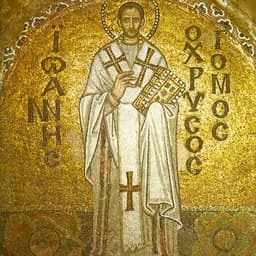
That thou mightest learn God's tender care, His yearning towards us, the cheerfulness of the state of things, that there is nothing sorrowful there, nor sad, but all things are full of spiritual joy.
St. John Chrysostom, Homilies on the Gospel of St. Matthew, Homily LXIX, section 1 (NPNF1 Vol. 10)
Patristic sources
- St. John Chrysostom
- Homilies on Matthew, Hom. 69
- Theophylact of Ohrid
- Commentary on Matthew, on Matt 22
- Origen of Alexandria
- Commentary on Matthew, Book XVII
Read the sources: Chrysostom on Matthew (CCEL)
The Wedding Banquet (Matthew 22:1–14)
The texts below are quoted verbatim from public-domain English translations; nothing is paraphrased.
St. John Chrysostom (c. 347–407)
From his Homilies on the Gospel of Matthew (Homily 69, on Matthew 22:1–14), NPNF translation. Public domain.
On what this parable adds to the one before it:
On why the feast is called a marriage:
On how the marriage after the death proclaims the resurrection:
On the excuses, and how spiritual things must be set first:
On the burning of the city, foretold:
On the wedding garment as life, and grace that must be kept:
Origen (c. 185–254)
From his Commentary on Matthew, as compiled in the Catena Aurea on Matthew. Public domain.
On the feast filled, and the garments to be put on:
St. Gregory the Great (c. 540–604)
From his Homilies on the Gospels (Homily 38), as compiled in the Catena Aurea on Matthew (Newman trans.). Public domain.
On the marriage feast as the Father joining the Son to human nature and to the Church:
On why this is a wedding feast, not the last and eternal supper:
On the wedding garment, which is charity, lacked by faith without love:
St. Jerome (c. 347–420)
From his Commentary on Matthew, as compiled in the Catena Aurea on Matthew. Public domain.
On the wedding garment as the commandments and works of the new man:
On the man called "friend," invited by faith yet shamed by his dress:
On why the parable ends as it does:
Blessed Augustine of Hippo (354–430)
From his Against Faustus, as compiled in the Catena Aurea on Matthew. Public domain.
On who it is that comes without a garment: