The Widow's Mite
Mark 12:41–44; Luke 21:1–4 · Passion week in Jerusalem
Scripture
Mark 12:41–44
nd Jesus sat over against the treasury, and beheld how the people cast money into the treasury: and many that were rich cast in much. 42And there came a certain poor widow, and she threw in two mites, which make a farthing. 43And he called unto him his disciples, and saith unto them, Verily I say unto you, That this poor widow hath cast more in, than all they which have cast into the treasury: 44For all they did cast in of their abundance; but she of her want did cast in all that she had, even all her living.
King James Version · public domain
Marku 12:41–44
dhe Jisuj ndënji kundruell arkës’ s’aspravet, edhe vinte re qysh gjindja hithte të-holla ndë arkët të aspravet; edhe shumë të-pasurë hithninë shumë. 42Edhe erdhi një e-ve e-varfërë, edhe hodhi dy të-imëta, do-me-thënë një kodhrant. 43Edhe Jisuj thirri përanë nxënësit’ e ti, e u tha atyre, Me të-vërtetë po u them juve, se kjo e-ve e-varfërë hodhi më tepërë se të-gjith’ ata që hothnë ndë arkët t’aspravet. 44Sepse të-gjithë prej tepëricës’ së tyre hothnë; po kjo prej skamjes së saj hodhi gjithë sa kishte, gjithë gjën’ e saj.
Kristoforidhi, Dhiata e Re Toskërisht 1879 · zotërim publik
In their own words
She who constantly asked alms of others, lends to God, making even poverty itself fruitful to His honour.
St. Cyril of Alexandria, Commentary on Luke, Sermon 138 (on Luke 21:1–4)
Patristic sources
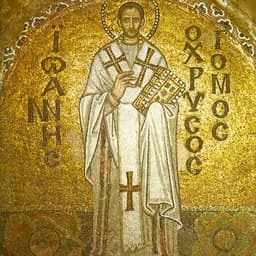
- St. John Chrysostom
- The widow's two mites, as preserved in the Catena Aurea on Luke
His comment on the widow survives in public-domain English only in the condensed form preserved by the Catena Aurea on Luke.
- St. Cyril of Alexandria
- Commentary on Luke, Sermon 138
The standalone sermon on Luke 21:1–4, from the Payne Smith translation of 1859.
- Theophylact of Ohrid
- Explanation of Mark (on Mark 12:41–44)
Preserved through the Catena Aurea on Mark; his standalone Explanation of Mark has no public-domain English edition.
- St. Bede the Venerable
- Commentary on Mark (on Mark 12:41–44)
Preserved through the Catena Aurea on Mark; Bede's Gospel exegesis is public-domain in English only through the Catena.
Read the sources: Cyril on Luke, Sermon 138 (tertullian.org) · Catena Aurea on Mark, ch. 12 (CCEL) · Catena Aurea on Luke (Internet Archive)
The Widow's Mite (Mark 12:41–44; Luke 21:1–4)
The texts below are quoted verbatim from public-domain English translations; nothing is paraphrased.
St. John Chrysostom (c. 347–407)
The widow's two mites (on Luke 21:1–4) As preserved in the Catena Aurea on Luke. Public domain. Full text: https://archive.org/details/CatenaAureaNewEdV5
On why the widow's small coins outweighed the great gifts of the rich:
St. Cyril of Alexandria (c. 376–444)
Commentary on the Gospel of Luke, Sermon 138 (on Luke 21:1–4) Source: trans. R. Payne Smith, 1859. Public domain. Full text: https://www.tertullian.org/fathers/cyril_on_luke_13_sermons_135_145.htm
On the poor widow who came in after the rich, oppressed by her poverty:
On her two farthings, and how she who begged of others lent to God:
On why her empty hand carried off the crown over all the rich:
On the offering God accepts and the shadows from which He turns His eyes:
Theophylact of Ohrid (c. 1055–1107)
Explanation of the Gospel of Mark (on Mark 12:41–44) As preserved in the Catena Aurea on Mark. Public domain. Full text: https://www.ccel.org/ccel/aquinas/catena2.iii.xii.html
On the custom of the treasury and the widow who showed her love according to her ability:
On the mystical widow — the soul that casts in its flesh and mind:
St. Bede the Venerable (c. 673–735)
Commentary on the Gospel of Mark (on Mark 12:41–44) As preserved in the Catena Aurea on Mark. Public domain. Full text: https://www.ccel.org/ccel/aquinas/catena2.iii.xii.html
On the sure test by which the Lord distinguishes those who bring their gifts:
On God weighing the conscience, not the property, of the giver:
On the mystical widow as the simplicity of the Church:
On the Church that gives her whole living, knowing it is all of grace: