The wise and foolish builders
Matt 7:24–27; Luke 6:46–49 · Early ministry in Galilee
Scripture
Matthew 7:24–27
herefore whosoever heareth these sayings of mine, and doeth them, I will liken him unto a wise man, which built his house upon a rock: 25And the rain descended, and the floods came, and the winds blew, and beat upon that house; and it fell not: for it was founded upon a rock. 26And every one that heareth these sayings of mine, and doeth them not, shall be likened unto a foolish man, which built his house upon the sand: 27And the rain descended, and the floods came, and the winds blew, and beat upon that house; and it fell: and great was the fall of it.
King James Version · public domain
Mateu 7:24–27
ushdo pra që dëgjon këto fjalët’ e mia, edhe i bën ato, dot’a përgjanj atë me një njeri të-mënçim që ndërtoj shtëpin’ e ti mbi shkëmpt; 25Edhe zbriti shiu, e erdhë lumënjtë, e frynë erëratë, edhe upërpoqnë pas asaj shtëpie, po nuk’ urrëzua; sepse ishte themelosurë mbi shkëmpt. 26Po kushdo që dëgjon këto fjalët’ e mia, edhe nuk’i bën, dot’i gjanjë një njeriu të-marrë, që ndërtoj shtëpin’ e ti mbi rërët; 27edhe sbriti shiu, e erdhë lumënjtë, e frynë erëratë, edhe upërpoqnë pas asaj shtëpie, edhe urrëzua; edhe të-rrëzuarit’ e asaj ishte të-madh.
Kristoforidhi, Dhiata e Re Toskërisht 1879 · zotërim publik
In their own words
none of which is feared by him who has his house founded upon a rock, i.e. who not only hears, but also does, the Lord's commands. And the man who hears and does them not is in dangerous proximity to all these, for he has no stable foundation; but by hearing and not doing, he builds a ruin.
Blessed Augustine, On the Sermon on the Mount, Book II, Chapter XXV, section 87 (NPNF1 Vol. 6)
Patristic sources
- St. John Chrysostom
- Homilies on Matthew, Hom. 24
- Theophylact of Ohrid
- Commentary on Matthew, on Matt 7
- Commentary on Luke, on Luke 6
- St. Cyril of Alexandria
- Commentary on Luke, on Luke 6
- Blessed Augustine
- On the Sermon on the Mount, Book II.25
Read the sources: Augustine, On the Sermon on the Mount (CCEL)
The Wise and Foolish Builders (Matthew 7:24–27; Luke 6:46–49)
The texts below are quoted verbatim from public-domain English translations; nothing is paraphrased.
St. Cyril of Alexandria (c. 376–444)
Commentary on the Gospel of Luke, Sermon 34 (on Luke 6:46–49) Source: trans. R. Payne Smith, 1859. Public domain. Full text: https://www.tertullian.org/fathers/cyril_on_luke_03_sermons_26_38.htm
Cyril gives the Lord's words as his text:
On the calling of Christ "Lord" that must become obedience:
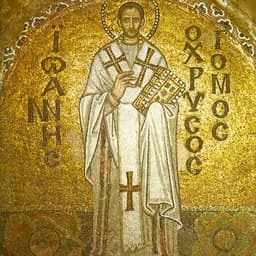
St. John Chrysostom (c. 347–407)
Homilies on the Gospel of Matthew, Homily 24 (on Matthew 7:21–27) Source: trans. in the Nicene and Post-Nicene Fathers, First Series, Vol. 10. Public domain. Full text: https://www.newadvent.org/fathers/200124.htm
On why the wise builder is rewarded already in this life, not only the next:
On the rock as the steadfastness of Christ's teaching, and the storms as the afflictions of life:
On hearing as insufficient without obedience:
On the folly of the man who builds on sand:
On the greatness of the fall:
St. Jerome (c. 347–420)
As preserved in the Catena Aurea on Matthew. Public domain.
On the sand as the unstable foundation of false teaching:
St. Hilary of Poitiers (c. 310–367)
As preserved in the Catena Aurea on Matthew. Public domain.
On the rising assault of the storm as the stages of temptation:
Blessed Augustine of Hippo (354–430)
From his Sermon on the Mount, as preserved in the Catena Aurea on Matthew. Public domain.
On the storms read as the evils that assail the soul:
On the doer alone standing unmoved:
On the whole Sermon as the rock of the Christian life: