The Woman Caught in Adultery
John 7:53–8:11 · Journey to Jerusalem
Scripture
John 7:53–8:11
nd every man went unto his own house. 1Jesus went unto the mount of Olives. 2And early in the morning he came again into the temple, and all the people came unto him; and he sat down, and taught them. 3And the scribes and Pharisees brought unto him a woman taken in adultery; and when they had set her in the midst, 4They say unto him, Master, this woman was taken in adultery, in the very act. 5Now Moses in the law commanded us, that such should be stoned: but what sayest thou? 6This they said, tempting him, that they might have to accuse him. But Jesus stooped down, and with his finger wrote on the ground, as though he heard them not. 7So when they continued asking him, he lifted up himself, and said unto them, He that is without sin among you, let him first cast a stone at her. 8And again he stooped down, and wrote on the ground. 9And they which heard it, being convicted by their own conscience, went out one by one, beginning at the eldest, even unto the last: and Jesus was left alone, and the woman standing in the midst. 10When Jesus had lifted up himself, and saw none but the woman, he said unto her, Woman, where are those thine accusers? hath no man condemned thee? 11She said, No man, Lord. And Jesus said unto her, Neither do I condemn thee: go, and sin no more.
King James Version · public domain
Joani 7:53–8:11
dhe gjithë-sicili vate ndë shtëpit të ti. 1Edhe Jisuj vate ndë malt t’ullinjvet. 2Edhe mbë të-vagulluarët erdhi përsëri ndë hieroret, edhe gjithë llauzi vinte tek ay; edhe ay ndënji e i mësonte. 3Edhe shkronjësit’ e Farisenjtë i bjenë një grua të-zënë ndë kurvëri, edhe si e vunë ndë mest, 4I thonë, Mësonjës, këjo grua është zënë mbi punët dyke kurvëruarë. 5Edhe Moisiu ndë nomt na ka porositurë të-tillatë gra të vritenë me gurë; ti pra ç’thua? 6Edhe këtë e thoshinë dyke ngarë atë, që të kenë me se t’a përflasënë. Po Jisuj uunjt, e shkruante me gishtinë mbë dhet. 7Edhe passi qëndroninë dyke pyetur’ atë, ungrit, e utha atyre, I-pafajmi prej jush, ky më përpara letë hedhë gurinë mbi atë. 8Edhe përsëri uunjt, e shkruante mbë dhet. 9Edhe ata kur dëgjuanë, edhe pasi qërtoneshinë prej ndërgjegjesë, zunë të dilninë jashtë një nga një, që prej pleqvet e gjer mbë të-fundëshmit; edhe Jisuj mbeti vetëmë, edhe gruaja ishte dyke ndënjurë ndë mest. 10Edhe Jisuj si ungrit, edhe nukë pa asndonjë veç gruasë, i tha asaj, grua, ku jan’ ata që të përflisninë? asndonjë s’të dënoj? 11Edhe ajo tha, Asndonjë, Zot. Edhe Jisuj i tha, As unë nukë të dënonj; shko, edhe mos fëje më.
Kristoforidhi, Dhiata e Re Toskërisht 1879 · zotërim publik
In their own words
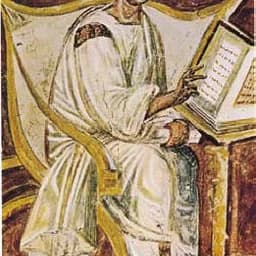
This is the voice of Justice: Let her, the sinner, be punished, but not by sinners: let the law be fulfilled, but not by the transgressors of the law.
Blessed Augustine of Hippo, Tractates on the Gospel of John, Tractate 33 (on John 8:1–11)
Patristic sources
- Blessed Augustine of Hippo
- Tractates on the Gospel of John, Tractate 33
Venerated in the East as Blessed; his Johannine tractates are the classic patristic treatment of this pericope and are drawn upon throughout the Catena Aurea on John.
- St. Gregory the Great
- Comment on John 8:7, as preserved in the Catena Aurea on John
- St. Bede the Venerable
- Exposition of the Gospel of John (on John 8:6)
- Alcuin
- Commentary on the Gospel of John (on John 8:6)
A later Carolingian compiler; his Johannine comment survives in public-domain English only through the Catena Aurea.
Read the sources: Augustine, Tractates on John, Tractate 33 (CCEL) · Catena Aurea on John (isidore.co)
The Woman Caught in Adultery (John 7:53–8:11)
The texts below are quoted verbatim from public-domain English translations; nothing is paraphrased.
Blessed Augustine of Hippo (354–430)
Tractates on the Gospel of John, Tractate 33 (on John 8:1–11) Source: trans. John Gibb and James Innes, Nicene and Post-Nicene Fathers, First Series, Vol. 7. Public domain. Full text: https://www.ccel.org/ccel/schaff/npnf107/npnf107.iii.xxxiv.html
On the snare the accusers laid, into which they thrust their own heads:
On "He that is without sin among you, let him first cast a stone at her":
On the mystery of His writing upon the ground:
On the voice of justice, that the sinner be punished but not by sinners:
On the two who alone remained:
On "Neither do I condemn thee: go, and sin no more":
St. Gregory the Great (c. 540–604)
On the accuser who does not first judge himself, as preserved in the Catena Aurea on John (on John 8:7) As preserved in the Catena Aurea on John, trans. J. H. Newman, 1845. Public domain. Full text: https://isidore.co/aquinas/english/CAJohn.htm
On why the man who spares not himself cannot rightly judge another:
St. Bede the Venerable (c. 673–735)
Exposition of the Gospel of John (on John 8:6) As preserved in the Catena Aurea on John, trans. J. H. Newman, 1845. Public domain. Full text: https://isidore.co/aquinas/english/CAJohn.htm
On the finger that had once written the law on stone:
Alcuin (c. 735–804)
Commentary on the Gospel of John (on John 8:6) As preserved in the Catena Aurea on John, trans. J. H. Newman, 1845. Public domain. (a later Carolingian compiler, quoted here where he supplies the moral sense) Full text: https://isidore.co/aquinas/english/CAJohn.htm
On the ground as the human heart and the finger of discretion: