Water into wine at Cana
John 2:1–11 · Early ministry in Galilee
Scripture
John 2:1–11
nd the third day there was a marriage in Cana of Galilee; and the mother of Jesus was there: 2And both Jesus was called, and his disciples, to the marriage. 3And when they wanted wine, the mother of Jesus saith unto him, They have no wine. 4Jesus saith unto her, Woman, what have I to do with thee? mine hour is not yet come. 5His mother saith unto the servants, Whatsoever he saith unto you, do it. 6And there were set there six waterpots of stone, after the manner of the purifying of the Jews, containing two or three firkins apiece. 7Jesus saith unto them, Fill the waterpots with water. And they filled them up to the brim. 8And he saith unto them, Draw out now, and bear unto the governor of the feast. And they bare it. 9When the ruler of the feast had tasted the water that was made wine, and knew not whence it was: (but the servants which drew the water knew;) the governor of the feast called the bridegroom, 10And saith unto him, Every man at the beginning doth set forth good wine; and when men have well drunk, then that which is worse: but thou hast kept the good wine until now. 11This beginning of miracles did Jesus in Cana of Galilee, and manifested forth his glory; and his disciples believed on him.
King James Version · public domain
Joani 2:1–11
dhe të-tretënë ditë ubë dasmë ndë Kana të Galilesë; edhe e ëm’ e Jisujt ishte atje. 2Edhe uftua ndë dasmët edhe Jisuj edhe nxënësit’ e ati. 3Edhe si umbarua vera, e ëm’ e Jisujt i thotë, Verë s’kanë. 4Jisuj i thotë, Ç’ke ti me mua, o grua? ora ime edhe s’ka ardhurë. 5E ëm’ e ati u thotë shëbëtorëvet, Bëni ç’t’u thotë juve. 6Edhe atje ishinë gjashtë enë të gurta vënë për të pastruarëtë pas zakonit të Judhenjvet, që nxininë sicila nga dy a tri masa. 7Jisuj u thot’ atyre, Mbushni enëtë me ujë. 8Edhe ata i mbushnë gjer sipërë. Pastaj u thot’ atyre, Nxirni ndashti, edhe shpini të-parit të mësallësë. Edhe ata shpunë. 9Edhe i-par’ i mësallësë si ungjërua ujëtë që ishte bërë verë, edhe nukë dinte nga është, (po shërbëtorëtë që kishinë nxjerrë ujëtë e dininë,) i-par’ i mësallësë thërret dhëndërrinë, 10Edhe i thotë, Çdo njeri më përpara nxjer verën’ e-mirë, edhe si të dehenë, atëhere nxjer të-poshtërënë; po ti ke ruajturë verën’ e mirë gjer ndashti. 11Këta të-nisurit’ e çudiravet Jisuj e bëri ndë Kana të Galilesë, edhe çfaqi lavdin’ e ti; edhe nxënësit’ e ati i besuanë.
Kristoforidhi, Dhiata e Re Toskërisht 1879 · zotërim publik
In their own words
But now to show that it is He who transmutes water in the vine plants, and who converts the rain by its passage through the root into wine, He effected that in a moment at the wedding which in the plant is long in doing.
St. John Chrysostom, Homilies on the Gospel of St. John, Homily XXII (on John ii. 4), section 2 (NPNF1 Vol. 14)
Patristic sources
- St. Cyril of Alexandria
- Commentary on the Gospel of John, Book II
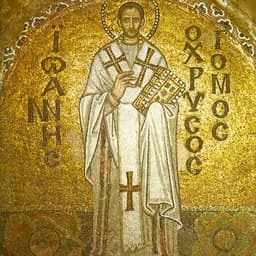
- St. John Chrysostom
- Homilies on John, Hom. 21–22
- Theophylact of Ohrid
- Commentary on John, on John 2
- St. Irenaeus of Lyons
- Against Heresies III.11
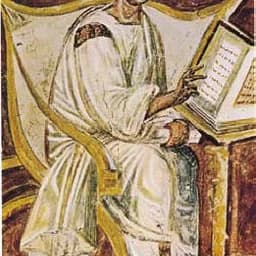
- Blessed Augustine
- Tractates on John, Tract. 8–9
Venerated in the East as Blessed; his Johannine tractates are cited in later Byzantine catenae.
Read the sources: Chrysostom on John (CCEL) · Augustine, Tractates on John (CCEL)
The Wedding at Cana (John 2:1–11)
The texts below are quoted verbatim from public-domain English translations; nothing is paraphrased.
St. John Chrysostom (c. 349–407)
Homilies on the Gospel of St. John, Homily XXII (on John 2:4–10) Source: trans. Charles Marriott, Nicene and Post-Nicene Fathers, First Series, Vol. 14, ed. Philip Schaff, 1889. Public domain. Full text: https://www.newadvent.org/fathers/240122.htm (Homily 21, on John 1:49–2:4: https://www.newadvent.org/fathers/240121.htm)
On "Woman, what have I to do with thee? Mine hour is not yet come":
Why He nevertheless acted:
On "Whatsoever He saith unto you, do it":
On the six waterpots and "after the manner of the purifying of the Jews":
On why He transformed existing matter rather than creating from nothing:
On the ruler of the feast as a sober witness:
The application:
(The homily continues with an extended exhortation against drunkenness and luxury, available in full at the link above.)
St. Cyril of Alexandria (c. 376–444)
Commentary on the Gospel of John, Book II (on John 2) Source: trans. for the Library of Fathers (P. E. Pusey / T. Randell), LFC 43, 48, 1874/1885. Public domain. Full text: https://www.tertullian.org/fathers/cyril_on_john_02_book2.htm
On "And the third day there was a marriage in Cana of Galilee":
On the changing of the water:
(Cyril continues with the spiritual reading of the third day, of Cana of Galilee, of the failing wine, and of the ruler of the feast; the whole section can be read above.)
Blessed Augustine of Hippo (354–430)
Tractates on the Gospel of John, Tractate VIII (on John 2:1–4) and Tractate IX (on John 2:1–11) Source: trans. John Gibb, Nicene and Post-Nicene Fathers, First Series, Vol. 7, ed. Philip Schaff, 1888. Public domain. Full text: https://www.newadvent.org/fathers/1701008.htm and https://www.newadvent.org/fathers/1701009.htm
From Tractate VIII, on the miracle as the everyday work of God:
On the mystery of the address to His mother:
From Tractate IX, on the six waterpots as the six ages of the world:
St. Hilary of Poitiers (c. 310–367)
As preserved in the Catena Aurea on John. Public domain.
On the creation of wine, witnessed by the very disagreement of those who poured and those who drew:
That it was no mere mixture but a true creation:
St. Irenaeus of Lyons (c. 130–202)
Against Heresies, Book III, Chapter 11, §5 Source: trans. Alexander Roberts and William Rambaut, Ante-Nicene Fathers, Vol. 1, ed. Roberts, Donaldson, and Coxe, 1885. Public domain. Full text: https://ccel.org/ccel/irenaeus/against_heresies_iii/anf01.ix.iv.xii.html
On the wine of Cana and the one Creator God:
St. Bede the Venerable (c. 673–735)
As preserved in the Catena Aurea on John. Public domain.
On why the Lord came to a marriage, and against those who detract from its honor:
On the mystery of the third day:
On the law weakened by carnal interpretation: