Whose Son Is the Christ?
Matt 22:41–46; Mark 12:35–37; Luke 20:41–44 · Passion week in Jerusalem
Scripture
Matthew 22:41–46
hile the Pharisees were gathered together, Jesus asked them, 42Saying, What think ye of Christ? whose son is he? They say unto him, The son of David. 43He saith unto them, How then doth David in spirit call him Lord, saying, 44The LORD said unto my Lord, Sit thou on my right hand, till I make thine enemies thy footstool? 45If David then call him Lord, how is he his son? 46And no man was able to answer him a word, neither durst any man from that day forth ask him any more questions.
King James Version · public domain
Mateu 22:41–46
dhe tek ishinë mbledhurë Farisenjtë, Jisuj i pyeti, 42dyke thënë, Ç’u duketë juve për Krishtinë? i bir’ i kujt është? I thonë, I Dhavidhit. 43U thot’ atyre, Qysh pra Dhavidhi me Frymë e quan atë Zot, 44dyke thënë, “I tha Zoti Zotit t’im, Rri mbë të-djathtët t’im gjersa të vë armiqt’ e tu ndënë këmbje të këmbëvet të tua?” 45Ndë qoftë pra se Dhavidhi e quan Zot, si ësht’ i bir’ i ati? 46Edhe asndonjë nukë muntte t’i përgjigjej ndonjë fjalë; as nukë kuxoj ndonjë që mb’atë ditë t’a pyesë atë më.
Kristoforidhi, Dhiata e Re Toskërisht 1879 · zotërim publik
In their own words
He is David's Lord therefore according to that which belongs to His divine glory and nature and sovereignty: but his son according to the flesh.
St. Cyril of Alexandria, Commentary on Luke, Sermon 137 (on Luke 20:41–44)
Patristic sources
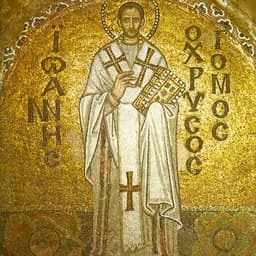
- St. John Chrysostom
- Homilies on Matthew, Hom. 71
- St. Cyril of Alexandria
- Commentary on Luke, Sermon 137
- Origen of Alexandria
- On Matthew (Catena Aurea)
Some of his speculative opinions were condemned in 553; the excerpts quoted here bear only on the plain sense of the passage.
- St. Jerome
- Commentary on Matthew (Catena Aurea)
- Remigius
- Catena Aurea on Matthew
A later Western compiler (Remigius of Auxerre); the Catena is the only public-domain English witness to his Gospel comment.
Read the sources: Chrysostom on Matthew, Homily 71 (CCEL) · Cyril of Alexandria on Luke, Sermon 137 (tertullian.org) · Catena Aurea on Matthew 22 (CCEL)
Whose Son Is the Christ? (Matthew 22:41–46)
The texts below are quoted verbatim from public-domain English translations; nothing is paraphrased.
St. John Chrysostom (c. 347–407)
Homilies on the Gospel of Matthew, Homily 71 (on Matthew 22:41–46), trans. in the Nicene and Post-Nicene Fathers, First Series, Vol. 10. Public domain. Full text: https://www.ccel.org/ccel/schaff/npnf110.iii.LXVIII.html
On the many signs that go before, and His secret aim to bring them to confess His Godhead:
On why they answer "the Son of David," and why He brings in the prophet:
On His not denying the Davidic sonship, but correcting the thought that He is son only and not also Lord:
On the silence that fell upon the questioners:
St. Cyril of Alexandria (c. 376–444)
Commentary on the Gospel of Luke, Sermon 137 (on Luke 20:41–44), trans. R. Payne Smith, 1859. Public domain. Full text: https://www.tertullian.org/fathers/cyril_on_luke_13_sermons_135_145.htm
On the two natures — Lord of David by His Godhead, son of David by the flesh:
On the session at the right hand as the pledge of supreme glory and equality of nature:
On how the Word, being God and equal to the Father, became flesh without leaving His divine dignity:
On the malicious silence of the Pharisees:
Origen of Alexandria (c. 185–254)
As preserved in the Catena Aurea on Matthew (on Matthew 22:41–46). Public domain. Full text: https://www.ccel.org/ccel/aquinas/catena1.ii.xxii.html
On the enemies made a footstool, for salvation as well as destruction:
On why He answered so as to deter them from further questioning:
St. Jerome (c. 347–420)
As preserved in the Catena Aurea on Matthew (on Matthew 22:41–46). Public domain. Full text: https://www.ccel.org/ccel/aquinas/catena1.ii.xxii.html
On the citation of Psalm 109 (110 in the Hebrew) and the eternal generation:
On how the question still stands against those who make Christ a mere man:
Remigius (c. 841–908)
As preserved in the Catena Aurea on Matthew (on Matthew 22:41–46). Public domain. Full text: https://www.ccel.org/ccel/aquinas/catena1.ii.xxii.html
(Remigius of Auxerre is a later Western compiler, included here for his gloss on the session at God's right hand.)
On what it means to sit at the right hand of God, who has no body:
On "till" as meaning not a limit but perpetuity: