Words of the services · Gestures and actions
Receiving Communion
Kungohem; kungimi: the sign of the cross, the cloth held under the chin · Greek: κοινωνῶ
At «With fear of God, faith and love, draw near» the faithful leave their places in silence and line up before the Holy Doors. Before the chalice each makes the sign of the cross, holds the communion cloth under the chin with both hands and opens the mouth; the priest gives the Body and Blood together in the spoon, naming the communicant. Each wipes the lips with the cloth, crosses again and returns quietly. In Russian usage communicants approach with their hands crossed on the breast.
What it means
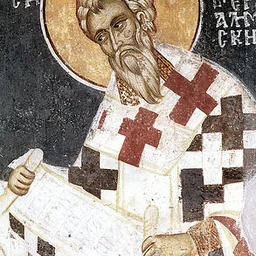 St Cyril of Jerusalem
«In approaching therefore, come not with thy wrists extended, or thy fingers spread; but make thy left hand a throne for the right, as for that which is to receive a King. And having hollowed thy palm, receive the Body of Christ, saying over it, Amen.»«Then, after a prostration, the communicants, one by one, without crowding one another, and with hands reverently crossed on the breast, approach the chalice, receive the Body and Blood of Christ out of the spoon from the hands of the Priest, and very gently kiss the edge of the chalice, as it were the side of Christ Himself.»Sokolof, A Manual of the Orthodox Church's Divine Services (1899), p. 76