The Church Building
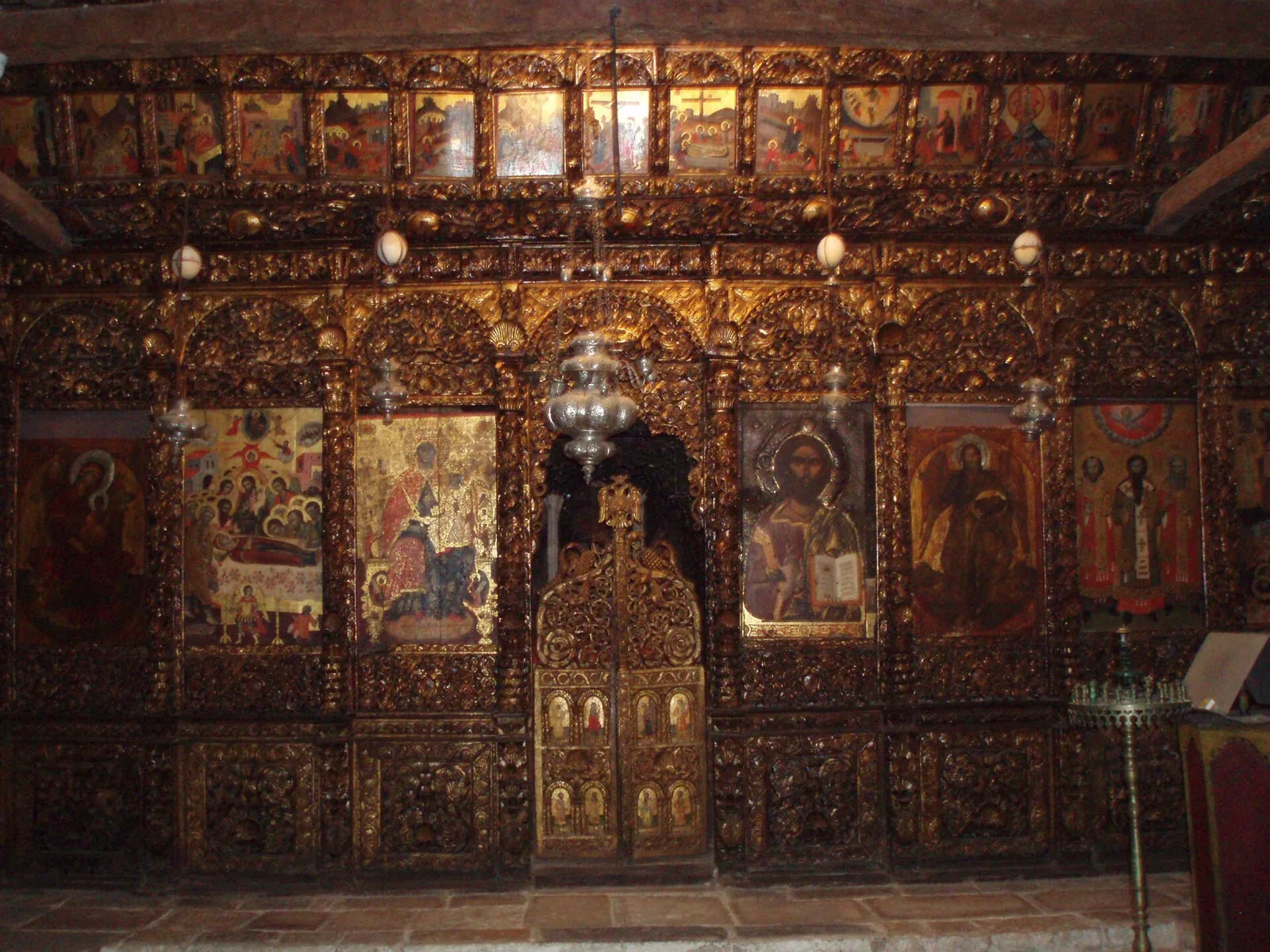
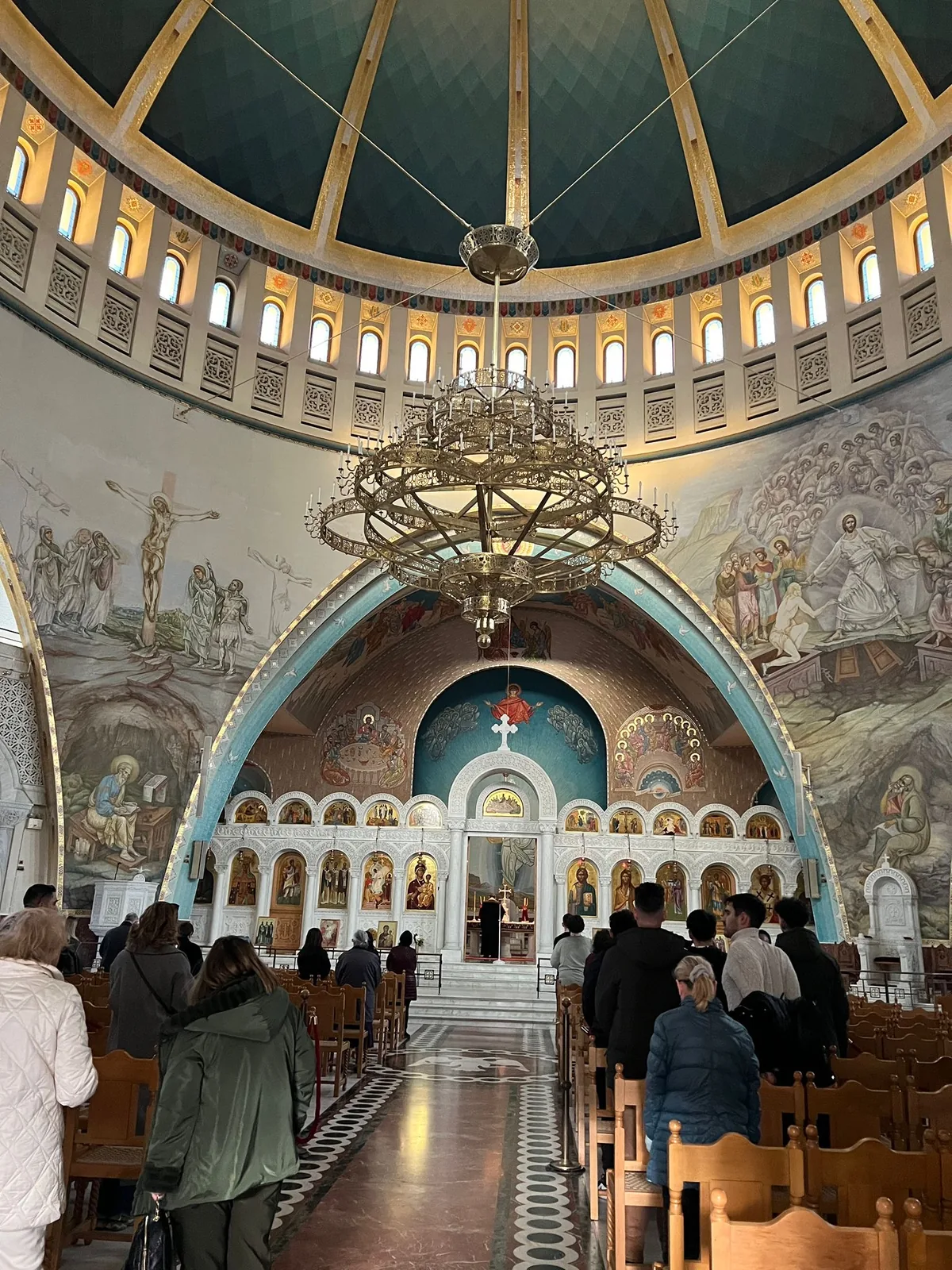
The iconostasis as you see it from the nave, the church from above, and what each place in it is and means, in the words of the Fathers and of the Church.
The iconostasis
Drawn here small: the lowest tier in the order the Church’s article gives it, the feasts above it in the order of the Church’s year, which begins in September, and the Cross at the top.
What stands where
- The lowest tier: The north door · The saint of the church · The Theotokos with the Child · The Holy Doors: the Annunciation · Christ · St John the Baptist · The south door
- Above the Holy Doors: The Mystical Supper
- The feasts: The Nativity of the Theotokos · The Exaltation of the Cross · The Entry of the Theotokos into the Temple · The Nativity of Christ · Theophany · The Meeting of the Lord in the Temple · The Annunciation · The Entry into Jerusalem · The Resurrection · The Ascension · Pentecost · The Transfiguration · The Dormition of the Theotokos
- At the top: The Cross of Christ
A larger iconostasis has more tiers: the apostles and the prophets, as many as its size allows.
In Russian usage the screen can rise as a solid wall to the ceiling in up to six tiers: the feasts in the second, the apostles round the Deesis in the third, the prophets round the Theotokos with the Child in the fourth, martyrs and holy bishops in a fifth and sixth, with the crucifix on top.
About the iconostasis
- The iconostasis is the screen between the sanctuary and the nave; the Greek word means a place, or stand, for images.
- It has three doors: the double Holy Doors in the middle, opening inwards, and a single door on either side.
- As one faces the altar, the north (left) door leads to the table of oblation and the south (right) door to the diakonikon.
- The Holy Table stands behind the Holy Doors, between the icons of the Theotokos with the child Christ and of Christ glorified.
- A curtain hangs just behind the Holy Doors and is drawn or drawn back as the services require.
- Icons of saints stand above and around the central doors; in the lowest tier, where there is room, are the saints most honoured in the place (Dabovich names St Basil and St Nicholas).
- The iconostasis does not stand on the very edge of the raised sanctuary floor: the part of the platform in front of it is the solea.
- The first churches had no screen: the sanctuary was set apart only by a curtain or a railing.
- In the Church's Liturgy the deacon stands before the icon of Christ while the first antiphon is sung, and at the end the priest comes out by the Holy Doors and says the prayer behind the ambo before the icon of Christ.
The church from above
East, where the altar is, at the top. Each number leads to the place in the lexicon.
- 1High place · 2
- 2Table of oblation · 1
- 3Diakonikon
- 4Holy Table · 3
- 5Curtain of the Holy Doors · 3
- 6North door · 1
- 7Holy Doors · 4
- 8South door
- 9Ambo
- 10Chanters' stands
- 11Bishop's throne · 2
- 12Icon stand
- 13Candle stand · 1
- 14Baptismal font · 1
What the church means
«The church is an earthly heaven, in which the heavenly God dwells and walks… The church is a divine house. It is the place where the mystical sacrifice of Christ was offered (that is, fearful Golgotha)… and the holy cave of Bethlehem. It is the all-holy tomb of the Lord and the soul-nourishing and life-giving Table of the Mystical Supper»«Kisha e shenjtë – Priftmurgu Grigor Kutlumusiani», the Church of Albania · translated by this site
«The interior of the Orthodox church building is built in such a way as to give the experience of the unity of all things in God. It is not built to reproduce the room of the Mystical Supper, nor to be simply a meeting place for people whose life lies only within the bounds of this world. The church building is modelled on the image of the Kingdom of God that is given in the Book of Revelation.»«Ndërtesa e Kishës», the Church of Albania · translated by this site
«The most generally accepted shape for Christian churches is the oblong, in imitation of a ship. By giving their churches such a shape, Christians express the thought that, as a ship, under the government of a good helmsman, carries men through stormy seas into a peaceful harbor, so the Church, governed by Christ, saves men from drowning in the deep waters of sin and brings them into the Kingdom of Heaven, " where there is neither sorrow nor sighing."»Sokolof, A Manual of the Orthodox Church's Divine Services (1899), p. 8
The icons in the drawing
- The north door: The Archangel Michael, by Theodoros Poulakis, second half of the 17th century; Benaki Museum, Athens Benaki Museum, Athens (Public domain)
- The saint of the church: St Nicholas, from the Church of St Mary Peribleptos, Ohrid, late 14th century; Icon Gallery, Ohrid Icon Gallery, Ohrid (Public domain)
- The Theotokos with the Child: The Mother of God with the Child, icon by Onufri, 16th century Onufri Museum, Berat (file category: Collections of the Onufri Museum) (Public domain)
- The Holy Doors: the Annunciation: The Archangel Gabriel of the Annunciation, left leaf of Holy Doors by Onufri, 16th century, Church of the Archangel Michael, Dolno Srabtsi Church of the Archangel Michael, Dolno Srabtsi (per the title) (Public domain)
- The Holy Doors: the Annunciation: The Mother of God of the Annunciation, right leaf of Holy Doors by Onufri, 16th century, Church of the Archangel Michael, Dolno Srabtsi Church of the Archangel Michael, Dolno Srabtsi (per the title) (Public domain)
- Christ: Christ with an open Gospel, icon by Onufri, 16th century, Berat Onufri Museum, Berat (file category: Collections of the Onufri Museum) (Public domain)
- St John the Baptist: St John the Forerunner, from the Church of St Mary Bolnichka, Ohrid, late 17th to early 18th century; Icon Gallery, Ohrid Icon Gallery, Ohrid (Public domain)
- The south door: The Archangel Gabriel, from the Annunciation on a king's door of an iconostasis, Greek, second half of the 15th century; Princeton University Art Museum Princeton University Art Museum (Public domain)
- The Mystical Supper: The Mystical Supper, by Michael Damaskinos, about 1591; Monastery of St Catherine, Heraklion Monastery of Agia Aikaterini, Heraklion (Public domain)
- The Nativity of the Theotokos: The Nativity of the Mother of God, by Elias Moskos, 1666, panel from an iconostasis; Byzantine and Christian Museum, Athens Byzantine and Christian Museum, Athens (per the file's Wikidata item Q113146696) (Public domain)
- The Exaltation of the Cross: The Exaltation of the Cross, icon from the Church of St Paraskevi, Langadas, before the 20th century Church of St Paraskevi, Langadas (Public domain)
- The Entry of the Theotokos into the Temple: The Entry of the Mother of God into the Temple, from the Church of St Mary Peribleptos, Ohrid, second half of the 14th century; Icon Gallery, Ohrid Icon Gallery, Ohrid (Public domain)
- The Nativity of Christ: The Nativity of Christ, icon by Onufri, 16th century Wikimedia Commons (Public domain)
- Theophany: The Baptism of Christ, from the Church of St Mary Peribleptos, Ohrid, early 14th century; Icon Gallery, Ohrid Icon Gallery, Ohrid (Public domain)
- The Meeting of the Lord in the Temple: The Presentation of Christ in the Temple, Byzantine, 15th century; The Metropolitan Museum of Art, New York The Metropolitan Museum of Art, New York (CC0)
- The Annunciation: The Annunciation, from the Church of St Mary Peribleptos, Ohrid, early 14th century; Icon Gallery, Ohrid Icon Gallery, Ohrid (Public domain)
- The Entry into Jerusalem: The Entry into Jerusalem, about 1400; The Menil Collection, Houston The Menil Collection, Houston (Public domain)
- The Resurrection: The Descent into Hades (the Resurrection), from the Church of St Mary Peribleptos, Ohrid, early 14th century; Icon Gallery, Ohrid Icon Gallery, Ohrid (Public domain)
- The Ascension: The Ascension, by Theophanes the Cretan, 1546; Stavronikita Monastery, Mount Athos Stavronikita Monastery, Mount Athos (Public domain)
- Pentecost: Pentecost, by Dionysius of Fourna, about 1711; Timios Prodromos, Karyes, Mount Athos Timios Prodromos, Karyes, Mount Athos (Public domain)
- The Transfiguration: The Transfiguration, Cretan, about 1550; Ikonen-Museum, Recklinghausen Ikonen-Museum, Recklinghausen (Public domain)
- The Dormition of the Theotokos: The Dormition of the Mother of God, from the Church of St Nicholas Gerakomia, Ohrid, early 14th century; Icon Gallery, Ohrid Icon Gallery, Ohrid (Public domain)
- The Cross of Christ: The Crucified, from a Crucifixion icon of the Church of St Mary Peribleptos, Ohrid, second half of the 13th century; Icon Gallery, Ohrid Icon Gallery, Ohrid (Public domain)
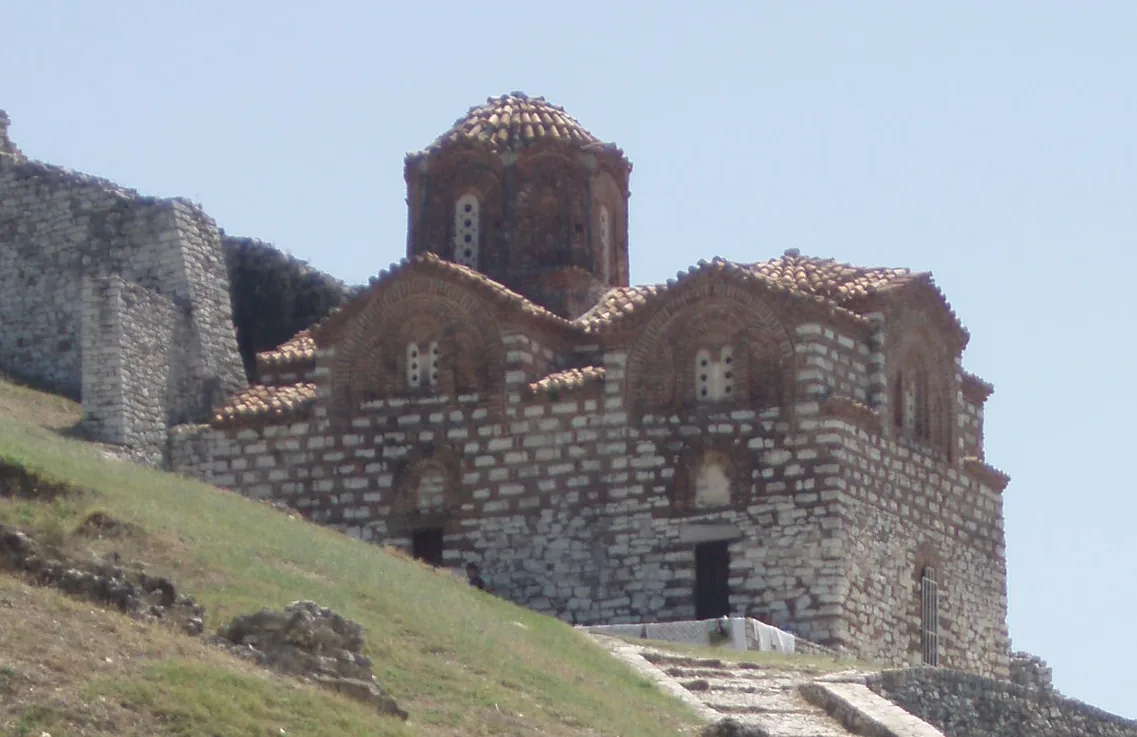
Churches as they are