Words of the services · Places in the church
Holy Table
Tryeza e Shenjtë · Greek: Ἁγία Τράπεζα (Agia Trapeza)
The Holy Table stands in the middle of the sanctuary, behind the Holy Doors. It is a plain table of carved wood or stone, often a perfect cube, placed so that one can walk round it, and is usually covered with a coloured cloth. On it lie the antimension, the Gospel book and the hand cross, with the tabernacle; a relic is usually set in the table itself, and a seven-branched lampstand stands behind it. In Russian usage it is vested in white linen under an outer cloth of brocade.
What it means
«The Holy Table does not represent merely the table of the Last Supper (the Mystical Supper). It is the symbolic and mystical presence of the heavenly throne and the table of the Kingdom of God; the table of Christ the Word, the Lamb and the King of eternal life, of the glorified dominion of God over all creation.»«Tryeza e Shenjtë (Altari)», the Church of Albania · translated by this site
«In the middle of the Sanctuary there stands a square table; it is the altar; also called Holy Throne, because the Lord is present on it, or Holy Table, because upon it Christians are offered the Sacrament of the Eucharist, and made to partake of the Body and Blood of Christ. The altar is made square, in token that Christ's doctrine and sacrament are free to men of all four parts of the world.»Sokolof, A Manual of the Orthodox Church's Divine Services (1899), p. 11
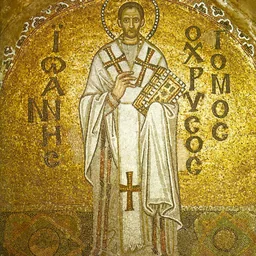 St John Chrysostom
«The Mysteries of the Church and the holy Altar inspire awe. From the spring of Paradise flowed waters which poured out into visible rivers. But from the spring of the Holy Table flow spiritual rivers.»«Kisha e shenjtë – Priftmurgu Grigor Kutlumusiani», the Church of Albania · translated by this site
Where it appears
- 1. The opening blessing
- 2. The Great Litany
- 4. The first small litany
- 7. The second small litany
- 9. The Little Entrance
- 10. The entrance hymn
- 11. The apolytikia and the kontakion
- 12. The Trisagion
- 14. The Epistle
- 15. The censing
- 19. The litany of fervent supplication
- 20. The litany of the catechumens
- 22. The Liturgy of the Faithful: the first prayer of the faithful
- 24. The Cherubic Hymn
- 25. The censing during the Cherubic Hymn
- 28. The Great Entrance
- 29. The Holy Gifts are set on the Holy Table
- 30. Priest and deacon ask each other's prayers
- 32. The kiss of peace
- 36. «Let us lift up our hearts»
- 37. The prayer of the Anaphora
- 42. «It is truly meet»
- 45. The litany before the Lord's Prayer
- 49. The communion hymn
- 53. The Communion of the clergy
- 54. The Gifts made ready for the people's Communion
- 59. The last showing of the Gifts
- 60. The litany of thanksgiving
- Great Vespers on Saturday evening · 1. The opening blessing
- Great Vespers on Saturday evening · 4. The Great Litany
- Great Vespers on Saturday evening · 6. The small litany
- Orthros on Sunday morning · 6. The Six Psalms: the opening verses and Psalm 3
- Orthros on Sunday morning · 7. The Six Psalms: Psalm 37
- Orthros on Sunday morning · 8. The Six Psalms: Psalm 62
- Orthros on Sunday morning · 18. The sessional hymns of the tone
- Orthros on Sunday morning · 20. The small litany after the Evlogitaria
- Orthros on Sunday morning · 22. The small litany of the canon
- Orthros on Sunday morning · 25. «Let every thing that has breath»
- Orthros on Sunday morning · 26. The Gospel of the Resurrection
- Orthros on Sunday morning · 27. «Having beheld the Resurrection of Christ»
- Orthros on Sunday morning · 30. The Magnificat
- Orthros on Sunday morning · 32. The small litany after the ninth ode
- Orthros on Sunday morning · 38. «Today salvation has come to the world»
- Small Compline · 9. The Trisagion prayers