The Divine Liturgy of St John Chrysostom · Step 28
The Great Entrance
«Hyrja e Madhe»
What happens
The Holy Gifts are carried from the table of oblation through the north door, round the nave and through the people, with altar servers going ahead. The procession stops before the iconostasis, the icon screen, where the deacon and then the priest pray aloud that the Lord God remember in his kingdom all present, the archbishop, the nation, the parish and its benefactors, and the departed. The clergy then go into the sanctuary, and the chanters finish the Cherubic Hymn.
Who does what
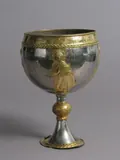
- PriestCarries the chalice behind the deacon and says the commemorations aloud before the iconostasis. Inside, he sets it on the antimension, on the right side, and, taking the censer from a server, censes the deacon.
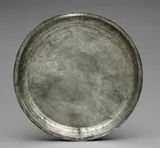
- DeaconCarries the diskos on his head and the aer on his shoulders. Before the iconostasis he prays aloud for all present and all devout Orthodox Christians, then goes in and waits by the Holy Table.
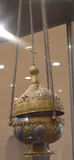
- Altar serversWalk ahead of the clergy with the processional cross, the ripidia (liturgical fans), lit processional candles and the censer, which one holds ready for the priest. There may be from one to ten servers.
- ChantersBreak off the Cherubic Hymn before its last lines, answer «Amen» to each commemoration, and sing the last lines once the clergy have gone in.
- PeopleThe procession passes through them round the nave, and they answer «Amen» quietly with the chanters to each commemoration.
When the priest serves without a deacon: Without a deacon the priest carries the Holy Gifts and says the deacon's words himself, and a server carries the censer.
In the parish: The procession goes round the nave through the people and stops in front of the iconostasis for the commemorations. The number of servers varies from one to ten; the book lists the cross, the fans, the lamps and the censer.
The words
When the chanters have finished singing «That we may raise on high the King...», the priest and the deacon go out by the north door for the Great Entrance; before them (translated by this site)
Kur psaltët kanë mbaruar së kënduari «Që mbretin...», prifti dhe dhiaku dalin nga dera veriore për Hyrjen e Madhe; përpara
go children with the Cross, the ripidia, lighted processional candles and a censer. As they pass through the middle of the church, the deacon says: (translated by this site)
shkojnë fëmijë me Kryqin, Gjashtëkrahëshet, llambada të ndezura dhe temjanicë. Duke shkuar mesit të kishës, dhiaku thotë:
All you Orthodox Christians, may the Lord God remember in his kingdom always, now, and ever, and unto ages of ages.
(me zë të lartë) Të gjithë ne, edhe të gjithë të krishterët shpresëtarë orthodhoksë na kujtoftë Zoti Perëndia në mbretërinë e Tij, gjithnjë; tani e përherë e në jetë të jetëve.
Amen.
Amin.
When they come before the Holy Doors, the deacon enters the sanctuary and stands on the right of the Holy Table, awaiting the priest. (translated by this site)
Kur vijnë përpara Derës së Bukur, Dhiaku hyn në Hierore dhe qëndron në të djathtë të Tryezës së Shenjtë duke pritur priftin.
The priest, when he reaches the middle of the church, says: (translated by this site)
Prifti kur arrin në mes të kishës thotë:
(aloud): Our Archbishop (or Bishop) (N.), and all our brotherhood in Christ. Our devout nation, its leaders and its army. All who dwell and sojourn in this city (or place): the parishioners, the church wardens, the helpers, the benefactors of this holy Temple, and also all of us who take part in this divine Liturgy. (translated by this site)
(me zë të lartë): Kryepiskopin (ose episkopin) tonë (aksh), dhe gjithë vëllazërinë tonë më Krishtin. Kombin tonë shpresëtar, udhëheqjen dhe ushtrinë e tij. Të gjithë ata që banojnë e ndodhen në këtë qytet (a vend): enoritët, epitropët, ndihmëtarët, dhuruesit e kësaj kishe të shenjtë, si edhe të gjithë ne që marrim pjesë në këtë meshë hyjnore.
Amen. (translated by this site)
Amin.
The blessed and ever-memorable builders, the restorers and the benefactors of this holy Temple, those who fell for the faith and for the fatherland, and all our fathers and brethren who have departed this life in the hope of resurrection and of life everlasting, may the Lord God remember in his kingdom, always, now, and ever, and unto ages of ages. (translated by this site)
Ndërtuesit e lumtur e të gjithmonëkujtueshëm, rindërtuesit dhe dhuruesit e kësaj kishe të shenjtë, ata që ranë për fenë e për atdhenë dhe të gjithë etërit dhe vëllezërit tanë që kanë ndërruar jetë me shpresë ngjalljeje dhe jetë të pasosur, i kujtoftë Zoti Perëndia në mbretërinë e Tij, gjithnjë; tani e përherë dhe në jetë të jetëve.
Amen. (translated by this site)
Amin.
The priest enters the sanctuary and sets the holy chalice on the antimension, on the Holy Table, on the right side. The priest, taking the censer from the hands of the server, censes the deacon, who holds the holy diskos on his head. (translated by this site)
Prifti hyn në Hierore, vendos Potirin e shenjtë mbi Andiminsin, mbi Tryezën e Shenjtë, nga krahu i djathtë. Prifti, duke marrë temjanicën nga duart e shërbyesit, temjanis dhiakun i cili mban Dhiskun e shenjtë mbi kryet.
The chanters finish the Cherubic Hymn: (translated by this site)
Psaltët përfundojnë himnin Keruvik:
That we may raise on high the King of all, like conqueror on shield and spears, by the Angelic Hosts invisibly up-borne. Alleluia.
...e të gjithave të presim, të pasuar padukurisht prej rreshtave engjëllore. Aliluia, Aliluia, Aliluia.
The Albanian text is the Orthodox Autocephalous Church of Albania’s, used with permission. orthodoxalbania.org. The English is from Isabel F. Hapgood’s Service Book (1922).
What it means
«The Great Entrance typifies our Lord's going to his Passion and death. Therefore it is customary for the Faithful to do homage to the Holy Gifts at this point, although these are not yet consecrated.»«All these prayers, as well as the transfer of the Precious Gifts from the holy table of oblation to the Holy Table, symbolize the entry of Jesus Christ into the Holy City, where he comes to be sacrificed “for the life of the world, and for its salvation”.»«Liturgjia Hyjnore (Pjesa I) – Priftmurgu Grigor Kutlumusiani», the Church of Albania · translated by this site
«The gifts of bread and wine, which stand for Christ and, in him, for all people and the whole creation of God (for Life itself), are now offered to God. They are carried in solemn procession from the table of oblation, around the church and through the Holy Doors to the altar.»«Hyrja e Madhe», the Church of Albania · translated by this site
«But the procession, after these things, of the Divine gifts, is with great pomp of Readers, Deacons, and Priests, with the lamps and holy vessels preceding and following: because this symbolises the last Advent of Christ, when He shall come with glory.»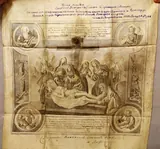 Antimension
 Censer
 Chalice
 Diskos
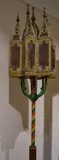 Processional candles
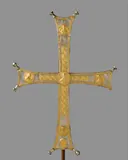 Processional cross
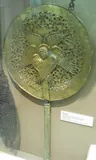 Ripidia