Words of the services · Objects and vessels
Antimension
Antimins · Greek: ἀντιμήνσιον (antiminsion)
The antimension is a cloth of silk or linen, larger than a handkerchief, signed by the bishop and showing Christ laid in the tomb; by it the local community is allowed to gather as the Church. A relic of a martyr is usually sewn into it. It lies always on the Holy Table, folded. The priest unfolds it at the end of the prayer for the catechumens and sets the Gifts on it, and after Communion folds it over the sponge: top, bottom, then the sides.
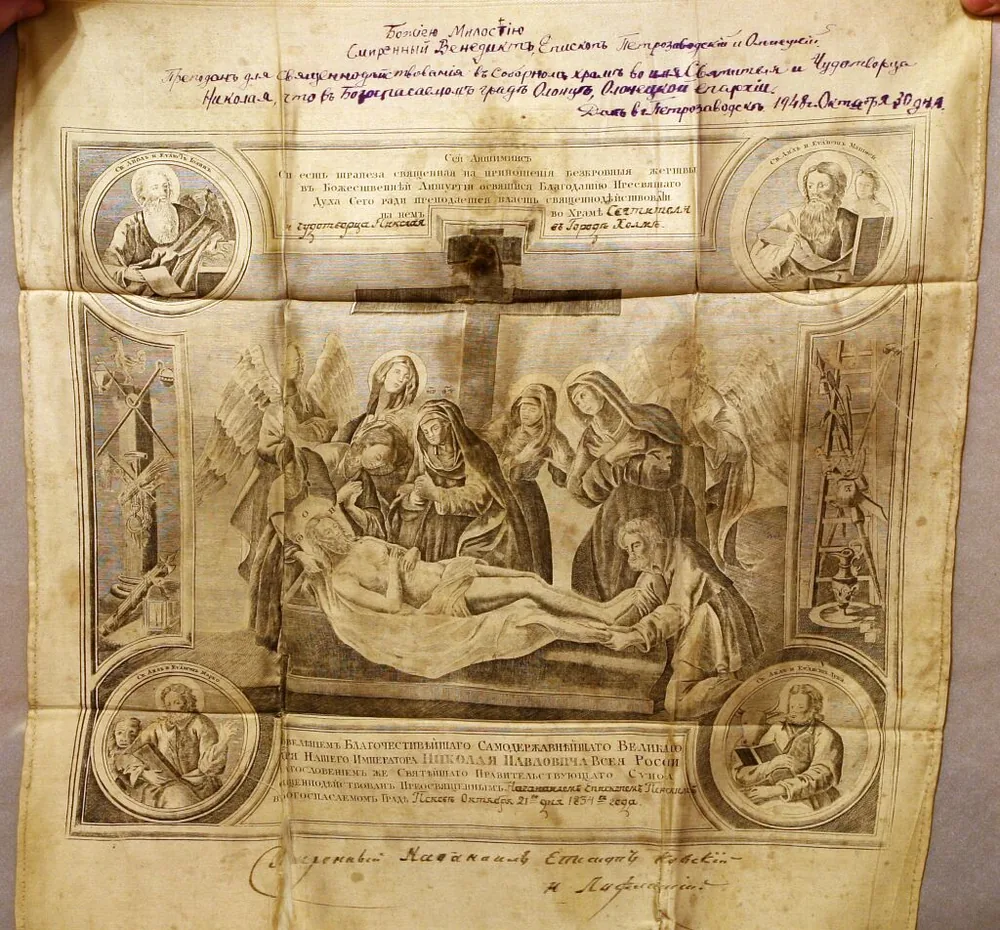
What it means
«“Antimension” literally means “instead of the table”. Since the bishop is the true shepherd and priest of the Church, the antimension is used in place of the bishop's table, which is in his church, the cathedral, the place where the bishop has his throne (cathedra).»«Tryeza e Shenjtë (Altari)», the Church of Albania · translated by this site
«Usually the antimension contains a relic (normally a part of the body) of a martyr, to show that the Church is built upon the blood of the martyrs and the lives of the holy people of God. This custom comes from the practice of the early Church, which gathered and celebrated Holy Communion at the tombs of those who lived and gave their lives for the Christian faith.»«Tryeza e Shenjtë (Altari)», the Church of Albania · translated by this site
«The holy Liturgy is offered over them in respect to the saints, and in memory of the times when the Church was persecuted, when the faithful were obliged to conceal themselves in order to celebrate the mysteries, which they celebrated over the graves of the Martyrs.»Where it appears
- 1. The opening blessing
- 20. The litany of the catechumens
- 22. The Liturgy of the Faithful: the first prayer of the faithful
- 25. The censing during the Cherubic Hymn
- 28. The Great Entrance
- 29. The Holy Gifts are set on the Holy Table
- 32. The kiss of peace
- 54. The Gifts made ready for the people's Communion
- 60. The litany of thanksgiving
- 61. The prayer behind the ambo