The Divine Liturgy of St John Chrysostom · Step 25
The censing during the Cherubic Hymn
«Temjanisja gjatë Himnit Keruvik»
What happens
The priest blesses the incense and censes the Holy Table, the icons and the people, saying Psalm 50 quietly. Returning to the sanctuary, he censes the Holy Table and the table of oblation, where the Holy Gifts wait. The deacon censes the priest and all present. The clergy bow three times and kiss the antimension, the cloth on the Holy Table, and the table itself, saying two troparia, short hymns asking mercy like the prodigal son and the publican.
Who does what
- PriestBlesses the incense, censes the Holy Table, the icons and the people while saying Psalm 50 quietly, then goes back in, censes the Holy Table and the table of oblation, and hands over the censer.
- DeaconTakes the censer and censes the priest first, then the others present. With the priest he bows three times and kisses the antimension and the Holy Table.
- Altar serversHave the censer ready, with lit charcoal and incense, for the priest to take.
- ChantersGo on with the Cherubic Hymn.
- PeopleAre censed by the priest, and go on singing the hymn quietly with the chanters.
When the priest serves without a deacon: Without a deacon no one censes the priest, and he makes the three bows and kisses the antimension and the Holy Table alone.
The words
The priest takes the censer with the incense, blesses it and says: (translated by this site)
Prifti merr temjanicën me temjamin, e bekon edhe thotë:
Blessed is our God always, now, and ever, and unto ages of ages. Amen. (translated by this site)
I bekuar është Perëndia ynë gjithnjë; tani e përherë, e në jetë të jetëve. Amin.
Unto thee, O Christ-God, do we offer incense for an odour of spiritual fragrance: which do thou accept upon thy most heavenly Altar, and pour forth upon us in return the grace of thine all-holy Spirit. (translated by this site)
Temjamë po të blatojmë, o Krisht Perëndi, si e erë kundërmimi shpirtëror, të cilën pasi ta pranosh në altarin tënd përmbiqiellor, dërgona si shpërblim hirin e Shpirtit tënd të tërëshenjtë.
Then the priest censes the Holy Table, the icons and the people, saying inaudibly, if it is Sunday, «In that we have beheld the Resurrection of Christ...» (three times), and then «O come, let us worship...» and Psalm 50; when he reaches the verse «Then shalt thou be pleased with the sacrifice of righteousness...», he goes into the sanctuary, censes the Holy Table, the table of oblation and all who are within, and hands over the censer. The deacon takes the censer and censes first the priest and then, in order, those present. Then the concelebrants bow three times before the Holy Table and kiss the holy antimension and the Holy Table, saying these troparia: (translated by this site)
Pastaj prifti temjanis Tryezën e shenjtë, ikonat dhe popullin duke thënë pa zë, në qoftë se është e diel, «Ne që pamë ngjalljen e Krishtit...» (tri herë) dhe pastaj «Ejani të falemi...» edhe psalmin 50; kur arrin te vargu «Atëherë do të të pëlqejë therore drejtësie...», hyn brenda në hierore, temjanis Tryezën e shenjtë, proskomidhinë dhe të gjithë sa janë brenda, dhe e dorëzon temjanicën. Dhiaku merr temjanicën, temjanis të parin priftin dhe me radhë të pranishmit. Pastaj bashkëmeshëtarët përkulen tri herë para Tryezës së Shenjtë, puthin Andiminsin e shenjtë dhe Tryezën e Shenjtë, duke thënë këto tropare:
I have sinned before thee, O Saviour, as did the prodigal son: receive me penitent, O Father, and have mercy upon me, O God. (translated by this site)
Mëkatova përpara teje, o Shpëtimtar, si biri i shthurur, pranomë të penduar, o Atë, dhe mëshiromë, o Perëndi.
I cry unto thee, O Christ the Saviour, with the voice of the publican: forgive me as thou didst him, and have mercy upon me, O God. (translated by this site)
Të thërres, o Krisht Shpëtimtar, me zërin e doganjerit, falmë si atë, dhe mëshiromë, o Perëndi.
The Albanian text is the Orthodox Autocephalous Church of Albania’s, used with permission. orthodoxalbania.org. The English is from Isabel F. Hapgood’s Service Book (1922).
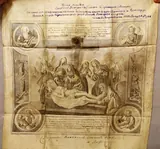 Antimension
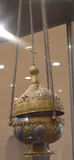 Censer
 Icon