The Divine Liturgy of St John Chrysostom · Step 24
The Cherubic Hymn
«Himni Keruvik»
What happens
As soon as the second prayer of the faithful ends, the chanters begin the Cherubic Hymn, «Let us, the Cherubim mystically representing…». At the Holy Table the priest, his head bowed, says the prayer of the Cherubic Hymn quietly and then the hymn itself three times, and the deacon completes the hymn with its closing lines. The chanters sing the hymn until the Great Entrance, the procession with the Holy Gifts, and keep its last lines for after it.
Who does what
- PriestStands before the Holy Table with bowed head and says quietly the prayer of the Cherubic Hymn, «No one who is in bondage…», then the first part of the hymn three times.
- DeaconStanding by the Holy Table, says «Let us pray to the Lord» in a low voice, then completes the priest's hymn with its closing lines, ending «Alleluia» three times.
- ChantersBegin the Cherubic Hymn at once and sing its first part; its last lines wait until after the Great Entrance.
- PeopleSing the Cherubic Hymn quietly with the chanters.
When the priest serves without a deacon: Without a deacon the priest says «Let us pray to the Lord» and the closing lines of the hymn himself.
The words
And immediately they sing the Cherubic Hymn. (translated by this site)
Dhe menjëherë këndojnë himnin keruvik.
Let us, the Cherubim mystically representing, and unto the Life-giving Trinity the thrice-holy chant intoning, all cares terrestrial now lay aside.
Ne që simbolizojmë mistikërisht Keruvimet, dhe i këndojmë Trinisë jetëbërëse himnin trishenjtor, le të largojmë prej nesh tërë kujdesin për jetën; që mbretin...
While the Cherubic Hymn is sung, the deacon says in a low voice: (translated by this site)
Kur psalet himni keruvik, dhiaku thotë me zë të ulët:
Let us pray to the Lord. (translated by this site)
Le t'i lutemi Zotit.
The priest, before the Holy Table, bowing his head, says in a low voice: (translated by this site)
Prifti, përpara Tryezës së Shenjtë, duke ulur kryet thotë me zë të ulët:
The Prayer of the Cherubic Hymn: (translated by this site)
Urata e himnit Keruvik:
No one who is in bondage unto carnal desires and sensual pleasures is worthy to approach, or to come near, or to serve thee, O King of Glory: For to serve thee is a great and terrible thing even to the Heavenly Powers. Nevertheless, through thine unutterable and boundless love toward mankind thou didst become man, yet without change, and without transmutation,
(pa zë) Asnjë nga ata që janë lidhur me epshet dhe dëfrimet trupore nuk është i denjë të vijë tek Ti, ose të të afrohet ose të të shërbejë Ty, o mbret i lavdisë. Se të shërbyerit tek Ti është një gjë e madhe dhe e frikshme edhe për fuqitë qiellore. Mirëpo nga njeridashja jote e patreguar dhe e pamatur u bëre njeri pa u ndryshuar, dhe ke qenë kryeprifti ynë, dhe si Zot i gjithësisë na dorëzove shërbesën e shenjtë të kësaj meshe dhe theroreje të pagjakshme; se vetëm Ti, o Zot Perëndia ynë, i sundon qielloret dhe të dheshmet, Ti që rri mbi fronin Keruvik, Zoti i Serafimeve dhe mbret i Izraelit, që je i vetmi shenjt dhe që prehesh ndër shenjtorët. Të lutem pra, Ty të vetmit të mirë dhe të gatshëm për të dëgjuar; shtjer sytë mbi mua shërbëtorin tënd mëkatar dhe të padobishëm, dhe pastroma shpirtin dhe zemrën nga ndërgjegja e keqe, dhe bëmë të zotin me fuqinë e Shpirtit tënd të Shenjtë, mua që kam veshur hirin e priftërisë, të qëndroj përpara kësaj tryezës tënde të shenjtë, dhe t'i shërbej flijimit të Trupit
and art become our High Priest, and hast committed unto us the ministry of this unbloody Sacrifice, in that thou art Lord over all. For thou alone, O Lord our God, rulest over those in heaven and on earth; who art borne on the throne of the Cherubim; who art Lord of the Seraphim and King over Israel; who alone art holy and restest in the Saints. Therefore do I now make my entreaty unto thee, who alone art good and art ready to listen: Look down upon me, a sinner, and thine unprofitable servant, and cleanse my soul and my heart from an evil conscience; and by the might of thy Holy Spirit enable me, who am endued with the grace of the priesthood, to stand before this thy holy Altar, and perform the sacred Mystery of thy Holy and Pure Body and Precious Blood. For unto thee do I draw near, and bowing my neck I implore thee: turn not thy face from me, neither cast me out from among thy children; but graciously vouchsafe that I, a sinner and thine unworthy servant, may offer unto thee these Holy Gifts. For it is thou who offerest and art offered, who receivest and art thyself received, O Christ our God: and unto thee we ascribe glory, together with thy Father, who is from everlasting, and thine all-holy, and good, and life-giving Spirit, now, and ever, and unto ages of ages.
tënd të shenjtë e të pacënuar dhe Gjakun nderuar. Se tek Ti vij duke ulur kryet dhe ty të lutem; mos e hiq fytyrën tënde nga unë, as mos më përjashto nga rrethi i shërbëtorëve të tu, po dënjo të të blatohen këto dhurata prej meje, shërbëtorit tënd mëkatar dhe të padenjë. Se ti je blatuesi dhe i blatuari, Ai që pranon dhe që jep vetveten, o Krisht Perëndia jonë dhe Ty ta drejtojmë lavdinë, bashkë me Atin tënd pa fillim dhe Shpirtin tënd të tërëshenjtë, të mirë dhe jetëbërës, tani e përherë e në jetë të jetëve. Amin.
Let us, the Cherubim mystically representing now lay aside.
Pasi mbaron uratën e himnit keruvik prifti thotë pa zë tri herë himnin keruvik «Ne që simbolizojmë...» deri «tërë kujdesin për jetën».
The deacon completes it, saying: (translated by this site)
Dhiaku e plotëson duke thënë:
That we may raise on high the King of all, like conqueror on shield and spears, by the Angelic Hosts invisibly up-borne. Alleluia.
Që mbretin e të gjithave të presim, të pasuar padukurisht prej rreshtave engjëllore. Aliluia, Aliluia, Aliluia (tri herë).
The Albanian text is the Orthodox Autocephalous Church of Albania’s, used with permission. orthodoxalbania.org. The English is from Isabel F. Hapgood’s Service Book (1922).
What it means
«After the two Little Ecteniæ for the faithful have been recited, ending with the exlamation, "Wisdom!" the Royal Gates are opened and the choir sings the hymn on the transfer of the Elements to the altar, which hymn is called the Cherubic Hymn, because we are preparing to minister at the Throne of God on earth even as the Cherubim minister at the Heavenly Throne.»Sokolof, A Manual of the Orthodox Church's Divine Services (1899), p. 68
«Through the Cherubic Hymn our holy Church prepares us to receive Christ the King, who comes into the Holy City. She invites us to prepare ourselves, so that we too may walk with Christ on the road towards martyrdom and stand beside his Cross, together with his all-holy Mother and the beloved disciple John.»«Liturgjia Hyjnore (Pjesa I) – Priftmurgu Grigor Kutlumusiani», the Church of Albania · translated by this site
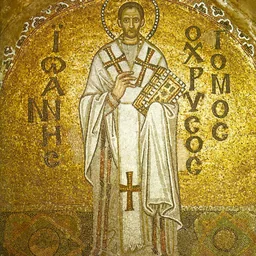 St John Chrysostom
«The Wise Men departed from Persia to go and worship Christ. Depart, then, you too, from earthly things and walk towards Jesus»«Liturgjia Hyjnore (Pjesa I) – Priftmurgu Grigor Kutlumusiani», the Church of Albania · translated by this site
«The word used in Greek and in Old-Slavic means literally "borne on lances " and alludes to the ancient military custom of soldiers raising their general on their shields above the points of their lances, and carrying him thus surrounded by troops, so that, from a distance, it looked as though he were borne on the points of lances.»Sokolof, A Manual of the Orthodox Church's Divine Services (1899), p. 68